
UNITED STATES
SECURITIES AND EXCHANGE COMMISSION
Washington, D.C. 20549
FORM
ANNUAL REPORT PURSUANT TO SECTION 13 OR 15(d) OF THE SECURITIES EXCHANGE ACT OF 1934 |
For the fiscal year ended
TRANSITION REPORT PURSUANT TO SECTION 13 OR 15(d) OF THE SECURITIES EXCHANGE ACT OF 1934 |
For the transition period from to
Commission File Number
(Exact name of registrant as specified in its charter)
(State or other jurisdiction of | (IRS Employer |
(Address of principal executive offices, zip code)
(
(Registrant’s telephone number, including area code)
Securities registered pursuant to Section 12(b) of the Act:
Title of Each Class | Trading Symbol(s) | Name of Each Exchange on which Registered |
Securities registered pursuant to Section 12(g) of the Act: None
Indicate by check mark if the registrant is a well-known seasoned issuer, as defined in Rule 405 of the Securities Act. Yes ☐
Indicate by check mark if the registrant is not required to file reports pursuant to Section 13 or Section 15(d) of the Act. Yes ☐
Indicate by check mark whether the registrant (1) has filed all reports required to be filed by Section 13 or 15(d) of the Securities Exchange Act of 1934 during the preceding 12 months (or for such shorter period that the registrant was required to file such reports), and (2) has been subject to such filing requirements for the past 90 days.
Indicate by check mark whether the registrant has submitted electronically every Interactive Data File required to be submitted pursuant to Rule 405 of Regulation S-T (§ 232.405 of this chapter) during the preceding 12 months (or for such shorter period that the registrant was required to submit such files).
Indicate by check mark whether the registrant is a large accelerated filer, an accelerated filer, a non-accelerated filer, a smaller reporting company or an emerging growth company. See the definitions of “large accelerated filer”, “accelerated filer”, “smaller reporting company” and “emerging growth company” in Rule 12b-2 of the Exchange Act. (Check one):
Large accelerated filer ☐ |
| Accelerated filer ☐ |
| Smaller reporting company | Emerging growth company |
If an emerging growth company, indicate by check mark if the registrant has elected not to use the extended transition period for complying with any new or revised financial accounting standards provided pursuant to Section 13(a) of the Exchange Act.
Indicate by check mark whether the registrant has filed a report on and attestation to its management’s assessment of the effectiveness of its internal control over financial reporting under Section 404(b) of the Sarbanes-Oxley Act (15 U.S.C. 7262(b)) by the registered public accounting firm that prepared or issued its audit report.
If securities are registered pursuant to Section 12(b) of the Act, indicate by check mark whether the financial statements of the registrant included in the filing reflect the correction of an error to previously issued financial statements.
Indicate by check mark whether any of those error corrections are restatements that required a recovery analysis of incentive-based compensation received by any of the registrant’s executive officers during the relevant recovery period pursuant to §240.10D-1(b). ☐
Indicate by check mark whether the registrant is a shell company (as defined in Rule 12b-2 of the Exchange Act). Yes
As of June 30, 2025, the aggregate market value of the registrant’s common stock held by non-affiliates of the registrant was $
DOCUMENTS INCORPORATED BY REFERENCE:
Auditor Firm ID: 34 Auditor Name: Deloitte & Touche LLP Auditor Location: New York, New York
TABLE OF CONTENTS
2
BASIS OF PRESENTATION
Except as otherwise indicated or as the context otherwise requires, all references in this Annual Report on Form 10-K (the “Annual Report”) to the “Company,” “we,” “our,” and “us” and similar terms refer to Jefferson Capital, Inc., a Delaware corporation, together with its subsidiaries. Unless otherwise indicated, all references to our financial information are to the combined and consolidated financial information of the Company and references to “dollars” and “$” in this Annual Report are to, and amounts are presented in, U.S. dollars. Financial data as of and for the years ended December 31, 2025 and December 31, 2024, relate to financial information of the Company on a combined and consolidated basis. All amounts referred to in the combined and consolidated financial statements have been rounded to the nearest thousandth, unless otherwise stated. All percentages are calculated based on actual amounts. Minor differences may exist due to rounding.
Special Note Regarding Forward-Looking Statements
This Annual Report contains forward-looking statements. We intend such forward-looking statements to be covered by the safe harbor provisions for forward-looking statements contained in Section 27A of the Securities Act of 1933, as amended, and Section 21E of the Securities Exchange Act of 1934, as amended. Statements that are not historical or current facts, including statements about beliefs and expectations, are forward-looking statements and are based on the information available to, and assumptions and estimates made by, management as of the date hereof. These forward-looking statements cover, among other things, future economic conditions and the anticipated future revenue, expenses, financial condition, asset quality, capital and liquidity levels, plans, prospects and operations of Jefferson Capital, Inc. Forward-looking statements often use words such as “anticipates,” “targets,” “expects,” “hopes,” “estimates,” “projects,” “forecasts,” “intends,” “plans,” “goals,” “believes,” “continue” and other similar expressions or future or conditional verbs such as “will,” “may,” “might,” “should,” “would” and “could.”
Forward-looking statements involve inherent risks and uncertainties that could cause actual results to differ materially from those set forth in forward-looking statements. Factors that may materially affect such forward-looking statements include those described under the sections in this Annual Report entitled “Risk Factors” and “Management’s Discussion and Analysis of Financial Condition and Results of Operations” and elsewhere in this Annual Report, also could adversely affect Jefferson Capital, Inc.’s results, and the reader should not consider these risks to be a complete set of all potential risks or uncertainties. Readers are cautioned not to place undue reliance on any forward-looking statements. Forward-looking statements speak only as of the date hereof, and Jefferson Capital, Inc. undertakes no obligation to update them in light of new information or future events, except as required by applicable law.
In addition, statements that “we believe” and similar statements reflect our beliefs and opinions on the relevant subject. These statements are based upon information available to us as of the date of this Annual Report, and while we believe such information forms a reasonable basis for such statements, such information may be limited or incomplete, and our statements should not be read to indicate that we have conducted an exhaustive inquiry into, or review of, all potentially available relevant information. These statements are inherently uncertain and investors are cautioned not to unduly rely upon these statements.
Summary Risk Factors
Investing in our common stock involves substantial risk. Our ability to execute our strategy is also subject to certain risks. The risks described under the heading “Risk Factors” in this Annual Report may cause us not to realize the full benefits of our strengths or may cause us to be unable to successfully execute all or part of our strategy. Some of the most significant challenges and risks we face include the following:
| ● | A deterioration in the economic or inflationary environment in the countries in which we operate could have an adverse effect on our business and results of operations. |
| ● | We may not be able to continually replace our nonperforming loans with additional portfolios sufficient to operate efficiently and profitably, and/or we may not be able to purchase nonperforming loans at appropriate prices. |
| ● | We may not be able to collect sufficient amounts on our nonperforming loans to fund our operations. |
3
| ● | Our collections may decrease if certain types of insolvency proceedings and bankruptcy filings involving liquidations increase. |
| ● | We outsource and offshore certain activities related to our business to third parties. Any disruption or failure of these third parties to provide these services could adversely affect our business operations, financial condition and reputation. |
| ● | Disruptions at our co-sourced operation in Mumbai could adversely impact our business. |
| ● | Goodwill impairment charges could negatively impact our net income and stockholders’ equity. |
| ● | Our loss contingency accruals may not be adequate to cover actual losses. |
| ● | Solicitors of Moriarty, our wholly-owned law firm subsidiary in the United Kingdom, could act outside our interests and/or regulatory bodies to which such law firm subsidiary and its solicitors are subject could take enforcement action or impose sanctions that could impact our business, financial condition and results of operations. |
| ● | Our expected collections from the Conn’s Portfolio Purchase may not be realized, or our expenses from the full-time equivalents (“FTE”) that were formerly employed by Conn’s may be higher than we anticipated, which may adversely impact our financial results. |
| ● | Our international operations expose us to risks, which could harm our business, financial condition and results of operations. |
| ● | We may experience losses on portfolios consisting of new asset classes of receivables or receivables in new geographies due to our lack of collection experience with these receivables, which could harm our business, financial condition and results of operations. |
| ● | Compliance with complex and evolving international and U.S. laws and regulations that apply to our international operations could increase our cost of doing business in international jurisdictions. |
| ● | Evolving regulation, particularly in Latin America, where the regulatory environment is less restrictive with respect to the use of certain new technologies and where we test new collection capabilities before broader adoption across our business, could adversely affect our business, financial condition, and results of operations. |
| ● | Our ability to collect and enforce our nonperforming and performing loans may be limited under federal, state, and international laws, regulations, and policies. |
| ● | The regulation of data privacy in the United States and globally, or an inability to effectively manage our data governance structures, could have an adverse effect on our business, financial condition, and results of operations by increasing our compliance costs or decreasing our competitiveness. |
| ● | We are dependent on our data gathering systems and proprietary consumer profiles, and if access to such data was lost or became public, our business could be materially and adversely affected. |
| ● | A cybersecurity incident could damage our reputation and adversely impact our business and financial results. |
| ● | The underperformance or failure of our information technology infrastructure, networks or communication systems could result in a loss in productivity, loss of competitive advantage and business disruption. |
| ● | We may not be able to adequately protect the intellectual property rights upon which we rely and, as a result, any lack of protection may diminish our competitive advantage. |
| ● | Our use of machine learning and AI technologies could adversely affect our products and services, harm our reputation, or cause us to incur liability resulting from harm to individuals or violation of laws and regulations or contracts to which we are a party. |
| ● | We expect to use leverage in executing our business strategy, which may have adverse consequences. |
| ● | We may not be able to generate sufficient cash flow or complete alternative financing plans, including raising additional capital, to meet our debt service obligations. |
| ● | The JCF Stockholders (as defined below) control us, and their interests may conflict with ours or yours in the future, including with respect to matters that involve corporate opportunities. |
| ● | We are a “controlled company” within the meaning of the corporate governance rules of the Nasdaq and, as a result, we qualify for exemptions from certain corporate governance requirements. You will not have the same protections as those afforded to stockholders of companies that are subject to such governance requirements. |
4
Part 1.
Item 1. Business
1.Organization and Description of Business
The accompanying combined and consolidated financial statements include the combined and consolidated results of operations of Jefferson Capital, Inc., and its subsidiaries (the “Company”). Jefferson Capital, Inc. is a Delaware corporation headquartered in Minneapolis, Minnesota.
The Company and its subsidiaries in the U.S., Canada, the U.K and Latin America, provide debt recovery solutions and other related services across a broad range of consumer receivables, including credit card, secured and unsecured automotive, utilities, telecom, and other receivables. The Company primarily purchases portfolios of consumer receivables at deep discounts to face value and manages them by working with individuals as they repay their obligations and work toward financial recovery. Previously charged-off receivables include receivables subject to bankruptcy proceedings. The Company also provides debt servicing and other portfolio management services to credit originators for non-performing loans. Through credit card acquisition programs, the Company earns credit card revenue. All deployments are purchased from independent third parties.
The Company purchases portfolios of receivables from a diverse client base, including Fortune 500 creditors, banks, fintech origination platforms, telecommunications providers, credit card issuers, and auto finance companies. The Company’s top five clients accounted for 45.2% and 55.3%, with the top client representing 23.6% and 32.8% of purchases for the years ended December 31, 2025 and 2024, respectively. For credit card receivables, the Company purchases from two issuers.
Initial Public Offering June 2025
In June 2025, the Company completed its initial public offering (“IPO”), in which the selling shareholders sold 10,875,000 shares after giving effect to the underwriters’ exercise of the over-allotment option, at a public offering price of $15.00 per share. The Company also issued and sold 625,000 shares of its common stock in the IPO, which resulted in net proceeds of $4.5 million after deducting the underwriting discounts and commissions. Prior to the IPO, our business operations were generally conducted through Jefferson Capital Holdings, LLC, and its subsidiaries. JCAP TopCo, LLC is a holding company and the direct parent of Jefferson Capital Holdings, LLC. JCAP TopCo, LLC was owned by (i) entities affiliated with J.C. Flowers, (ii) members of Management Invest, LLC, and (iii) former equity holders of Canaccede Financial Group, Ltd. (“Canaccede”).
Following a series of transactions that we refer to collectively as the “Reorganization,” Jefferson Capital, Inc. became a holding company with no material assets other than 100% of the equity interests in JCAP TopCo, LLC, which is held by Jefferson Capital, Inc. both directly and indirectly through other wholly-owned holding companies that have no material assets other than direct or indirect equity interests in JCAP TopCo, LLC. JCAP TopCo, LLC remains a holding company with no material assets other than 100% of the equity interests in Jefferson Capital Holdings, LLC. Jefferson Capital, Inc. also succeeded to federal Net Operating Losses (NOLs), state NOLs and tax credit carryforwards under Section 381 of the Code as a result of its acquisition in the Reorganization of certain affiliated corporations that held direct or indirect equity interests in JCAP TopCo, LLC. As indirect parent of Jefferson Capital Holdings, LLC, following the Reorganization, Jefferson Capital, Inc. operates and controls all of the business and affairs, and consolidates the financial results of, Jefferson Capital Holdings, LLC, and its subsidiaries. To effect the Reorganization, the then-current direct and indirect owners of JCAP TopCo, LLC, including (i) entities affiliated with J.C. Flowers, (ii) members of Management Invest, LLC, an entity through which employees of JCAP TopCo, LLC and its subsidiaries and certain of our directors held equity interests, and (iii) former equity holders of Canaccede, exchanged their direct and indirect interests in JCAP TopCo, LLC for shares of our common stock. We refer to the entities affiliated with J.C. Flowers, members of Management Invest, LLC and former stockholders of Canaccede who own shares of our common stock following the Reorganization and the IPO as the “JCF Stockholders,” “Management Stockholders” and “Former Canaccede Stockholders,” respectively. As a result of the Reorganization and after giving effect to the completion of the IPO at the initial public offering price of $15.00 per share, as of December 31, 2025:
5
| ● | the investors in the IPO collectively own 18.1% of our common stock; |
| ● | the JCF Stockholders collectively own 67.6% of the outstanding shares of our common stock. Following quarter end, we executed a follow-on equity offering, which reduced the ownership of JCF Stockholders to 53.1%. The company repurchased $58.9 million of stock to support that transaction; |
| ● | the Management Stockholders collectively own 14.3%; |
| ● | The number of shares of common stock received by the JCF Stockholders, the Former Canaccede Stockholders and the Management Stockholders in exchange for the 132,828,019 Class A Units and Class C Units of JCAP TopCo, LLC outstanding immediately prior to the Reorganization was based on an exchange ratio of one share of our common stock for every 2.4150549 interests in JCAP TopCo, LLC (the “Exchange Ratio”), resulting in an aggregate of 55,000,000 shares of our common stock being issued in exchange for such Class A Units and Class C units. |
In addition, based on the initial public offering price of $15.00 per share, an aggregate of 9,060,082 shares of common stock were issued in exchange for the 27,937,232 Class B Units of JCAP TopCo, LLC outstanding immediately prior to the Reorganization, resulting in a total of 64,060,082 shares of common stock outstanding immediately after the Reorganization and before giving effect to the IPO. The number of shares of common stock that the Management Stockholders collectively received pursuant to the Reorganization was based in part on the value that Management Invest, LLC would have received under the distribution provisions of the limited liability agreement of JCAP TopCo, LLC, with shares of our common stock valued by reference to the ultimate initial public offering price of shares of common stock in the IPO. Specifically, of the 9,060,082 shares of common stock issued to the Management Stockholders in the Reorganization, 6,418,775 shares were issued in respect of Class B Units of Management Invest, LLC (which correspond to Class B Units of JCAP TopCo, LLC) that are “in- the-money” but remain subject to certain vesting conditions specified in individual award agreements. These shares were issued as restricted stock either with the same time-based vesting requirements that the corresponding Class B Units were subject to prior to the Reorganization or, if such corresponding Class B Units had performance vesting requirements, with a three year time-vesting requirement. If the vesting conditions of the restricted stock are not satisfied, such restricted stock will be forfeited and canceled.
Business Model
Portfolio Purchasing
We purchase portfolios of nonperforming loans, and occasionally those that are performing but with significant credit deterioration, through either single portfolio transactions, referred to as spot sales, or through the pre-arranged purchase of multiple portfolios at regular intervals, referred to as forward flow sales. Under a forward flow contract, we agree to purchase statistically similar nonperforming loan portfolios from credit grantors on a periodic basis at a pre-negotiated price over a specified time period, generally from six months to a year.
When we purchase portfolios with credit deterioration, we find that our expertise in evaluating and managing charged-off accounts allows us to confidently manage such portfolios with a higher level of credit risk than a buyer without that level of expertise would be comfortable. In such instances, a portfolio may include a mix of loans that are delinquent and restructured as well as a significant amount of charged-off or nonperforming loans, as was the case with the Conn’s Portfolio, and with a high level of risk that more of the current loans will become delinquent over time and eventually need to be charged-off. In these cases, we can offer the seller the convenience of purchasing all its loan assets together as opposed to bidding for only a single category of loan, which might result in a seller needing to transact with multiple counterparties. We regularly evaluate the opportunity to purchase portfolios that include a mix of performing accounts and nonperforming accounts, and that comprise all of a credit originator’s loan assets and believe we will find attractive opportunities to make more purchases like these going forward.
6
We purchase portfolios of nonperforming loans from credit grantors through auctions and negotiated sales. In an auction process, the seller will assemble a portfolio of nonperforming loans and will seek purchase prices from specifically invited potential purchasers. In a privately negotiated sale process, the seller will contact one or more purchasers directly, receive a bid, and negotiate the terms of sale. In either case, invited purchasers will typically have already successfully completed a qualification process and due diligence examination that includes the seller’s review of the purchaser’s experience, financial standing, operating procedures, business practices, and compliance oversight.
We purchase receivables based on robust, account-level valuation methods and employ proprietary statistical and behavioral models across our operations. These methods and models allow us to value portfolios accurately (and limit the risk of overpaying), avoid buying portfolios that are incompatible with our methods or strategies, and align the accounts we purchase with our business and collection channels to maximize future collections. As a result, we have been able to realize attractive returns from the receivables we acquire. We maintain strong relationships with many of the largest financial service providers in the United States, Canada, United Kingdom and Latin America.
Bluestem Receivables Asset Acquisition
On October 29, 2025, we entered into an Asset Purchase Agreement (the “Purchase Agreement”) with BLST Holding Company LLC, BLST Operating Company, LLC, BLST FinCo, LLC and BLST FinCo SubCo, LLC (collectively, “Bluestem”). On December 4, 2025, pursuant to the terms and conditions of the Purchase Agreement, we completed the portfolio acquisition of credit card assets from Bluestem (the “Acquisition”). We do not intend to pursue ongoing originations through the Bluestem platform, and the Acquisition did not include any Bluestem retail operations or assets. The net purchase price for the portfolio was $196.3 million and the estimated remaining collections associated with the portfolio are $295.6 million.
Deployments and Collections
Creditors sell their volume in a mix of forward flow arrangements and competitive bid transactions. Sales levels are expected to fluctuate from quarter to quarter with portfolio pricing remaining competitive. We believe that smaller competitors continue to face difficulties in the portfolio purchasing market because of the high cost to operate due to regulatory pressure, issuers’ selectiveness with buyers and lack of consistent access to capital. We believe these operational costs favor larger participants, such as us, because the larger market participants are better able to adapt to these pressures and commit to larger purchases and forward flow agreements.
Deployments
Our deployments are a mix of spot sales and forward flow agreements. The timing, contract duration and volumes for each contract can fluctuate leading to variation when compared to prior years. The average purchase price, as a percentage of face value, varies from year to year depending on, among other factors, the type and quality of the accounts purchased and the length of time from charge-off to the time we purchase the portfolios.
The average purchase price as a percentage of face value is higher for newly charged-off portfolios as compared to more seasoned portfolios because newly charged-off portfolios generally have higher liquidation rates. Similarly, portfolios consisting of paying accounts tend to have a higher purchase price relative to face value than non-paying accounts due to the higher expectations for collections, as well as lower anticipated collection costs. As a result, in years that we purchase a higher percentage of newly charged-off assets or paying portfolios, we expect that our purchase price as a percentage of face value would be higher than would be in years where a higher ratio of seasoned paper or non-paying portfolios were purchased.
Collections
We have two primary types of collection channels for the collection of our purchased receivables, legal and voluntary. The legal collection channel consists of collections that result from our internal legal channel or from our network of retained law firms. The voluntary collection channel utilizes call centers (domestic and offshore) and collection agencies. The call center collections include collections that result from our call centers, direct mail programs and digital collections. The
7
collection agencies collections consist of collections from third-party collection agencies that we utilize when we believe they can liquidate better or less expensively than we can.
Seasonality
Our business typically experiences its busiest season in terms of deployments in the fourth quarter of the year. Banks and other credit originators prefer to cleanse their balance sheets of unwanted accounts before year end, and if a gain can be recorded from the sale of accounts that were written off, our clients may also prefer to realize that gain before year end. In our Canadian business, most major banks use an October fiscal year end, and we may experience the same phenomenon in terms of deployment timing at the beginning of our fourth quarter that we experience in December, in our other markets.
By contrast, the strongest months for collections, particularly in the United States, correspond to the period from February to the middle of April, due to the timing of income tax refund checks resulting in higher collections and recoveries as consumers are more likely to use their excess cash to pay off old debts.
Competition
We face bidding competition in our purchase of nonperforming loans and in obtaining placements for our fee-based businesses. Our primary competitors in our purchased portfolio business are other purchasers of debt that manage their own nonperforming loans or outsource such servicing. Some smaller competitors occasionally bid for portfolios as well, although middle market debt buyers have come under capital constraints recently and as result have reduced their purchasing activity. In some of our asset classes, we do not believe we have any significant competitors, and our growth strategy is not to take market share away from other debt buyers, but rather to unlock debt sales of portfolios which are currently serviced internally.
In Canada, there are a number of smaller market participants, including hedge funds and collection agencies, purchase portfolios sporadically or operate regionally. In the United Kingdom, there are a handful of large debt buyers that focus on the high street banks, but our focus is on utilities and telecom and point-of-sale installment loans. In Latin America, we face competition from mainly smaller local players, which vary from country to country. We believe that in some markets, such as the Caribbean, there are few or no active competitors, but also few credit grantors that choose to sell in those markets.
Our primary competitors in our fee-based business are providers of outsourced receivables management services. Regulatory complexity and burdens, strict privacy laws in the case of Canada and the United Kingdom, combined with seller preference for experienced portfolio purchasers, create significant barriers to successful entry for new competitors. In the United Kingdom, there are no significant competitors to ResolveCall for consumer reconnection services nationally. While both markets remain competitive, the contingent fee industry is more fragmented than the purchased portfolio industry.
We also compete on the basis of reputation, industry experience, compliance practices and performance. We believe that our competitive strengths include:
| ● | our disciplined and proprietary underwriting process; |
| ● | the extensive data set we have developed since our founding in 2002; |
| ● | our ability to analyze and bid on portfolios at appropriate prices; |
| ● | our capital position; |
| ● | our reputation from previous portfolio purchase transactions; |
| ● | our ability to close transactions in a timely fashion; |
| ● | our strong relationships with credit grantors; |
| ● | quality customer service while complying with applicable collection laws; and |
| ● | our ability to efficiently and effectively collect on various asset types. |
8
Human Capital
Commitment to Values and Ethics
Our approach to attract, hire and retain talented employees is firmly grounded in our belief in doing the right thing for all of our stakeholders, most notably consumers. By promoting a culture of treating others fairly, maintaining a commitment to ethics and working collaboratively with others, we believe we can effectively attract, develop and retain talent to help execute our strategy. In support of these values, we offer competitive pay and bonus opportunities, health and wellness benefits and retirement plans. We support the well-being of our employees with market-competitive pay and benefits while also investing in their growth and development. We also employ employee engagement best practices to improve our work experience. We believe that our relations with our employees across our organization are positive, and none of our employees are represented by a union or covered by a collective bargaining agreement.
As of December 31, 2025, we had 1,120 FTE in nine offices, located in Minneapolis, Minnesota; Sartell, Minnesota; Denver, Colorado; Basingstoke, United Kingdom; Paisley, United Kingdom; London, United Kingdom; London, Ontario; Toronto, Ontario; and Bogotá, Colombia.
Government Regulation
We are subject to a variety of federal, state, local and international laws that establish specific guidelines and procedures that debt collectors must follow when collecting customer accounts, including laws relating to the collection, use, retention, security and transfer of personal information. It is our policy to comply with applicable federal, state, local and international laws in all our activities even though there are inconsistencies between jurisdictions and frequent changes in these laws and regulations, including their interpretation and application. Our failure to comply with these laws could result in enforcement action against us, the payment of significant fines and penalties, restrictions upon our operations or our inability to recover amounts owed to us.
Significant laws and regulations in the United States applicable to our business include the following:
U.S. Regulations
| ● | Fair Debt Collection Practices Act (as amended, the “FDCPA”), and similar state laws, which impose certain obligations and restrictions on the practices of debt collectors, including specific restrictions regarding the time, place and manner of the communications. |
| ● | Fair Credit Reporting Act (as amended, the “FCRA”), and similar state laws, which obligate credit information providers to verify the accuracy of information provided to credit reporting agencies and investigate consumer disputes concerning the accuracy of such information. |
| ● | Equal Credit Opportunity Act, which, among other things, prohibits discrimination in the extension of credit on the basis of any protected category, such as age, race, color, sex, religion, marital status, national origin, receipt of public assistance or the exercise of any right under the Consumer Credit Protection Act. |
| ● | Truth-in-Lending Act, and similar state laws, which, among other things, requires certain disclosures to borrowers regarding the terms of their contracts. |
| ● | Gramm-Leach-Bliley Act (as amended, the “GLBA”), which requires that certain financial institutions, including collection agencies, develop policies to protect the privacy and security of consumers’ nonpublic personal information, including by providing notices to consumers advising them of their privacy policies and instituting safeguards to protect the security of consumers’ nonpublic personal information. |
| ● | Electronic Funds Transfer Act, which regulates electronic fund transfer transactions, including a consumer’s right to stop payments on a pre-approved fund transfer and right to receive certain documentation of the transaction. |
| ● | Controlling the Assault of Non-Solicited Pornography and Marketing Act of 2003 (as amended, the “CAN-SPAM Act”), Telephone Consumer Protection Act of 1991 (as amended, the “TCPA”) and Telemarketing Sales Rule, which, along with similar state laws, place certain restrictions and requirements on the manner and content of email and telephone communications, and place certain restrictions on users of certain automated dialing equipment and pre-recorded messages that place telephone calls to consumers. |
9
| ● | Servicemembers Civil Relief Act, which gives United States military service personnel relief from credit obligations they may have incurred prior to entering military service and may also apply in certain circumstances to obligations and liabilities incurred by a servicemember while serving on active duty. |
| ● | Health Insurance Portability and Accountability Act, which provides standards to protect the confidentiality of patients’ personal healthcare and financial information in the United States. |
| ● | U.S. Bankruptcy Code, which prohibits certain contacts with consumers after the filing of bankruptcy petitions and dictates what types of claims will or will not be allowed in a bankruptcy proceeding including how such claims may be discharged. |
| ● | Americans with Disabilities Act, which requires that telecommunications companies operating in the United States take steps to ensure functionally equivalent services are available for their consumers with disabilities, and requires accommodation of consumers with disabilities, such as the implementation of telecommunications relay services. |
| ● | U.S. Foreign Corrupt Practices Act (as amended, the “FCPA”), United Kingdom Bribery Act (“U.K. Bribery Act”) and similar laws. Our operations outside the United States are subject to various United States and international laws and regulations, such as the FCPA and the U.K. Bribery Act, which prohibit corrupt payments to governmental officials and certain other individuals. The FCPA prohibits United States companies and their agents and employees from providing anything of value to a foreign official for the purposes of influencing any act or decision of these individuals in order to obtain an unfair advantage or help obtain or retain business. Although similar to the FCPA, the U.K. Bribery Act is broader in scope and covers bribes given to or received by any person with Improper Intent. |
| ● | Economic sanctions regulations. Our operations outside the United States are subject to various United States and international laws and regulations relating to financial sanctions and trade embargoes administered and enforced by the U.S. government, including OFAC and the U.S. Department of State; the United Nations Security Council; the European Union and its member states; and the United Kingdom. These laws and regulations prohibit transactions or dealings, direct or indirect, with countries and regions (and their governments) that are the target of comprehensive sanctions. The laws and regulations also prohibit dealings or transactions with individuals on certain denied persons lists, such as OFAC’s Specially Designated Nationals and Blocked Persons List, or any person 50% or more owned by persons on such lists. |
| ● | Dodd-Frank Wall Street Reform and Consumer Protection Act (as amended, the “Dodd-Frank Act”), Federal Trade Commission Act (as amended, the “FTCA”), and similar state laws. The Dodd-Frank Act restructured the regulation and supervision of the financial services industry in the United States and created the Consumer Financial Protection Bureau (the “CFPB”), an agency responsible for administering and enforcing the laws and regulations for consumer financial products and services. The CFPB has rulemaking, supervisory and enforcement authority over larger consumer debt collectors. The Dodd-Frank Act, prohibits unfair, deceptive, or abusive acts or practices, FTCA prohibits unfair or deceptive acts or practices, and the U.S. Federal Trade Commission’s (the “FTC”) Holder-in-Due-Course Rule, permits borrowers of certain loans to assert any claims and defenses that they would have against the originator of such loans against a subsequent purchaser of such loans. Similar state laws prohibit unfair, deceptive, abusive and/or unconscionable trade practices. |
The Dodd-Frank Act was adopted to reform and strengthen regulation and supervision of the U.S. financial services industry. It contains comprehensive provisions governing the oversight of financial institutions, some of which apply to us. Among other things, the Dodd-Frank Act established the CFPB, which has broad authority to implement and enforce “federal consumer financial law,” as well as authority to examine financial institutions, including credit issuers that may be sellers of receivables and debt buyers and collectors such as us, for compliance with federal consumer financial law. The CFPB has broad authority to prevent unfair, deceptive, or abusive acts or practices by issuing regulations or by using its enforcement authority without first issuing regulations. State Attorneys General and state financial regulators have authority to enforce the Dodd-Frank Act’s general prohibitions against unfair, deceptive, or abusive acts or practices, as well as state specific prohibitions against unfair or deceptive acts or practices. Additionally, the FTCA prohibits unfair and deceptive acts or practices in connection with a trade or business and gives the FTC enforcement authority to prevent and redress violations of this prohibition.
The Dodd-Frank Act also gave the CFPB supervisory and examination authority over a variety of institutions that may engage in debt collection, including us. Accordingly, the CFPB is authorized to supervise and conduct examinations of
10
our business practices. The prospect of supervision has increased the potential consequences of noncompliance with federal consumer financial law.
The CFPB can conduct hearings, adjudication proceedings, and investigations, either unilaterally or jointly with other state and federal regulators, to determine if federal consumer financial law has been violated. The CFPB has authority to impose monetary penalties for violations of applicable federal consumer financial laws (including the Dodd-Frank Act, the FDCPA and the FCRA, among other consumer protection statutes), require remediation of practices, and pursue enforcement actions. The CFPB also has authority to obtain cease and desist orders (which can include orders for restitution or rescission of contracts, as well as other kinds of affirmative relief), costs, and monetary penalties ranging from $5,000 per day for ordinary violations of federal consumer financial laws to $25,000 per day for reckless violations and $1 million per day for knowing violations. The CFPB has been active in its supervision, examination and enforcement of financial services companies, including bringing enforcement actions, imposing fines and mandating large refunds to customers of several financial institutions for practices relating to debt collection practices.
The CFPB and the FTC continue to devote substantial attention to debt collection activities, and, as a result, the CFPB and the FTC have brought multiple investigations and enforcement actions against debt collectors for violations of the FDCPA and other applicable laws. Continued regulatory scrutiny by the CFPB and the FTC over debt collection practices may result in additional investigations and enforcement actions against the debt collection industry.
In October 2020, the CFPB issued final rules in the form of new Regulation F to implement the Fair Debt Collection Practices Act, which rules restate and clarify prohibitions on harassment and abuse, false or misleading representations, and unfair practices by debt collectors when collecting consumer debt. The rules included provisions related to, among other things, the use of newer technologies (text, voicemail and email) to communicate with consumers and limits relating to telephonic communications. In December 2020, the CFPB also issued an additional debt collection final rule focused on consumer disclosures. This final rule amended Regulation F to provide additional requirements regarding validation information and disclosures provided at the outset of debt collection communications, prohibit suits and threats of suits regarding time-barred debt, and identify actions that must be taken before a debt collector may report information about a debt to consumer reporting agencies. The rules became effective on November 30, 2021. The rules have not had a material incremental effect on our operations.
In addition, the CFPB has issued guidance in the form of bulletins on debt collection and credit furnishing activities generally, including one that specifically addresses representations regarding credit reports and credit scores during the debt collection process, another that focuses on the application of the Dodd-Frank Act’s prohibition of unfair, deceptive, or abusive acts or practices on debt collection and another that discusses the risks that in-person collection of consumer debt may create in violating the FDCPA and Dodd-Frank Act. The CFPB also accepts debt collection consumer complaints and has released template letters for consumers to use when corresponding with debt collectors. The CFPB makes publicly available its data on consumer complaints. The Dodd-Frank Act also mandates the submission of multiple studies and reports to Congress by the CFPB, and CFPB staff regularly make speeches on topics related to credit and debt. All of these activities could trigger additional legislative or regulatory action. In addition, the CFPB and FTC have has engaged in enforcement activity in sectors adjacent to our industry, impacting credit originators, collection firms, and payment processors, among others. The CFPB’s and FTC’s enforcement activity in these spaces, especially in the absence of clear rules or regulatory expectations, can be disruptive to third parties as they attempt to define appropriate business practices. As a result, certain commercial relationships we maintain may be disrupted or impacted by changes in third-parties’ business practices or perceptions of elevated risk relating to the debt collection industry.
In addition, on June 11, 2024, the CFPB proposed a rule related to medical bills and credit reports. Among other things, the rule prohibits certain activities of debt collectors related to collection of medical debt, including prohibiting reporting to credit reporting agencies certain medical debt. During 2025, the CFPB reduced its staff by over 80%. The reduction in force is the subject of litigation, and a federal circuit court’s decision allowing the staffing cuts to continue is currently held in abeyance while the plaintiffs file a petition for rehearing. The effects of these developments on financial organizations subject to CFPB regulation and supervision, including Jefferson Capital, Inc., is uncertain. States and state attorneys general may increase regulatory, investigative and enforcement activity with respect to consumer protection, in response to changes in regulation, supervision and enforcement of consumer protection laws by federal regulators. Any new rules may have a material incremental effect on our operations.
11
In addition, state consumer protection laws also impose substantial requirements on servicers involved in consumer finance. Additionally, Congress, states, localities and regulatory agencies could introduce new regulations or further regulate the consumer credit industry in ways that make it more difficult or costly for the servicer to collect payments on the receivables. Any such changes in the regulatory application or judicial interpretation of the laws and regulations applicable to financial institutions also could impact the manner in which the servicer conducts its business and adversely affect its ability to collect and service the receivables. We cannot determine with any degree of certainty whether any such legislative or regulatory proposals will be enacted and, if enacted, the ultimate impact that any such potential legislation or implementing regulations, or any such potential regulatory actions by federal or state regulators, would have upon our business, financial condition or results of operations.
Our activities are also subject to federal and state laws concerning identity theft, data privacy, and cybersecurity. The GLBA and its implementing regulations require us generally to protect the confidentiality of our consumers’ nonpublic personal information and to disclose to our consumers our privacy policy and practices, including those regarding sharing consumers’ nonpublic personal information with third parties. In addition, the FCRA requires us to prevent identity theft and to securely dispose of consumer credit reports. Certain state laws impose similar or stricter privacy obligations as well as obligations to provide notification of security breaches of personal information to affected individuals, consumer reporting agencies, businesses and governmental agencies. The applicable regulatory framework for privacy and cybersecurity issues is evolving and uncertain. For example, the California Consumer Privacy Act, as amended by the California Privacy Rights Act (the “CCPA”) imposes stringent requirements on certain businesses with respect to the privacy and security of information of California residents. The CCPA includes provisions that give California residents, among other things, rights to access, correct and delete certain personal information. Compliance with the CCPA and any other similar data privacy laws in the United States, including any state or federal laws, may require significant resources and subject us to a variety of regulatory and private sanctions. Any violations of these laws and regulations may require us to change its business practices or operational structure, and could subject it to legal claims, monetary penalties, sanctions, and the obligation to indemnify and/or notify customers or take other remedial actions.
Our activities are also subject to federal and state laws concerning the use of automated dialing equipment, and other laws related to consumers and consumer protection. We are subject to laws, regulations and standards covering marketing, advertising and other activities conducted by telephone, email, mobile devices and the internet, such as the Federal Communications Act, the Federal Wiretap Act, the Electronic Communications Privacy Act, the TCPA, the CAN-SPAM Act and similar state consumer protection and communication privacy laws. Numerous class-action suits under federal and state laws have been filed in recent years against companies who conduct telemarketing and/or SMS texting programs, with many resulting in multi-million-dollar settlements to the plaintiffs.
In addition to the federal statutes detailed above, many states have general consumer protection statutes, laws, regulations, or court rules that apply to debt purchasing and collection. In a number of states and cities, we must maintain licenses to perform debt recovery services and must satisfy ongoing compliance and bonding requirements. It is our policy to comply with all material licensing, compliance and bonding requirements. Our failure to comply with existing requirements, changing interpretations of existing requirements, or adoption of new requirements, could subject us to a variety of regulatory and private sanctions. These could include license suspension or revocation; orders or injunctive relief, including orders providing for rescission of transactions or other affirmative relief; and monetary relief, including restitution, damages, fines and/or penalties. In addition, failure to comply with state licensing and compliance requirements could restrict our ability to collect in regions, subject us to increased regulation, increase our costs, or adversely affect our ability to collect our receivables.
State laws, among other things, also may limit the interest rate and the fees that a credit originator may impose on our consumers, limit the time in which we may file legal actions to enforce consumer accounts, and require specific account information for certain collection activities. By way of example, the California Fair Debt Buying Practices Act that directly applies to debt buyers, applies to accounts sold after January 1, 2014. The law requires debt buyers operating in the state to have in their possession specific account information before debt collection efforts can begin, among other requirements. Moreover, the New York State Department of Financial Services issued new debt collection regulations, which took effect in September 2015 and established new requirements for collecting debt in the state. In addition, other state and local requirements and court rulings in various jurisdictions may also affect our ability to collect.
12
The relationship between consumers and credit card issuers is also extensively regulated by federal and state consumer protection and related laws and regulations. These laws may affect some of our operations because some of our receivables originate through credit card transactions. The laws and regulations applicable to credit card issuers, among other things, impose disclosure requirements when a credit card account is advertised, when it is applied for and when it is opened, at the end of monthly billing cycles, and at year-end. Federal law requires, among other things, that credit card issuers disclose to consumers the interest rates, fees, grace periods, and balance calculation methods associated with their credit card accounts. Some laws prohibit discriminatory practices in connection with the extension of credit. If the originating institution fails to comply with applicable statutes, rules, and regulations, it could create claims and rights for consumers that would reduce or eliminate their obligations related to those receivables. When we acquire receivables, we generally require the credit originator or portfolio reseller to represent that they have complied with applicable statutes, rules, and regulations relating to the origination and collection of the receivables before they were sold to us.
Federal statutes further provide that, in some cases, consumers cannot be held liable for, or their liability is limited with respect to, charges to their credit card accounts that resulted from unauthorized use of their credit cards. These laws, among others, may give consumers a legal cause of action against us, or may limit our ability to recover amounts owing with respect to the receivables, whether or not we committed any wrongful act or omission in connection with the account.
These laws and regulations, and others similar to the ones listed above, as well as laws applicable to specific types of debt or debt collection, impose requirements or restrictions on collection methods or our ability to enforce and recover certain of our receivables. Effects of the law, including those described above, and any new or changed laws, rules, or regulations, and reinterpretation of the same, may adversely affect our ability to recover amounts owing with respect to our receivables or the sale of receivables by creditors and resellers.
Canadian Regulations
We are subject to a variety of federal, provincial, and territorial laws that establish specific guidelines and procedures that debt collectors must follow when collecting customer accounts. It is our policy to comply with applicable laws and regulations, including providing extensive training and ongoing monitoring. Our compliance management system and related controls are embedded in business processes and are also tested regularly by our compliance and quality assurance protocols. Our failure to comply with these laws could result in fines or restrictions upon our operations. Significant laws and regulations material to our business include the following:
| ● | Debt Collection legislation and Consumer Protection Acts are provincial statutes in Canada, which impose certain obligations and restrictions on debt collection activities including specific restrictions regarding the time, place and manner of communications for collection activity and unfair business practices. Prohibited collection practices are generally harmonized across Canada; however each province governs compliance with the applicable provincial legislation and regulations. |
| ● | Consumer Reporting Acts are provincial statutes in Canada, which obligate credit reporting agencies to collect, maintain, and report consumers credit and personal information accurately and investigate consumer disputes concerning the accuracy of such information. |
| ● | Bankruptcy and Insolvency Act (the “BIA”) is federal legislation that establishes a detailed framework for the administration of insolvencies in Canada, including the requirements of bankruptcy trustees and creditors who file claims and receive dividends. The Superintendent of Bankruptcy supervises the administration of all estates and matters under the BIA. |
| ● | Personal Information Protection and Electronic Documents Act (“PIPEDA”) is federal legislation that establishes national standards for privacy practices in Canada. PIPEDA aims to protect personal information that is collected, used or disclosed in certain circumstances for purposes of commercial activity in Canada. The Office of the Privacy Commissioner of Canada oversees compliance with PIPEDA. Certain provinces have similar provincial laws to PIPEDA. |
The credit card we issue in Canada is issued by Peoples Trust Company, a federal corporation incorporated pursuant to the Trust and Loan Companies Act (Canada), pursuant to their license with MasterCard. The credit card complies with the regulatory authority having jurisdiction over Peoples Trust Company, maintains strict compliance with the Proceeds of Crime (Money Laundering) and Terrorist Financing Act, implements comprehensive policies and
13
procedures to ensure ongoing compliance and operates in accordance with the security standards of the Payment Card Industry Security Standards Council. We also ensure ongoing compliance with the maximum permitted interest rate in Canada, including the recent amendments pursuant to the Budget Implementation Act, 2023, which came into force on January 1, 2025.
U.K. Regulations
Our operations in Europe are affected by local statutes, rules and regulations. It is our policy to comply with these laws in all of our recovery activities in Europe, where applicable.
Financial Conduct Authority Regulation. U.K. debt purchase and services collections businesses are principally regulated by the Financial Conduct Authority (the “FCA”), the U.K. Information Commissioner’s Office and the U.K. Office of Communications. We have two regulated entities in the United Kingdom, JC International Acquisition LLC and Credit Account Recovery Solutions Limited. The FCA regards debt collection as a “high risk” activity primarily due to the potential impact that poor practice can have on already vulnerable consumers and as a result maintains a high focus on the sector. The FCA Handbook sets out the FCA rules and other provisions. Firms wishing to carry on regulated consumer credit activities must comply with all applicable sections of the FCA Handbook, including the principles of “Treating Customers Fairly” and delivering good outcomes for retail consumers under the Consumer Duty, as well as the applicable consumer credit laws and regulations. The FCA also publishes guidance on various topics from time to time that it expects firms to comply with.
The FCA has applied its rules to consumer credit firms in a number of areas, including its high-level principles and conduct of business standards. The FCA has significant powers and, as the FCA deepens its understanding of the industry through continued supervision, it is likely that the regulatory requirements applicable to the debt purchase industry will continue to increase. In addition, it is likely that the compliance framework that will be needed to continue to satisfy the FCA requirements will demand continued investment and resources in our compliance governance framework.
One particularly significant regulatory change program was the implementation of the Consumer Duty for U.K. operations in July 2023. These requirements introduce a more outcomes-focused approach to consumer protection and set higher expectations for the standard of care that firms give customers.
Companies authorized by the FCA must be able to demonstrate that they meet the threshold conditions for authorization and comply on an ongoing basis with the FCA’s high level standards for authorized firms, such as its Principles for Business (including the principles of “Treating Customers Fairly” and delivering good outcomes for retail consumers), and rules and guidance on systems and controls. The FCA has the ability to, among other things, impose significant fines, ban certain individuals from carrying on trade within the financial services industry, impose requirements on a firm’s permission, cease certain products from being collected upon and, in extreme circumstances, remove permissions to trade.
Consumer protection. The Consumer Credit Act of 1974 (and its related regulations) (collectively, the “U.K. Consumer Credit Act”) and the U.K. Consumer Rights Act 2015 set forth requirements for the entry into and ongoing management of consumer credit arrangements in the United Kingdom. A failure to comply with these requirements can make agreements unenforceable or can result in a requirement that charged and collected interest be repaid. In June 2022, the U.K. government announced its decision to reform the U.K. Consumer Credit Act (and its related regulations) to ensure it is fit for purpose and keeps pace with technological advancements and changing consumer needs. While the reform will take a number of years to deliver, it should be noted that consultation up to the end of 2024 indicates that significant overhaul of this area of regulation is forthcoming. On October 25, 2024, a Court of Appeal ruling declared it unlawful for lenders to have paid a commission to car dealers without obtaining borrowers’ fully-informed consent. In particular, the ruling has increased the set-off risk of commissions that may be packaged into relevant underlying car loans. While the ramifications of this ruling on the wider consumer credit and consumer debt repurchase markets (i.e., beyond motor finance) remains unknown, several lenders active in the motor finance space have put aside significant sums to cover potential fines and other payouts.
Data protection. In addition to these regulations on debt collection and debt purchase activities, we must comply with the European Union General Data Protection Regulation (the “EU GDPR”) and the United Kingdom General Data Protection
14
Regulation and Data Protection Act 2018 (collectively, the “UK GDPR”). These laws require us to adhere to certain disclosure restrictions and deletion obligations with respect to personal information, and allow for penalties for violations.
Solicitors’ Professional Conduct. The regulatory body for solicitors in England and Wales is the Solicitors Regulation Authority (the “SRA”). It is responsible for regulating the professional conduct of solicitors and other authorized individuals at law firms, including our operations at Moriarty. It created and maintains the Solicitors Handbook, including the Code of Conduct, which contains the ethical principles that guide solicitors in their work, authorizes the law firms like Moriarty within which legal activities are carried out, and supervises the firms and individuals to ensure they adhere to professional standards. The SRA can take enforcement action against those that have breached the Code of Conduct, and has a range of sanctions available to ensure compliance.
Latin America Regulations
Our operations in Latin America are affected by local statutes, rules and regulations. It is our policy to comply with these laws in all of our recovery activities in Latin America, where applicable. Although we have purchased nonperforming loans in Colombia, Peru and the Caribbean, our collections activity is focused in Colombia.
The most significant laws, regulations and regulatory oversight in Colombia include:
| ● | The Superintendence of Industry and Commerce (the “SIC”) is a national public authority organized into six principal divisions, which include, inter alia, Consumer Protection and Personal Data Protection. The SIC ensures the protection of all the rights of people against companies that process their personal, financial, credit or commercial information. |
| ● | Law 1266 of 2008 and Law 1581 of 2012 are two key personal financial data protection laws which protect individuals’ right to know, update and rectify information gathered about them in databases or files. |
| ● | Law 2300 of 2023 safeguards the privacy of financial consumers and primarily applies to entities regulated by the Financial Superintendency and those engaged in collection operations. It governs contact and communication channels, as well as timing, for debt collection purposes. |
| ● | There are also three main circular letters from the Financial Superintendent Office which regulate collections practices: External Circular 48 of 2009 which gives Instructions related to the conditions of pre-legal collection management, External Circular 15 of 2010 which addresses protection of financial consumers’ rights, and External Circular 38 of 2011 which regulates personal and credit information treatment during the collection process. |
Available Information
Jefferson Capital, Inc.’s website can be found at www.jcap.com. Jefferson Capital, Inc. makes available free of charge on its website, by clicking on “Investor Relations” and then clicking on “Financial Information” and then clicking on "SEC filings," its annual reports on Form 10-K, quarterly reports on Form 10- Q, current reports on Form 8-K, and amendments to those reports filed or furnished pursuant to Section 13 or 15(d) of the Exchange Act, as well as all other reports filed by Jefferson Capital, Inc. with the SEC as soon as reasonably practicable after electronically filed with, or furnished to, the SEC.
15
Item 1A. Risk Factors
Investing in our common stock involves a high degree of risk. You should carefully consider the risks and uncertainties described below and the other information contained in this Annual Report on Form 10-K before making an investment in our common stock. Our business, financial condition, results of operations, or prospects could be materially and adversely affected if any of these risks occurs, and as a result, the market price of our common stock could decline and you could lose all or part of your investment. This Annual Report on Form 10-K also contains forward-looking statements that involve risks and uncertainties. See “Special Note Regarding Forward-Looking Statements.” Our actual results could differ materially and adversely from those anticipated in these forward-looking statements as a result of certain factors, including those set forth below.
Risks Related to our Business
A deterioration in the economic or inflationary environment in the countries in which we operate could have an adverse effect on our business and results of operations.
Our performance may be adversely affected by economic, political or inflationary conditions in any market in which we operate. These conditions could include regulatory developments, changes in global or domestic economic policy, legislative changes, and sovereign debt crises. Deterioration in economic conditions, or a significant rise in inflation or high level of sustained inflation could negatively affect the ability of consumers to pay their debts and could reduce the real value of our purchased receivables. This may in turn adversely impact our business and financial results.
If global credit market conditions and the stability of global banks deteriorate, the amount of consumer or commercial lending and financing could be reduced, thus reducing the volume of nonperforming loans available for purchase, which could adversely affect our business, financial results and ability to succeed in the markets in which we operate. Uncertainty about future economic conditions, including the possibility of a recession, a disease outbreak and impacts from wars, such as in Ukraine and in the Middle East makes it difficult for us to forecast operating results and to make decisions about future investments.
Other economic factors that could influence our performance include the financial stability of the lenders on our Revolving Credit Facility (as defined herein) and our access to capital and credit. For example, deterioration in the financial markets could contribute to the insolvency of lending institutions, notably those providing our Revolving Credit Facility, or the tightening of credit markets, which could make it difficult or impossible for us to obtain credit on favorable terms or at all. These and other economic factors could have an adverse effect on our financial condition and results of operations.
We may not be able to continually replace our nonperforming loans with additional portfolios sufficient to operate efficiently and profitably, and/or we may not be able to purchase nonperforming loans at appropriate prices.
To operate profitably, we must purchase and service a sufficient amount of nonperforming loans to generate revenue that exceeds our expenses. Salaries and other compensation expense constitute a significant portion of our operating expenses and, if we do not replace the nonperforming loan portfolios we service with additional portfolios, we may have to reduce the number of our collection and other administrative personnel. We may then have to rehire staff if we subsequently obtain additional portfolios. These practices could lead to negative consequences, including the following:
| ● | low employee morale; |
| ● | fewer experienced employees; |
| ● | higher training costs; |
| ● | disruptions in our operations; |
| ● | loss of efficiency; and |
| ● | excess costs associated with unused space in our facilities. |
The availability of nonperforming loan portfolios at prices that generate an appropriate return on our investment depends on a number of factors, including the following:
| ● | consumer debt levels; |
| ● | sales of nonperforming loan portfolios by credit originators; and |
| ● | competitive factors affecting potential purchasers and credit originators of receivables. |
16
Furthermore, heightened regulation of the credit card and consumer lending industry or changing credit origination strategies may result in decreased availability of credit to consumers, potentially leading to a future reduction in nonperforming loans available for purchase from credit originators. We cannot predict how our ability to identify and purchase nonperforming loans and the quality of those nonperforming loans would be affected if there were a shift in lending practices, whether caused by changes in the regulations or accounting practices applicable to credit originators or purchasers, a sustained economic downturn or otherwise.
Moreover, there can be no assurance that credit originators will continue to sell their nonperforming loans consistent with historical levels or at all, or that we will be able to bid competitively for those portfolios. As a substantial percentage of our purchases are concentrated with a few large sellers, with our top client representing 23.6% and 32.8% of purchases for the years ended December 31, 2025 and 2024, respectively, a significant decrease in the volume of nonperforming loan purchases from any of these large sellers could force us to seek to source nonperforming loan portfolios from other existing or new clients, which could cost time and additional resources and adversely impact our business. In addition, because of the length of time involved in collecting on acquired portfolios and the variability in the timing of our collections, we may not be able to identify trends and make changes in our purchasing strategies in a timely manner. If we are unable to maintain our business or adapt to changing market needs as well as our current or future competitors, we may experience reduced access to nonperforming loan portfolios at appropriate prices and, therefore, reduced profitability.
We may not be able to collect sufficient amounts on our nonperforming loans to fund our operations.
Our principal business consists of purchasing and collecting nonperforming loans that consumers or others have failed to pay. The credit originators have typically made numerous attempts to recover on their receivables, often using a combination of in-house recovery efforts and third-party collection agencies. These nonperforming loans are difficult to collect, and we may not collect a sufficient amount to cover our investment and the costs of running our business. Furthermore, if the statistical and behavioral models we use to prepare financial projections and make business decisions are inaccurate, we may acquire nonperforming loan portfolios that ultimately prove to be unprofitable. Moreover, if we experience operational issues in making collections on our nonperforming loan portfolios, we may incur losses on portfolios that would have otherwise been profitable.
Our collections may decrease if certain types of insolvency proceedings and bankruptcy filings involving liquidations increase.
Various economic trends and potential changes to existing legislation may contribute to an increase in the amount of personal bankruptcy and insolvency filings. Under certain of these filings, a debtor’s assets may be sold to repay creditors, but because most of the receivables we collect through our collection operations are unsecured, we typically would not be able to collect on those receivables. Although our insolvency collections business could benefit from an increase in personal bankruptcies and insolvencies, we cannot ensure that our collections operations business would not decline with an increase in personal insolvencies or bankruptcy filings or changes in related regulations or practices. If our actual collection experience with respect to a nonperforming or insolvent bankrupt receivables portfolio is significantly lower than the total amount we projected when we acquired the portfolio, our financial condition and results of operations could be adversely impacted.
Obligors of the nonperforming loans that we have purchased and attempt to collect on may have sought, or in the future may seek, protection under federal or state bankruptcy or debtor relief laws. If an obligor seeks protection under federal or state bankruptcy or debtor relief laws, or has become the subject of an involuntary bankruptcy petition, a stay will go into effect that will automatically put any pending collection actions on the related receivable on hold and prevent further collection action absent bankruptcy court approval, and a court could reduce, restructure or discharge completely such obligor’s obligations to make payments due under its contract. Federal bankruptcy and state debtor relief and collection laws may also affect the ability to collect outstanding balances owed by debtors. As a result, all or a portion of the related receivable would be written off as uncollectible and our financial condition and results of operations could be adversely impacted.
17
We outsource and offshore certain activities related to our business to third parties. Any disruption or failure of these third parties to provide these services could adversely affect our business operations, financial condition and reputation.
We use third parties to conduct collection and other activities through outsourcing and offshoring. These third parties include law firms, collection agencies, data providers, tracing service providers, business process outsourcing and information technology firms. One or more of these third parties could fail to meet its obligations and service level expectations, become insolvent or cease operations, which could adversely impact our business operations and financial condition. Furthermore, we may not be able to find alternative third parties in a timely manner on terms that are acceptable to us or because of contractual restrictions that limit our flexibility in responding to disruptions at these vendors, resulting in operational inefficiencies. If any of these third-party service providers violate laws, regulatory requirements, contractual obligations, or act inappropriately in the conduct of their business, our operations and reputation could be negatively impacted and result in regulatory fines and penalties. Any of these factors could cause our business, financial condition, results of operations and reputation to be adversely affected.
Disruptions at our co-sourced operation in Mumbai could adversely impact our business.
Our co-sourced operation in Mumbai, India provides critical support within our voluntary collection channel. If our operations at our co-sourced operation are disrupted, whether due to malevolent acts, computer viruses, strikes, wars, terrorism, other geopolitical unrest, climate change, natural disasters, power or telecommunications failures, or other external events beyond our control, it could result in interruptions in service to our customers, damage to our reputation, harm to our customer relationships, and reduced revenues and profitability. Our operation in Mumbai may be more exposed to certain geopolitical and other risks than the voluntary collection channel that we operate and maintain in other markets. Should our Mumbai operation be disrupted, there is no guarantee that we could transition our servicing back to our domestic operations or to external resources without the disruption significantly impacting our business.
Goodwill impairment charges could negatively impact our net income and stockholders’ equity.
We have recorded goodwill as a result of our acquisitions. Goodwill is not amortized, but rather, is tested for impairment at the reporting unit level. Goodwill is required to be tested for impairment annually and between annual tests if events or circumstances indicate that it is more likely than not that the fair value of a reporting unit is less than its carrying amount. There are numerous risks that may cause the fair value of a reporting unit to fall below its carrying amount, which could lead to the recognition of a goodwill impairment charge.
These risks include:
| ● | adverse changes in macroeconomic conditions, the business climate, or the market for the entity’s products or services; |
| ● | significant variances between actual and expected financial results; |
| ● | negative or declining cash flows; |
| ● | lowered expectations of future results; |
| ● | failure to realize anticipated synergies from acquisitions; |
| ● | significant expense increases; |
| ● | a more likely-than-not expectation of selling or disposing all, or a portion of, a reporting unit; |
| ● | the loss of key personnel; |
| ● | an adverse action or assessment by a regulator; and |
| ● | significant increase in discount rates. |
Our goodwill impairment testing involves the use of estimates and the exercise of judgment, including judgments regarding expected future business performance and market conditions. Significant changes in our assessment of such factors, including the deterioration of market conditions, could affect our assessment of the fair value of one or more of our reporting units and could result in a goodwill impairment charge in a future period.
Our loss contingency accruals may not be adequate to cover actual losses.
We are involved in judicial, regulatory and arbitration proceedings or investigations concerning matters arising from our business activities. We establish accruals for potential liability arising from legal proceedings when it is probable that such liability has been incurred and the amount of the loss can be reasonably estimated. However, there can be no assurance as to the ultimate outcome. We may still incur legal costs for a matter even if we have not accrued a liability. In addition, actual losses may be higher than the amount accrued for a certain matter, or in the aggregate. An unfavorable resolution
18
of a legal proceeding or claim could adversely impact our business, financial condition, results of operations, or liquidity.
Solicitors of Moriarty, our wholly-owned law firm subsidiary in the United Kingdom, could act outside our interests and/or regulatory bodies to which such law firm subsidiary and its solicitors are subject could take enforcement action or impose sanctions that could impact our business, financial condition and results of operations.
Moriarty, our wholly-owned law firm subsidiary in the United Kingdom that specializes in debt collections, is regulated by the Solicitors Regulation Authority (the “SRA”), which is responsible for regulating the professional conduct of solicitors and other authorized individuals at law firms in England and Wales. Pursuant to the Code of Conduct of the SRA, which contains the ethical principles that guide solicitors in their work and which apply to all of our solicitors and govern the responsibilities owed to clients by licensed solicitors, the solicitors of Moriarty must place the interests of their clients as their first priority, including the interests of the external clients they continue to serve. It is possible that these duties may lead to decisions that are not in our financial interest and which limit short-term financial gain, which may adversely affect our results of operations. In addition, under these ethical requirements of the legal profession, for Moriarty’s external cases, we will have no right to, and will not make decisions with respect to, the conduct or direction of any particular legal claim or any settlement or resolution thereof. The right to make such decisions remains solely with the client and his or her Moriarty solicitor.
It is possible that external clients might sue for malpractice or make claims against Moriarty. Because Moriarty is governed by the rules of the SRA, the SRA retains the ultimate discretion to impose economic sanctions in England and Wales.
Our expected collections from the Conn’s and Bluestem Portfolio Purchases may not be realized, or our expenses from the FTE that were formerly employed by Conn’s may be higher than we anticipated, which may adversely impact our financial results.
Our ability to realize the anticipated benefits of the purchase of a substantial portfolio of unsecuritized loans and credit card receivables from Conn’s, Inc. (the “Conn’s Portfolio Purchase”) and Bluestem depends on our ability to collect the unsecuritized loans and credit card receivables we acquired. The portfolios acquired could underperform relative to our expectations or not perform in accordance with our anticipated timetable, either of which could result in an impairment charge. We may also find that the operating expenses we incur to make our expected collections of the Conn’s and Bluestem Portfolios exceed our forecast. We could experience higher expenses than we anticipate from the 197 FTE we hired from Conn’s, should we encounter difficulties integrating these FTEs into our workforce, as well as from the vendor contracts we entered into or from the new operating site in San Antonio, Texas. Any one of these factors could adversely impact our financial results. There are 91 FTE from the Conn’s Portfolio Purchase remaining as of December 31, 2025.
Risks Related to Our International Operations
Our international operations expose us to risks, which could harm our business, financial condition and results of operations.
A portion of our operations is conducted outside the United States. This could expose us to adverse economic, industry and political conditions that may have a negative impact on our ability to manage our existing operations or pursue alternative strategic transactions, which could have a negative effect on our business, financial condition and results of operations.
The global nature of our operations expands the risks and uncertainties described elsewhere in this section, including the following:
| ● | changes in local political, economic, social and labor conditions in the markets in which we operate; |
| ● | foreign exchange controls on currency conversion and the transfer of funds that might prevent us from repatriating cash earned in countries outside the United States in a tax-efficient manner; |
| ● | currency exchange rate fluctuations, currency restructurings, inflation or deflation and our ability to manage these fluctuations through a foreign exchange risk management program; |
| ● | different employee/employer relationships, laws and regulations, union recognition and the existence of employment tribunals and works councils; |
| ● | laws and regulations imposed by international governments, including those governing data security, sharing and transfer and debt collection activities; |
| ● | potentially adverse tax consequences resulting from changes in tax laws in the jurisdictions in which we operate or challenges to our interpretations and application of complex international tax laws; |
19
| ● | logistical, communications and other challenges caused by distance and cultural and language differences, each making it harder to do business in certain jurisdictions; |
| ● | volatility of global credit markets and the availability of consumer credit and financing in our international markets; |
| ● | uncertainty as to the enforceability of contract rights under local laws; |
| ● | the potential of forced nationalization of certain industries, or the impact on creditors’ rights, consumer disposable income levels, flexibility and availability of consumer credit and the ability to enforce and collect aged or charged-off debts stemming from international governmental actions, whether through austerity or stimulus measures or initiatives, intended to control or influence macroeconomic factors such as wages, unemployment, national output or consumption, inflation, investment, credit, finance, taxation or other economic drivers; |
| ● | the presence of varying levels of business corruption in international markets and the effect of various anti-corruption and other laws on our international operations; |
| ● | the impact on our day-to-day operations and our ability to staff our international operations given long-term trends towards higher wages in developed and emerging international markets as well as the potential impact of union organizing efforts; |
| ● | the potential for a widening military conflict in Europe and in the Middle East; |
| ● | potential damage to our reputation due to non-compliance with international and local laws; and |
| ● | the complexity and necessity of using non-U.S. representatives, consultants and other third-party vendors. |
Any one of these factors could adversely affect our business, financial condition and results of operations.
We may experience losses on portfolios consisting of new asset classes of receivables or receivables in new geographies due to our lack of collection experience with these receivables, which could harm our business, financial condition and results of operations.
We continually evaluate opportunities to expand the asset classes we acquire. We may sometimes evaluate and may acquire portfolios consisting of assets with which we have little or no collection experience or portfolios of receivables in new geographies where we do not historically maintain an operational footprint. While we typically look to mitigate risks from this approach, including by partnering with an operator with the requisite experience and the right alignment, or by limiting purchases made without strong historical experience to a relatively small proportion of our quarterly deployments, our lack of experience in new asset classes or geographies may negatively impact our ability to generate our expected level of profits from these portfolios. Further, our existing methods of collections may prove less effective than we expect for these new receivables, which may have an adverse effect on our business, financial condition and results of operations.
Compliance with complex and evolving international and U.S. laws and regulations that apply to our international operations could increase our cost of doing business in international jurisdictions.
We operate on a global basis with offices and activities in a number of jurisdictions throughout the United States, Canada, the United Kingdom and Latin America. We face increased exposure to risks inherent in conducting business internationally, including compliance with complex international and U.S. laws and regulations that apply to our international operations, which could increase our cost of doing business in international jurisdictions. These laws and regulations include those related to taxation and anti-corruption laws such as the FCPA and the U.K. Bribery Act, and economic and trade sanctions laws and regulations, such as those administered and enforced by the U.S. Department of Treasury’s Office of Foreign Assets Control (“OFAC”), the U.S. Department of State, the U.S. Department of Commerce, the United Nations Security Council, and other relevant sanctions authorities. Given the complexity of these laws, there is a risk that we may inadvertently breach certain provisions of these laws, such as through the negligent behavior of an employee or our failure to comply with certain formal documentation requirements. Violations of these laws and regulations by us, any of our employees or our third-party vendors, either inadvertently or intentionally, could result in fines and penalties, criminal sanctions, restrictions on our operations and ability to offer our products and services in one or more countries. Violations of these laws could also adversely affect our business, brand, international expansion efforts, ability to attract and retain employees and results of operations.
We are subject to tax in the United States and in certain foreign jurisdictions in which we operate. The United States and many countries in Europe, as well as a number of other countries and organizations, have recently proposed or recommended changes to existing tax laws or have enacted new laws that could significantly increase our tax obligations in countries where we do business, or require us to change the manner in which we operate our business. For example, in
20
August 2022, the Inflation Reduction Act (the “IRA”) was signed into law. The IRA, among other things, includes a new 15% corporate minimum tax as well as a 1% excise tax on corporate stock repurchases, subject to certain exceptions. In July 2025, the One Big Beautiful Bill Act (the “OBBBA”) was signed into law. The OBBBA introduced significant changes to numerous areas of U.S. federal income tax law, including permanency of certain provisions in the 2017 Tax Cuts and Jobs Act, and changes to R&D expensing, bonus depreciation, and international tax provisions. Additional guidance with respect to any of these rules or other changes in tax law could materially affect our financial position, tax
obligations, and effective tax rate.
Evolving regulation, particularly in Latin America, where the regulatory environment is less restrictive with respect to the use of certain new technologies and where we test new collection capabilities before broader adoption across our business, could adversely affect our business, financial condition and results of operations.
Our operations in Latin America are subject to various laws and regulations that govern debt collection practices. Currently, these jurisdictions have regulatory environments that are less restrictive with respect to the use of certain new technologies compared to other regions where we operate. This regulatory landscape currently allows for the development and testing of innovative collection capabilities, including the use of artificial intelligence (“AI”). Although not currently introduced outside of Latin America, we can introduce in other jurisdictions these AI collection capabilities found to be effective.
There is a risk that regulatory regimes in Latin America may change in the future and impose greater restrictions on the use of new technologies, including through increased restrictions on debt collection practices and enhanced consumer protection laws. If such changes were to occur, they could require us to modify our business practices, incur additional compliance costs, or limit our ability to operate as effectively across jurisdictions.
Risks Related to Government Regulation and Litigation
Our ability to collect and enforce our nonperforming and performing loans may be limited under federal, state and international laws, regulations and policies.
Our operations are subject to licensing and regulation by governmental and regulatory bodies in the many jurisdictions in which we operate. U.S. federal, state and local laws and regulations, and the laws and regulations of the international countries in which we operate, may limit our ability to collect on and enforce our rights with respect to our nonperforming and performing loans and may hinder portfolio purchases such as the Conn’s Portfolio Purchase, regardless of any act or omission on our part. Some laws and regulations applicable to credit issuers may preclude us from collecting on nonperforming and performing loans we acquire if the credit issuer previously failed to comply with applicable laws in generating or servicing those receivables. Collection laws and regulations also directly apply to our business. Such laws and regulations are extensive and subject to change. A variety of state, federal and international laws and regulations govern the collection, use, retention, transmission, sharing and security of consumer data. Consumer protection and privacy protection laws, changes in the ways that existing rules or laws are interpreted or enforced and any procedures that may be implemented as a result of regulatory consent orders may adversely affect our ability to collect on our nonperforming loans and adversely affect our business. Our failure to comply with laws or regulations applicable to us could limit our ability to collect on our receivables, which could reduce our profitability and adversely affect our business.
Failure to comply with government regulation of the collections industry could result in penalties, fines, litigation, damage to our reputation or the suspension or termination of our ability to conduct our business.
The collections industry throughout the markets in which we operate is governed by various laws and regulations, many of which require us to be a licensed debt collector. Our industry is also at times investigated by regulators and offices of state attorneys general, and subpoenas and other requests or demands for information may be issued by governmental authorities who are investigating debt collection activities. These investigations may result in enforcement actions, fines and penalties, or the assertion of private claims and lawsuits. If any such investigations result in findings that we or our vendors have failed to comply with applicable laws and regulations, we could be subject to penalties, litigation losses and expenses, damage to our reputation, or the suspension or termination of, or required modification to, our ability to conduct collections, which would adversely affect our business, financial condition and results of operations.
In a number of jurisdictions, we must maintain licenses to purchase or own debt, and/or to perform debt recovery services and must satisfy related bonding requirements. Our failure to comply with existing licensing requirements, changing interpretations of existing requirements, or adoption of new licensing requirements, could restrict our ability to collect in
21
certain jurisdictions, subject us to increased regulation, increase our costs or adversely affect our ability to purchase, own and/or collect our receivables.
Some laws, among other things, also may limit the interest rate and fees that we may impose on consumers, limit the time in which we may file legal actions to enforce consumer accounts and require specific account information for certain collection activities. In addition, local requirements and court rulings in various jurisdictions may affect our ability to collect.
Regulations and statutes applicable to our industry further provide that, in some cases, consumers cannot be held liable for, or their liability may be limited with respect to, charges to their debit or credit card accounts that resulted from unauthorized use of their credit. These laws, among others, may limit our ability to recover amounts owing with respect to the receivables, whether or not we committed any wrongful act or omission in connection with the account.
In the United States and certain other jurisdictions we are subject to laws and regulations that broadly prohibit unfair competition and unfair, deceptive and abusive acts and practices. These consumer-focused regulations impose requirements on the way we operate our business and could restrict our ability to collect in certain jurisdictions, subject us to increased regulation, increase our costs or adversely affect our ability to purchase, own and/or collect our receivables.
If we fail to comply with any applicable laws and regulations discussed above, such failure could result in penalties, litigation losses and expenses, damage to our reputation, or otherwise impact our ability to conduct collections efforts, which could adversely affect our business, financial condition and results of operations.
Investigations, reviews or enforcement actions by governmental authorities may result in changes to our business practices; negatively impact our deployment volume; make collection of receivables more difficult; or expose us to the risk of fines, penalties, restitution payments and litigation.
Our debt collection activities and business practices are subject to review from time to time by various governmental authorities and regulators, including the CFPB, which may commence investigations, reviews or enforcement actions targeted at businesses in the financial services industry. These investigations or reviews may involve individual consumer complaints or our debt collection policies and practices generally. Such investigations or reviews could lead to assertions by governmental authorities that we are not complying with applicable laws or regulations. In such circumstances, authorities may request or seek to impose a range of remedies that could involve potential compensatory or punitive damage claims, fines, restitution payments, sanctions or injunctive relief, that if agreed to or granted, could require us to make payments or incur other expenditures. The CFPB has the authority to obtain cease and desist orders (which can include orders for restitution or rescission of contracts, as well as other kinds of affirmative relief), recover costs, and impose monetary penalties (ranging from $5,000 per day to over $1 million per day, depending on the nature and gravity of the violation). In addition, where a company has violated Title X of the Dodd-Frank Act or CFPB regulations implemented thereunder, the Dodd-Frank Act empowers state attorneys general and other state regulators to bring civil actions to remedy violations under state law. Governmental authorities could also request or seek to require us to cease certain practices or institute new practices. Negative publicity relating to investigations or proceedings brought by governmental authorities could have an adverse impact on our reputation, harm our ability to conduct business with industry participants, and result in financial institutions reducing or eliminating sales of receivables portfolios to us. Moreover, changing or modifying our internal policies or procedures, responding to governmental inquiries and investigations and defending lawsuits or other proceedings could require significant efforts on the part of management and result in increased costs to our business. In addition, such efforts could divert management’s full attention from our business operations. All of these factors could have an adverse effect on our business, financial condition and results of operations.
22
Changes in tax provisions or exposures to additional tax liabilities could have an adverse tax effect on our financial condition.
Our tax filings are subject to audit by domestic and international tax authorities. If our tax filing positions are successfully challenged, payments could be required that are in excess of reserved amounts or we may be required to reduce the carrying amount of our net deferred tax asset, either of which could be significant to our financial condition or results of operations. Although we believe our estimates are reasonable, the ultimate tax outcome may differ from the amounts recorded in our financial statements and may adversely or beneficially affect our financial results in the period(s) for which such determination is made.
Recent changes in U.S. trade policy could have an adverse effect on our business, financial condition and results of operations.
The U.S. government has made significant changes in U.S. trade policy and has taken certain actions that have negatively impacted U.S. trade, including imposing tariffs on certain goods imported into the United States. For example, in March 2025, the Trump administration implemented a 25% additional tariff on imports from Canada and Mexico, which have since been adjusted, and a 10% additional tariff on imports from China, which has since been increased. To date, several governments, including those of Canada, Mexico, the European Union and China have imposed tariffs on certain goods imported from the United States. The Trump administration has since that date implemented, and it is possible it will continue to implement, additional tariffs on imports from the same or other countries and such countries will implement reciprocal tariffs on imports from the United States. Any further changes in U.S. or international trade policy could trigger additional retaliatory actions by affected countries, resulting in “trade wars” that could indirectly affect service businesses involved in debt purchasing and collections on charged-off consumer accounts. While these tariffs primarily target goods, and the accounts we purchase would not be covered, the broader economic implications may influence consumer behavior and financial stability, thereby impacting the debt purchasing and collection industries. Potential impacts include:
| ● | higher prices for imported goods, contributing to inflation and reducing consumers’ disposable income, which may result in higher delinquency rates on performing loans or lower liquidation rates on non-performing loans as individuals have less disposable income to meet their debt obligations; |
| ● | rising default rates on loans and credit accounts, which could lead to a larger volume of charged-off accounts entering the market, potentially increasing deployment opportunities for debt purchasers; |
| ● | lenders adopting more stringent credit policies, which could reduce the issuance of new credit, thereby affecting the flow of accounts that debt purchasers typically acquire, or influence lenders’ strategies regarding debt sales and collections as they prepare for potential loan defaults amid declining revenues; and |
| ● | increased volatility in capital markets, such as the rise of borrowing costs since April 2, 2025, which may impact the ability to secure financing for purchasing portfolios. |
A variety of these tariffs enacted in 2025 have been subject to successful legal challenge, but it remains unclear whether and to whom those tariffs may be refunded, and the federal government may attempt to impose new or similar tariffs under alternative statutory mechanisms. While the tariffs are not expected to directly impact the debt purchasing business, their potential ripple effects through the economy, such as heightened consumer financial stress, increased default rates and market volatility, could have an adverse effect on our business, financial condition and results of operations.
Risks Related to Information Technology, Cybersecurity and Intellectual Property
The regulation of data privacy in the United States and globally, or an inability to effectively manage our data governance structures, could have an adverse effect on our business, financial condition and results of operations by increasing our compliance costs or decreasing our competitiveness.
A variety of jurisdictions in which we operate have laws and regulations concerning, privacy, cybersecurity, and the protection of personal information, including the EU GDPR, the U.K. GDPR, the GLBA, and the CCPA, each as defined herein. These laws and regulations create certain privacy rights for individuals and impose prescriptive operational requirements for covered businesses relating to the processing and protection of personal information and may also impose substantial penalties for non-compliance.
In addition, laws and regulations relating to privacy, cybersecurity and data protection are quickly evolving, and any such proposed or new legal frameworks could significantly impact our operations, financial performance and business. The application and enforcement of these evolving legal requirements is uncertain and may require us to further change or
23
update our information practices, and could impose additional compliance costs and regulatory scrutiny. If we fail to effectively implement and maintain data governance structures across our business, or to effectively interpret and utilize such data, our operations could be exposed to additional adverse impacts, and we could be at a competitive disadvantage.
We may incur significant costs complying with legal obligations and inquiries, investigations or any other government actions related to privacy, cybersecurity, and data protection. Such legal requirements and government actions also may impede our development of new products, services, or businesses, make existing products, services, or businesses unprofitable, increase our operating costs, require substantial management resources, result in adverse publicity and subject us to remedies that harm our business or profitability, including penalties or orders that we may change or terminate current business practices. Our insurance policies may be insufficient to insure us against such risks, and future escalations in premiums and deductibles under these policies may render them uneconomical.
We are dependent on our data gathering systems and proprietary consumer profiles, and if access to such data was lost or became public, our business could be materially and adversely affected.
Our models and consumer databases provide information that is critical to our business. We rely on data provided to us by multiple credit reference agencies, our servicing partners and other sources in order to operate our systems, develop our proprietary consumer profiles and run our business generally. If these credit reference agencies were to terminate their agreements or stop providing us with data for any reason, for example, due to a change in governmental regulation, or if they were to considerably raise the price of their services, our business could be materially and adversely affected. Also, if any of the proprietary information or data that we use became public, for example, due to a change in government regulations, we could lose a significant competitive advantage and our business could be negatively impacted.
If we become unable to continue to acquire or use information and data in the manner in which it is currently acquired and used, or if we were prohibited from accessing or aggregating the data in these systems or profiles for any reason, we may lose a significant competitive advantage, in particular if our competitors continue to be able to acquire and use such data, and our business could be materially and adversely affected.
We and our third-party providers are exposed to cybersecurity risks and incidents which could damage our reputation and adversely impact our business and financial results.
Our business is highly dependent on our ability to process and monitor a large number of transactions across markets and in multiple currencies. We rely on information technology systems to conduct our business, including systems developed and administered by third parties. We own and manage some of these information technology systems but also rely on third parties for a range of information technology systems and related products and services. Many of these systems contain sensitive and confidential information, including personal information, our trade secrets and proprietary business information, and information and materials owned by or pertaining to our customers, vendors and business partners (collectively, “Confidential Information”). The secure maintenance of this Confidential Information and the information technology systems on which they reside is critical to our business strategy as well as our operations and financial performance. As we expand geographically, and our reliance on information technology systems increases, maintaining the security of such systems and our data becomes more significant and challenging.
We face numerous and evolving cybersecurity risks that threaten the confidentiality, integrity and availability of our information technology systems and Confidential Information, including from diverse threat actors, such as state-sponsored organizations, opportunistic hackers and hacktivists, as well as through diverse attack vectors, such as social engineering/phishing, malware (including ransomware), malfeasance by insiders, human or technological error, and as a result of malicious code embedded in open-source software, or misconfigurations, bugs or other vulnerabilities in commercial software that is integrated into our (or our suppliers’ or service providers’) information technology systems, products or services. Although we take a number of steps to protect our information technology systems, the attacks that companies have experienced have increased in number, sophistication and complexity over the past few years, as threat actors use techniques and tools – including AI – that circumvent security controls, evade detection and remove forensic evidence. Additionally, any integration of AI in our or any third party’s operations, products or services is expected to pose new or unknown cybersecurity risks and challenges. Further, remote and hybrid working arrangements at our company (and at many third-party providers) also increase cybersecurity risks due to the challenges associated with managing remote computing assets and security vulnerabilities that are present in many non-corporate and home networks.
24
Accordingly, we may be unable to detect, investigate, remediate or recover from future attacks or incidents, or to avoid a material adverse impact to our information technology systems, Confidential Information or business. We and certain of our third-party providers regularly experience data security incidents or other cybersecurity incidents, and we expect such attacks and incidents to continue in varying degrees. Any such breach or other incident could result in the Confidential Information stored on our information technology systems and networks, or our vendors’ systems and networks, being improperly accessed, acquired or modified, publicly disclosed, lost, or stolen, which could subject us to liability to our customers, vendors, business partners and others. We seek to detect and investigate such incidents and to prevent their recurrence where practicable through preventive and remedial measures, but such measures may not be successful. There can also be no assurance that our cybersecurity risk management program and processes, including our policies, controls or procedures, will be fully implemented, complied with or effective in protecting our information technology systems and Confidential Information.
Should a cybersecurity incident occur, we may be required to expend significant resources to notify affected parties, modify our protective measures or investigate and remediate vulnerabilities or other exposures. Further, such cybersecurity events could cause reputational damage and subject us to fines, penalties, litigation costs (including from class actions) and settlements and financial losses that may not be fully covered by our cybersecurity insurance. To date, disruptions to our information technology systems, due to outages, security breaches or other causes, including cybersecurity incidents have not had a material impact on our business. However, any such disruption could have significant consequences for our business, including financial loss and reputational damage.
The underperformance or failure of our information technology infrastructure, networks or communication systems could result in a loss in productivity, loss of competitive advantage and business disruption.
We depend on effective information and communication systems to operate our business. We have also acquired and expect to acquire additional systems as a result of business acquisitions. Significant resources are required to maintain or enhance our existing information and telephone systems and to replace obsolete systems. Although we periodically upgrade, streamline, and integrate our systems and have invested in strategies to prevent a failure, our systems are susceptible to outages due to natural disasters, power loss, computer viruses, security breaches, hardware or software vulnerabilities, disruptions, and similar events. Failure to adequately implement or maintain effective and efficient information systems with sufficiently advanced technological capabilities, or our failure to efficiently and effectively consolidate our information systems to eliminate redundant or obsolete applications, could cause us to lose our competitive advantage, divert management’s time, result in a loss of productivity or disrupt business operations, which could have a material adverse effect on our business, financial condition and results of operations.
We may not be able to adequately protect the intellectual property rights upon which we rely and, as a result, any lack of protection may diminish our competitive advantage.
We rely on proprietary software programs and valuation and collection processes and techniques, and we believe that these assets provide us with a competitive advantage. We consider our proprietary software, processes, and techniques to be trade secrets, but they are not protected by patent or registered copyright. We may not be able to protect our technology and data resources adequately, which may diminish our competitive advantage, which may, in turn, adversely affect our business, financial condition and results of operations.
We may be subject to intellectual property rights claims by third parties, which may be costly to defend and could require us to pay significant damages. We cannot be certain that the operation of our business does not, or will not, infringe or otherwise violate the intellectual property rights of third parties. We may in the future be subject, to legal proceedings and claims alleging that we infringe or otherwise violate the intellectual property rights of third parties. We may not be aware if we are infringing, misappropriating, or otherwise violating third-party intellectual property rights, and third parties may bring claims alleging such infringement, misappropriation or violation. Moreover, the law continues to evolve and be applied and interpreted by courts in novel ways that we may not be able to adequately anticipate, and such changes may subject us to additional claims and liabilities. In addition, certain companies and rights holders seek to enforce and monetize intellectual property rights they own, have purchased, or otherwise obtained and many potential litigants have the ability to dedicate substantial resources to assert their intellectual property rights and to defend claims that may be brought against them. We may not be able to defend ourselves effectively against such intellectual property rights claims and could be forced to incur significant defense costs and pay significant damages, which, in turn, could adversely affect
25
our business, financial condition and results of operations.
Our proprietary technology platforms and business solutions contain third-party open-source software components, and failure to comply with the terms of the applicable underlying open-source software licenses could compromise the proprietary nature of our platform or could require disclosure of affected proprietary software source code.
Our proprietary technology platforms and business solutions contain software modules licensed to us by third-party authors under “open source” licenses. Use and distribution of open-source software may entail greater risks than use of third-party commercial software, as open-source licensors generally do not provide support, warranties, indemnification or other contractual protections regarding infringement claims or the quality of the software and open-source software may have security and other vulnerabilities and architectural instabilities due to their wide availability.
In addition, if we combine our proprietary software with open-source software in a certain manner, we could, under certain “copyleft” open source licenses, be required to release the source code of our proprietary software under the terms of such an open source software license, which could require us to offer our source code at little or no cost or grant other rights to our intellectual property. This could enable our competitors to create similar offerings with lower development effort, resources and time and ultimately could result in a loss of our competitive advantages.
Even though we have certain procedures in place to monitor our use of open-source software, we could inadvertently breach the terms of an open source license, or such breach could be claimed, in part because open source license terms are often ambiguous and the terms of many open-source licenses have not been interpreted by U.S. or foreign courts, leaving a risk that licenses could be construed as imposing unanticipated restrictions. As a result, we could be subject to lawsuits by parties claiming breach or failure to comply with the terms and conditions of the open source software licenses and we could face infringement or other liability. Many of these risks associated with the use of open source software, cannot be eliminated, and could, if not properly addressed, negatively affect our business.
Our use of machine learning and AI technologies could adversely affect our products and services, harm our reputation, or cause us to incur liability resulting from harm to individuals or violation of laws and regulations or contracts to which we are a party.
We and some of our vendors use or are exploring use of machine learning, AI and automated decision-making technologies to improve operational efficiency and for other purposes in our business. Predictive prioritization models are used in this market to estimate the expected value of accounts, which allows resources to be optimized and improves operational efficiency. In addition, algorithms are developed to analyze the historical behavior of accounts to recommend the best next action or offer in real time. These activities can result in increased recovery rates on accounts. In the United States, one of our vendors uses AI to train agents on how to provide better responses to questions. In addition, we authorized the use of AI for some limited activities including content generation for marketing, communications and similar business activities.
Further, the regulatory framework for AI is rapidly evolving as many federal, state and foreign government bodies and agencies have introduced or are currently considering additional laws and regulations. Additionally, existing laws and regulations may be interpreted in ways that could affect the operation of our AI technologies, or could be rescinded or amended as new administrations take differing approaches to evolving AI technologies. As a result, implementation standards and enforcement practices are likely to remain uncertain for the foreseeable future, and we cannot yet completely determine the impact future laws, regulations, standards or market perception of their requirements may have on our business and may not always be able to anticipate how to respond to these laws or regulations.
Although we have adopted a governance policy for the use of AI to establish guidelines and best practices for the appropriate, responsible and secure use of generative AI, as with many technological innovations, there are significant risks and challenges involved in developing, maintaining and deploying these technologies, and there can be no assurance that the usage of such technologies will always enhance our solutions or be beneficial to our business, including our efficiency or profitability.
In particular, if the models underlying machine learning, AI and automated decision-making technologies that we develop or use are: (i) incorrectly designed or implemented; (ii) trained or reliant on incomplete, inadequate, inaccurate, biased or otherwise poor quality data, or on data to which we do not have sufficient rights or in relation to which we and/or the providers of such data have not implemented sufficient legal compliance measures (including with respect to the
26
processing and protection of such data); (iii) used without sufficient oversight and governance to ensure their responsible and ethical use; and/or (iv) adversely impacted by unforeseen defects, technical challenges, cybersecurity threats or material performance issues, the performance of our products, services and business, as well as our reputation and the reputations of our customers and business partners, could suffer or we could incur liability resulting from harm to individuals, civil claims or the violation of laws or contracts to which we are a party.
Risks Related to Our Financial Condition and Indebtedness
We expect to use leverage in executing our business strategy, which may have adverse consequences.
We may incur a substantial amount of debt in the future. As of December 31, 2025, we had total consolidated indebtedness of $1,409.0 million, which was comprised of $300.0 million outstanding principal amount of the 2026 Notes (as defined herein), $400.0 million outstanding principal amount of the 2029 Notes (as defined herein), $500.0 million outstanding principal amount of 2030 Notes (as defined herein). As of December 31, 2025, the amount available to be borrowed under the Revolving Credit Facility, subject to borrowing base restrictions, was $768.4 million, all of which if borrowed would be secured. Our management team considers a number of factors when evaluating our level of indebtedness and when making decisions about incurring any new indebtedness, including the purchase price of assets to be acquired with debt financing, the estimated market value of our assets and the ability of particular assets and the Company as a whole, to generate cash flow to cover the expected debt service.
Incurring a substantial amount of debt could have important consequences for our business, including:
| ● | making it more difficult for us to satisfy our obligations with respect to our debt or to our trade or other creditors; |
| ● | increasing our vulnerability to adverse economic or industry conditions; |
| ● | limiting our ability to obtain additional financing to fund capital expenditures and acquisitions, particularly when the availability of financing in the capital markets is constrained; |
| ● | requiring a substantial portion of our cash flows from operations and reducing our ability to use our cash flows to fund working capital, capital expenditures, acquisitions and general corporate requirements; |
| ● | increasing the amount of interest expense because the indebtedness under our Revolving Credit Facility bears interest at floating rates, which, if interest rates increase, will result in higher interest expense; |
| ● | limiting our flexibility in planning for, or reacting to, changes in our business and the industry in which we operate; and |
| ● | placing us at a competitive disadvantage compared to less leveraged competitors. |
We cannot assure you that our business will generate sufficient cash flow from operations or that future borrowings will be available to us through capital markets financings, under credit facilities or otherwise, in an amount sufficient to enable us to repay our indebtedness, or fund our other liquidity needs. We may need to refinance all or a portion of our indebtedness, at or before its scheduled maturity. We cannot assure you that we will be able to refinance any of our indebtedness on commercially reasonable terms or at all. In addition, we may incur additional indebtedness in order to finance our operations or to repay existing indebtedness. If we cannot service our indebtedness, we may have to take actions such as selling assets, seeking additional debt or equity or reducing or delaying capital expenditures, strategic acquisitions, investments and alliances. We cannot assure you that any such actions, if necessary, could be effected on commercially reasonable terms or at all, or on terms that would be advantageous to our stockholders or on terms that would not require us to breach the terms and conditions of our existing or future debt agreements. Our ability to access additional future borrowings could be negatively impacted as a result of the impact of disease outbreaks, the possibility of a recession and the impacts from the wars in Ukraine and in the Middle East on the global debt and capital markets.
We may not be able to generate sufficient cash flow or complete alternative financing plans, including raising additional capital, to meet our debt service obligations.
Our ability to generate sufficient cash flow from operations to make scheduled payments on our debt obligations will depend on our current and future financial performance, which is subject to general economic, financial, competitive, legislative, regulatory and other factors that are beyond our control. In the future, we may fail to generate sufficient cash flow from the collection of nonperforming loans to meet our cash requirements. Further, our capital requirements may vary materially from those currently planned if, for example, our collections do not reach expected levels, we have to incur unforeseen expenses, we invest in acquisitions or make other investments that we believe will benefit our competitive position. If we do not generate sufficient cash flow from operations to satisfy our debt obligations, including interest payments and the payment of principal at maturity, we may have to undertake alternative financing plans, such as
27
refinancing or restructuring our debt, selling assets or seeking to raise additional capital. We cannot provide assurance that any refinancing would be possible, that any assets could be sold, or, if sold, of the timeliness and amount of proceeds realized from those sales, that additional financing could be obtained on acceptable terms, if at all, or that additional financing would be permitted under the terms of our various debt instruments then in effect. Furthermore, our ability to refinance would depend upon the condition of the finance and credit markets. Our inability to generate sufficient cash flow to satisfy our debt obligations, or to refinance our obligations on commercially reasonable terms or on a timely basis, would materially affect our business, financial condition or results of operations and may delay or prevent the expansion of our business.
The agreements governing our indebtedness include provisions that may restrict our financial and business operations.
Our Revolving Credit Facility, the indentures governing our 2026 Notes, 2029 Notes and 2030 Notes (each as defined herein, and together, the “Senior Notes”) and our other indebtedness contain financial and other restrictive covenants, including restrictions on certain types of transactions and our ability to pay dividends to our stockholders. These restrictions may interfere with our ability to engage in other necessary or desirable business activities, which could materially affect our business, financial condition and results of operations.
Failure to satisfy any one of these covenants could result in negative consequences, including the following:
| ● | acceleration of outstanding indebtedness; |
| ● | our inability to continue to purchase nonperforming loans needed to operate our business; or |
| ● | our inability to secure alternative financing on favorable terms, if at all. |
In addition, the amounts borrowed under the Revolving Credit Facility are secured by substantially all of the assets of four of our operating subsidiaries, collectively accounting for a significant amount of our total assets. As a result, in the event of the occurrence of a default under our Revolving Credit Facility, the Administrative Agent (as defined herein) may enforce its security interests (for the ratable benefit of the lenders under our Revolving Credit Facility and the other secured parties) over our subsidiaries’ assets that secure the obligations under our Revolving Credit Facility, take control of the assets and businesses of those subsidiaries, force us to seek bankruptcy protection, or force us to curtail or abandon our current business plans. If that were to happen, you may lose all, or a part of, your investment in our common stock.
If we fail to satisfy the restrictive covenants contained in our Revolving Credit Facility or our Senior Notes, or if we are unable to renegotiate, expand or replace the Revolving Credit Facility when needed, our business, financial condition and results of operations could be impacted negatively.
Adverse changes in our credit ratings could have a negative impact on our business, financial condition and results of operations.
Our ability to access capital markets is important to our ability to operate our business. Increased scrutiny of our industry and the impact of regulation, as well as changes in our financial performance and unfavorable conditions in the capital markets, could result in credit agencies reexamining and downgrading our credit ratings. A downgrade in our credit ratings may restrict or discontinue our ability to access capital markets at attractive rates and increase our borrowing costs, which could adversely affect our business, financial condition and results of operations.
Risks Related to Ownership of Our Common Stock
The JCF Stockholders control us, and their interests may conflict with ours or yours in the future, including with respect to matters that involve corporate opportunities.
As of December 31, 2025, the JCF Stockholders control approximately 67.6% of the voting power for our common stock. As such, the JCF Stockholders control the vote of all matters submitted to a vote of our stockholders, which enables them to control the election of the members of the board of directors and all other corporate decisions. Even when the JCF Stockholders cease to own shares of our stock representing a majority of the total voting power, for so long as the JCF Stockholders continue to own a significant percentage of our stock, the JCF Stockholders will still be able to significantly influence the composition of our board of directors and the approval of actions requiring stockholder approval. Accordingly, for such period of time, the JCF Stockholders will have significant influence with respect to our management, business plans and policies, including the appointment and removal of our officers, decisions on whether to raise future capital and amending our charter and bylaws, which govern the rights attached to our common stock. In particular, for so long as the JCF Stockholders continue to own a significant percentage of our stock, the JCF Stockholders will be able to
28
cause or prevent a change of control of us or a change in the composition of our board of directors and could preclude any unsolicited acquisition of us. The concentration of ownership could deprive you of an opportunity to receive a premium for your shares of common stock as part of a sale of us and ultimately might affect the market price of our common stock.
In addition, our amended and restated certificate of incorporation provides that the JCF Stockholders have the right to designate four nominees for election to our board of directors, which number shall decline in the future in proportion to any declines in the JCF Stockholders’ ownership in us.
The JCF Stockholders and their affiliates engage in a broad spectrum of activities, including investments in the financial services industry generally. In the ordinary course of their business activities, the JCF Stockholders and their affiliates may engage in activities where their interests conflict with our interests or those of our stockholders, such as investing in or advising businesses that directly or indirectly compete with certain portions of our business or are customers of ours. Although the “corporate opportunities doctrine” provides that directors and officers of a corporation, as part of their duty of loyalty to the corporation and its stockholders, generally have a fiduciary duty to disclose opportunities to the corporation that are related to its business and are prohibited from pursuing those opportunities unless the corporation determines that it is not going to pursue them, our amended and restated certificate of incorporation waives the corporate opportunities doctrine. Specifically, our amended and restated certificate of incorporation provides that none of the JCF Stockholders, any of their affiliates or any director affiliated with the JCF Stockholders who is not employed by us (including any such non-employee director who serves as one of our officers in both his director and officer capacities) have any duty to refrain from engaging, directly or indirectly, in the same business activities or similar business activities or lines of business in which we operate. The JCF Stockholders and their affiliates also may pursue acquisition opportunities that may be complementary to our business, and, as a result, those acquisition opportunities may not be available to us. In addition, if the JCF Stockholders or any non-employee director acquires knowledge of a potential transaction or other business opportunity which may be a corporate opportunity for us, such person has no duty to communicate or offer such transaction or business opportunity to us and they may take any such opportunity for themselves or offer it to another person or entity. The JCF Stockholders and their affiliates may have an interest in pursuing acquisitions, divestitures and other transactions that, in its judgment, could enhance its investment, even though such transactions might involve risks to you.
An active, liquid trading market for our common stock may not be sustained, which may limit your ability to sell your shares.
An active trading market for our shares may not be sustained. A public trading market having the desirable characteristics of depth, liquidity and orderliness depends upon the existence of willing buyers and sellers at any given time, such existence being dependent upon the individual decisions of buyers and sellers over which neither we nor any market maker has control. The failure of an active and liquid trading market to develop and continue would likely have a material adverse effect on the value of our common stock and may reduce the fair value of your shares. You may not be able to sell your shares of our common stock at or above the price you paid, or at all. An inactive market may also impair our ability to raise capital to continue to fund operations by issuing shares and may impair our ability to acquire other companies or technologies by using our shares as consideration.
Our stock price may change significantly and you may not be able to resell shares of our common stock at or above the price you paid or at all, and you could lose all or part of your investment as a result. Our operating results and the trading price of our common stock may fluctuate and you may not be able to resell your shares at or above the public offering price due to a number of factors, including:
| ● | market conditions in our industry or the broader stock market; |
| ● | actual or anticipated fluctuations in our quarterly financial and operating results; |
| ● | introduction of new solutions or services by us or our competitors; |
| ● | issuance of new or changed securities analysts’ reports or recommendations; sales, or anticipated sales, of large blocks of our stock; |
| ● | additions or departures of key personnel; |
| ● | regulatory or political developments; |
| ● | litigation and governmental investigations; |
| ● | changing economic conditions; investors’ perception of us; |
| ● | events beyond our control such as weather and war; and |
29
| ● | any default on our indebtedness. |
In particular, securities markets worldwide have experienced, and are likely to continue to experience, significant price and volume fluctuations. This market volatility, as well as general economic, market or political conditions, could subject the market price of our shares to wide price fluctuations regardless of our operating performance. These and other factors, many of which are beyond our control, may cause our operating results and the market price and demand for our shares to fluctuate substantially. Fluctuations in our quarterly operating results could limit or prevent investors from readily selling their shares and may otherwise negatively affect the market price and liquidity of our shares. In addition, in the past, when the market price of a stock has been volatile, holders of that stock have sometimes instituted securities class action litigation against the company that issued the stock. If any of our stockholders brought a lawsuit against us, we could incur substantial costs defending the lawsuit. Such a lawsuit could also divert the time and attention of our management from our business, which could significantly harm our profitability and reputation.
There can be no assurance that we will continue to declare cash dividends or repurchase our shares at all or in any particular amounts.
Since the beginning of the third quarter of 2025, we have paid and intend to continue to pay quarterly cash dividends and also may consider share repurchase programs in the future to supplement our dividend policy. Our intent to pay quarterly dividends and potentially repurchase our shares is subject to capital availability and periodic determinations by our board of directors that such actions are in the best interest of our stockholders. Future dividends and share repurchases may be affected by, among other factors that our board of directors may deem relevant, our financial condition, earnings, liquidity and capital requirements, regulatory constraints, level of indebtedness, contractual restrictions with respect to payment of future dividends, restrictions imposed by Delaware law and general business conditions. Our policies regarding dividend payments and share repurchases may change from time to time, and there can be no assurance that we will pay any dividends to holders of our common stock or repurchase any shares of our common stock, or as to the amount of any such dividends or repurchases. Therefore, any return on investment in our common stock may depend solely upon the appreciation of the price of our common stock on the open market, which may not occur. Additionally, any reduction or suspension in our dividend payments could have a negative effect on our stock price.
We are a “controlled company” within the meaning of the corporate governance rules of the Nasdaq and, as a result, we qualify for exemptions from certain corporate governance requirements. You will not have the same protections as those afforded to stockholders of companies that are subject to such governance requirements.
JCF Stockholders together control a majority of the voting power of our outstanding common stock. As a result, we are a “controlled company” within the meaning of the corporate governance rules of the Nasdaq. Under these rules, a company of which more than 50% of the voting power for the election of directors is held by an individual, group or another company is a “controlled company” and may elect not to comply with certain corporate governance requirements, including the requirements that, within one year of the date of the listing of our common stock:
| ● | we have a board that is composed of a majority of “independent directors” as defined under the rules of such exchange; and |
| ● | we have a compensation committee that is composed entirely of independent directors. |
These exemptions do not modify the requirement for a fully independent audit committee, which is permitted to be phased-in as follows: (1) one independent committee member at the time of our initial public offering; (2) a majority of independent committee members within 90 days of our initial public offering; and (3) all independent committee members within one year of our initial public offering. Similarly, once we are no longer a “controlled company,” we must comply with the independent board committee requirements as they relate to the compensation committee, on the same phase-in schedule as set forth above, with the trigger date being the date we are no longer a “controlled company” as opposed to our initial public offering date.
Additionally, we have 12 months from the date we cease to be a “controlled company” to have a majority of independent directors on our board of directors. We are currently utilizing the “controlled company exemption,” and therefore, you will not have the same protections afforded to stockholders of companies that are subject to all of the corporate governance requirements of the Nasdaq.
30
We are an emerging growth company and our compliance with the reduced reporting and disclosure requirements applicable to emerging growth companies could make our common stock less attractive to investors.
We are an “emerging growth company,” as defined in the Jumpstart Our Business Startups Act (the “JOBS Act”), and may remain an emerging growth company until the earliest of:
| ● | the last day of our fiscal year following the fifth anniversary of the date of our initial public offering of common stock; |
| ● | the last day of our fiscal year in which we have an annual gross revenue of $1.235 billion or more; the date on which we have, during the previous three-year period, issued more than $1 billion in nonconvertible debt; and |
| ● | the date on which we are deemed to be a “large accelerated filer,” which will occur at such time as we (i) have an aggregate worldwide market value of common equity securities held by non-affiliates of $700 million or more as of the last business day of our most recently completed second fiscal quarter, (ii) have been required to file quarterly and annual reports under the Exchange Act for a period of at least 12 months, and (iii) have filed at least one annual report pursuant to the Exchange Act. |
For as long as we are an emerging growth company, we will not be required to comply with certain requirements that are applicable to other public companies that are not emerging growth companies, including the auditor attestation requirements of Section 404 of the Sarbanes-Oxley Act, and may also avail ourselves of the reduced disclosure obligations regarding executive compensation in our periodic reports, proxy statements and registration statements and the exemptions from the requirements of holding a nonbinding advisory vote on executive compensation and obtaining stockholder approval of any golden parachute payments not previously approved. As a result, the information we provide stockholders is different than the information that is available with respect to other public companies. If some investors find our common stock less attractive as a result, there may be a less active trading market for our common stock, and our stock price may be more volatile.
The JOBS Act also permits an emerging growth company like us to avail ourselves of an extended transition period to comply with new or revised accounting standards applicable to public companies. We have elected to avail ourselves of this extended transition period for complying with new or revised accounting standards and, therefore, we will not be subject to the same new or revised accounting standards as other public companies that comply with such new or revised accounting standards on a non-delayed basis.
The requirements of being a public company may strain our resources and distract our management, which could make it difficult to manage our business, particularly after we are no longer an “emerging growth company.”
As a public company, we will incur legal, accounting and other expenses that we did not previously incur. We are subject to the reporting requirements of the Exchange Act and the Sarbanes-Oxley Act, the listing requirements of the Nasdaq and other applicable securities rules and regulations. Compliance with these rules and regulations will increase our legal and financial compliance costs, make some activities more difficult, time consuming or costly and increase demand on our systems and resources, particularly after we are no longer an “emerging growth company.” The Exchange Act requires that we file quarterly, annual and current reports with respect to our business, financial condition and results of operations. The Sarbanes-Oxley Act requires, among other things, that we establish and maintain effective internal controls and procedures for financial reporting. Furthermore, the need to establish the corporate infrastructure demanded of a public company may divert our management’s attention from implementing our growth strategy, which could prevent us from improving our business, financial condition and results of operations. We have made, and will continue to make, changes to our internal controls and procedures for financial reporting and accounting systems to meet our reporting obligations as a public company. However, the measures we take may not be sufficient to satisfy our obligations as a public company. In addition, these rules and regulations have increased and will continue to increase our legal and financial compliance costs and will make some activities more time-consuming and costly. For example, these rules and regulations make it more difficult and more expensive for us to obtain director and officer liability insurance, and we may be required to incur substantial costs to maintain the same or similar coverage. These additional obligations could have a material adverse effect on our business, financial condition and results of operations.
In addition, changing laws, regulations and standards relating to corporate governance, Environmental, Social and Governance (“ESG”) related matters and general public disclosure are creating uncertainty for public companies around public company standards, increasing legal and financial compliance costs and making certain activities more time consuming. These laws, regulations and standards are subject to varying interpretations, in many cases due to their lack of
31
specificity, and, as a result, their application in practice may evolve over time as new guidance is provided by regulatory and governing bodies. This could result in continuing uncertainty regarding compliance matters and higher costs necessitated by ongoing revisions to disclosure and governance practices. We intend to invest resources to comply with evolving laws, regulations and standards, and this investment may result in increased general and administrative expenses and a diversion of our management’s time and attention from revenue-generating activities to compliance activities. If our efforts to comply with new laws, regulations and standards differ from the activities intended by regulatory or governing bodies due to ambiguities related to their application and practice, regulatory authorities may initiate legal proceedings against us and there could be a material adverse effect on our business, financial condition and results of operations.
If securities or industry analysts do not publish research or reports about our business, if they adversely change their recommendations regarding our shares or if our results of operations do not meet their expectations, our stock price and trading volume could decline.
The trading market for our common stock is influenced by the research and reports that industry or securities analysts publish about us or our business. We do not have any control over these analysts. If one or more of these analysts cease coverage of us or fail to publish reports on us regularly, we could lose visibility in the financial markets, which in turn could cause our stock price or trading volume to decline. Moreover, if one or more of the analysts who cover us downgrade our stock, or if our results of operations do not meet their expectations, our stock price could decline.
General Risk Factors
We are obligated to develop and maintain proper and effective internal control over financial reporting in order to comply with Section 404 of the Sarbanes-Oxley Act. We may not complete our analysis of our internal control over financial reporting in a timely manner or these internal controls may not be determined to be effective, which may adversely affect investor confidence in us and, as a result, the value of our common stock.
Our management is responsible for establishing and maintaining adequate internal control over financial reporting. Internal control over financial reporting is a process designed to provide reasonable assurance regarding the reliability of financial reporting and the preparation of financial statements in accordance with GAAP. We are in the early stages of the costly and challenging process of compiling the system and processing documentation necessary to perform the evaluation needed to comply with Section 404 of the Sarbanes-Oxley Act. We may not be able to complete our evaluation, testing and any required remediation prior to becoming a public company or in a timely manner thereafter. If we are unable to assert that our internal control over financial reporting is effective, we could lose investor confidence in the accuracy and completeness of our financial reports, which would cause the price of our common stock to decline, and we may be subject to investigation or sanctions by the SEC.
We will be required, pursuant to Section 404 of the Sarbanes-Oxley Act, to furnish a report by management on, among other things, the effectiveness of our internal control over financial reporting as of the end of the fiscal year that coincides with the filing of our second annual report on Form 10-K. This assessment will need to include disclosure of any material weaknesses identified by our management in our internal control over financial reporting. We will also be required to disclose changes made in our internal control and procedures on a quarterly basis. However, our independent registered public accounting firm will not be required to report on the effectiveness of our internal control over financial reporting pursuant to Section 404 of the Sarbanes-Oxley Act until the later of the year following our first annual report required to be filed with the SEC, or the date we are no longer an “emerging growth company” as defined in the JOBS Act. At such time, our independent registered public accounting firm may issue a report that is adverse in the event it is not satisfied with the level at which our controls are documented, designed or operating.
Additionally, if one or more material weaknesses in our internal control over financial reporting are identified in future periods, our management would be required to devote significant time and incur significant expense to remediate any such material weaknesses and may not be able to remediate any such material weaknesses in a timely manner. Any such material weaknesses in our internal control over financial reporting could also result in errors in our financial statements that could require us to restate our financial statements, cause us to fail to meet our reporting obligations and cause stockholders to lose confidence in our reported financial information, all of which could materially and adversely affect our business and stock price. To comply with the requirements of being a public company, we may need to undertake various costly and time-consuming actions, such as implementing new internal controls and procedures and hiring accounting or internal audit staff, which may adversely affect our business, financial condition and results of operations.
32
The number of shares of our common stock eligible for future sale could adversely affect the market price of our stock.
We have reserved approximately 6,739,713 shares of our common stock for future equity grants under the 2025 Plan, which includes the 477,542 options to purchase shares of our common stock that we have granted in connection or since the IPO. We may issue additional restricted securities or register additional shares of our common stock under the Securities Act of 1933, as amended (the “Securities Act”), in the future. The issuance of a significant number of shares of our common stock upon the exercise of stock options or the availability for sale, or sale, of a substantial number of the shares of common stock eligible for future sale under effective registration statements, under Rule 144 or otherwise, could adversely affect the market price of our common stock.
The value of our common stock may be materially adversely affected by additional issuances of common stock by us. Any future issuances or sales of our common stock by us will be dilutive to our existing common stockholders. We may choose to raise additional capital to grow our business and implement our growth strategy through public or private issuances of our common stock or securities convertible into, or exchangeable for, our common stock. Sales of substantial amounts of our common stock in the public or private market, a perception in the market that such sales could occur, or the issuance of securities exercisable or convertible into our common stock, could dilute your interest in our share capital and adversely affect the prevailing price of our common stock. In addition, in the event that additional financing is required from outside sources, we may not be able to raise it on terms acceptable to us or at all. If we are unable to raise additional capital when desired, our business, financial condition and results of operations would be harmed.
Our anti-takeover provisions may delay or prevent a change of control, which could adversely affect the price of our common stock.
Our amended and restated certificate of incorporation and amended and restated bylaws, contain provisions that may make it difficult to remove our board of directors and management and may discourage or delay “change of control” transactions, which could adversely affect the price of our common stock. These provisions include, among others:
| ● | our board of directors is divided into three classes, with each class serving for a staggered three-year term, which prevents stockholders from electing an entirely new board of directors at an annual meeting; |
| ● | no cumulative voting in the election of directors, which prevents the minority stockholders from electing director candidates; |
| ● | the exclusive right of our board of directors to elect a director to fill a vacancy created by the expansion of the board of directors or the resignation, death or removal of a director, which prevents stockholders from being able to fill vacancies on our board of directors; |
| ● | from and after such time as the JCF Stockholders and their affiliates cease to own (directly or indirectly) at least 40% of the shares of our outstanding common stock (the “Trigger Date”), actions to be taken by our stockholders may only be effected at an annual or special meeting of our stockholders and not by written consent; |
| ● | from and after the Trigger Date, special meetings of our stockholders can be called only by the board of directors, the Chairman of the board of directors, our chief executive officer, our president or other officer selected by a majority of our directors; |
| ● | advance notice procedures that stockholders, other than the JCF Stockholders prior to the Trigger Date, must comply with in order to nominate candidates to our board of directors and propose matters to be brought before an annual meeting of our stockholders may discourage or deter a potential acquirer from conducting a solicitation of proxies to elect the acquirer’s own slate of directors or otherwise attempting to obtain control of our company; |
| ● | from and after the Trigger Date, a 66 ⅔% stockholder vote is required for removal of a director and a director may only be removed for cause, and a 66 ⅔% stockholder vote is required for the amendment, repeal or modification of certain provisions of our amended and restated certificate of incorporation and amended and restated bylaws; |
| ● | the JCF Stockholders have the right to designate a specified number of nominees for election to our board of directors for so long as the JCF Stockholders beneficially own, in the aggregate, at least 10% of the outstanding shares of our common stock; and |
| ● | our board of directors may, without stockholder approval, issue series of preferred stock, or rights to acquire preferred stock, that could dilute the interest of, or impair the voting power of, holders of our common stock or could also be used as a method of discouraging, delaying or preventing a change of control. |
Certain anti-takeover provisions under Delaware law also apply to our company. In general, Section 203 of the Delaware
33
General Corporation Law (“DGCL”), an anti-takeover provision, prohibits a publicly held Delaware corporation from engaging in a business combination, such as a merger, with an “interested stockholder,” or person or group owning 15% or more of the corporation’s voting stock, for a period of three years following the date the person became an interested stockholder, unless (with certain exceptions) the business combination or the transaction in which the person became an interested stockholder is approved in the manner prescribed by the DGCL and Delaware Court of Chancery.
We elected in our amended and restated certificate of incorporation not to be subject to Section 203 of the DGCL; however, our amended and restated certificate of incorporation contains provisions that have generally the same effect as Section 203. Nonetheless, our amended and restated certificate of incorporation provides that the JCF Stockholders, their respective affiliates and successors, and their respective direct and indirect transferees are not deemed “interested stockholders” for purposes of such provisions and therefore are not subject to such provisions regardless of the percentage of our voting stock owned by them.
34
Our amended and restated certificate of incorporation and amended and restated bylaws provide for an exclusive forum in the Court of Chancery of the State of Delaware for certain disputes between us and our stockholders, and that the federal district courts of the United States will be the exclusive forum for the resolution of any complaint asserting a cause of action under the Securities Act.
Our amended and restated certificate of incorporation and amended and restated bylaws provide, that: (i) unless we consent in writing to the selection of an alternative forum, the Court of Chancery of the State of Delaware (or, if such court does not have subject matter jurisdiction thereof, the federal district court of the State of Delaware) will, to the fullest extent permitted by law, be the sole and exclusive forum for: (A) any derivative action or proceeding brought on behalf of us, (B) any action asserting a claim for or based on a breach of a fiduciary duty owed by any of our current or former directors, officers, other employees, agents or stockholders to us or our stockholders, including without limitation a claim alleging the aiding and abetting of such a breach of fiduciary duty, (C) any action asserting a claim against us or any of our current or former directors, officers, employees, agents or stockholders arising pursuant to any provision of the DGCL or our amended and restated certificate of incorporation or amended and restated bylaws or as to which the DGCL confers jurisdiction on the Court of Chancery of the State of Delaware, or (D) any action asserting a claim related to or involving us that is governed by the internal affairs doctrine; (ii) unless we consent in writing to the selection of an alternative forum, the federal district courts of the United States will, to the fullest extent permitted by law, be the sole and exclusive forum for the resolution of any complaint asserting a cause or causes of action arising under the Securities Act, and the rules and regulations promulgated thereunder, including all causes of action asserted against any defendant to such complaint; (iii) any person or entity purchasing or otherwise acquiring or holding any interest in shares of our capital stock will be deemed to have notice of and consented to these provisions; and (iv) failure to enforce the foregoing provisions would cause us irreparable harm, and we will be entitled to equitable relief, including injunctive relief and specific performance, to enforce the foregoing provisions.
This exclusive forum provision will not apply to suits brought to enforce any liability or duty created by the Exchange Act or any other claim for which the federal courts have exclusive jurisdiction. Nothing in our amended and restated certificate of incorporation or amended and restated bylaws precludes stockholders that assert claims under the Exchange Act, from bringing such claims in federal court to the extent that the Exchange Act confers exclusive federal jurisdiction over such claims, subject to applicable law.
We believe these provisions may benefit us by providing increased consistency in the application of Delaware law and federal securities laws by chancellors and judges, as applicable, particularly experienced in resolving corporate disputes, efficient administration of cases on a more expedited schedule relative to other forums and protection against the burdens of multi-forum litigation. If a court were to find the choice of forum provision to be inapplicable or unenforceable in an action, we may incur additional costs associated with resolving such action in other jurisdictions, which could materially adversely affect our business, financial condition and results of operations. For example, Section 22 of the Securities Act creates concurrent jurisdiction for federal and state courts over all suits brought to enforce any duty or liability created by the Securities Act or the rules and regulations thereunder. Accordingly, there is uncertainty as to whether a court would enforce such a forum selection provision as written in connection with claims arising under the Securities Act.
The choice of forum provisions may limit a stockholders ability to bring a claim in a judicial forum that it finds favorable for disputes with us or any of our current or former directors, officers, other employees, agents or stockholders, which may discourage such claims against us or any of our current or former directors, officers, other employees, agents or stockholders and result in increased costs for investors to bring a claim.
We are a holding company and rely on dividends, distributions, and other payments, advances, and transfers of funds from our subsidiaries to meet our obligations.
We are a holding company that does not conduct any business operations of our own. As a result, we are largely dependent upon cash dividends and distributions and other transfers, including for payments in respect of indebtedness, at the holding company level from our subsidiaries to meet our obligations. The agreements governing the indebtedness of our subsidiaries impose restrictions on our subsidiaries’ ability to pay dividend distributions or other transfers to us. Each of our subsidiaries is a distinct legal entity, and under certain circumstances legal and contractual restrictions may limit our ability to obtain cash from them. The deterioration of the earnings from, or other available assets of, our subsidiaries for any reason could also limit or impair their ability to pay dividends or other distributions to us.
35
Item 1B. Unresolved Staff Comments
None.
Item 1C. Cybersecurity
Cybersecurity Risk Management and Strategy
We have developed and implemented a cybersecurity risk management program intended to protect the confidentiality, integrity, and availability of our critical systems and information.
We design and assess our cybersecurity risk management program based on our International Organization for Standardization (the “ISO”) and International Electrotechnical Commission (the “IEC”) ISO 27001 certified Information Security Management System (the “ISMS”), as well as other recognized industry best-practice frameworks, including the National Institute of Standards and Technology Cybersecurity Framework (NIST CSF) and the Center for Internet Security (the “CIS”) Controls. This does not imply that we meet any particular technical standards, specifications, or requirements beyond the scope of our formal ISO/IEC 27001 certification; rather, these frameworks serve as guiding references to help us identify, assess, and manage cybersecurity risks relevant to our business.
Key elements of our cybersecurity risk management program include but are not limited to the following:
| ● | risk assessments designed to help identify material risks from cybersecurity threats to our critical systems and information; |
| ● | a security team principally responsible for managing (1) our cybersecurity risk assessment processes, (2) our security controls, and (3) our response to cybersecurity incidents; |
| ● | the |
| ● | cybersecurity awareness training of our employees, including incident response personnel and senior management; |
| ● | a cybersecurity incident response plan that includes procedures for responding to cybersecurity incidents; and |
| ● |
To date,
Cybersecurity Governance
36
The Committee receives quarterly reports from management on our cybersecurity risks. In addition, management updates the Committee, where it deems appropriate, regarding cybersecurity incidents it considers to be significant or potentially significant.
The Committee reports to the full Board regarding its activities, including those related to cybersecurity. The full Board also regularly receives briefings from management on our cyber risk management program. Board members receive presentations and training on cybersecurity topics from our internal Information Technology security staff including on topics that impact public companies.
Our management team, including our
Item 2. Properties
The Company is headquartered in Minneapolis, Minnesota with additional offices and operations located in Sartell, Minnesota, Denver, Colorado and San Antonio, Texas (for our United States segment); Basingstoke, England, London, England and Paisley, Scotland (for our United Kingdom segment); London, Ontario and Toronto, Ontario (for our Canada segment); as well as Bogota (for our Latin America segment).
Item 3. Legal Proceedings
In the ordinary course of business, we may at times be subject to claims and legal actions. We do not believe the results of any current or threatened proceedings, individually or in the aggregate, will have a material adverse effect on our business, financial condition, results of operations or liquidity.
Item 4. Mine Safety Disclosures
Not applicable.
37
Part II
Item 5. Market for Registrant’s Common Equity, Related Stockholder Matters and Issuer Purchases of Equity Securities
Common Stock
Our common stock is traded on the Nasdaq Global Market under the symbol “JCAP”. The following graph and subsequent table compare, from June 30, 2025 to December 31, 2025, cumulative stockholder returns assuming an initial investment of $100 in our common stock (JCAP), the stocks comprising the Nasdaq Financial 100 (IXF) and the stocks comprising the Nasdaq Global Market Composite Index (NQGM) at the beginning of the period. Any dividends paid during the period are assumed to be reinvested.
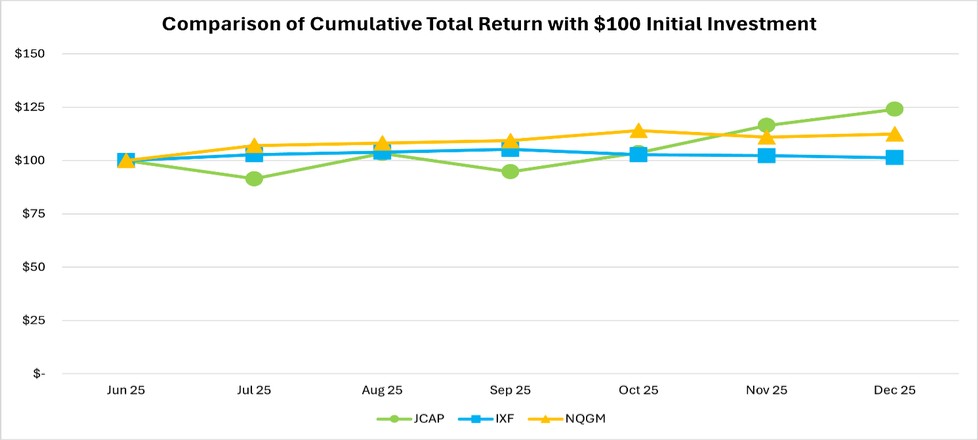
2025 | |||||||||||||||
Ticker | June | July | August | September | October | November | December | ||||||||
Jefferson Capital, Inc. | JCAP | $100.0 | $91.4 | $103.3 | $94.7 | $103.6 | $116.4 | $124.0 | |||||||
Nasdaq Financial 100 | IXF | $100.0 | $102.7 | $103.9 | $105.2 | $102.7 | $102.2 | $101.3 | |||||||
Nasdaq Global Market Composite Index | NQGM | $100.0 | $107.0 | $108.2 | $109.3 | $114.1 | $111.0 | $112.4 | |||||||
The comparisons of stock performance shown above are not intended to forecast or be indicative of possible future performance of our common stock. We do not make or endorse predictions as to our future stock performance.
Holders
As of March 9, 2026, there were 178 holders of record of our common stock. Because many of our shares of common stock are held by brokers and institutions on behalf of stockholders, we are unable to estimate the total number of beneficial owners of our common stock represented by these record holders.
38
Dividend Policy
Declaration and payment of any dividend will be subject to the discretion of our board of directors. The time and amount of dividends will be dependent upon our business prospects, results of operations, financial condition, cash requirements and availability, debt repayment obligations, capital expenditure needs, contractual restrictions, covenants in the agreements governing our current and future indebtedness, industry trends, the provisions of Delaware law affecting the payment of distributions to stockholders and any other factors our board of directors may consider relevant. We have paid and intend to continue to pay quarterly cash dividends of $0.24 per share.
Issuer Purchases of Equity Securities
None.
Recent Sales of Unregistered Securities
None.
Use of Proceeds
All shares of common stock issued and sold in the IPO were registered under the Securities Act pursuant to our registration statement on Form S-1, as amended (File No. 333-287488), which was declared effective by the SEC on June 25, 2025.
There have been no material changes in the expected use of net proceeds from our IPO as described under the heading “Use of Proceeds” in our final prospectus filed with the SEC pursuant to Rule 424(b)(4) under the Securities Act on June 27, 2025.
Item 6. [Reserved]
39
Item 7. Management’s Discussion and Analysis of Financial Condition and Results of Operations
MANAGEMENT’S DISCUSSION AND ANALYSIS OF FINANCIAL CONDITION AND RESULTS OF OPERATIONS
You should read the following discussion and analysis of our financial condition and results of operations in conjunction with the combined and consolidated financial statements and the related notes and other financial data included elsewhere in the Annual Report on Form 10-K. In addition to historical financial information, the following discussion contains forward-looking statements that reflect our plans, estimates, beliefs, and expectations that involve risks and uncertainties. Our actual results and the timing of events could differ materially from those discussed in the forward-looking statements. Factors that could cause or contribute to these differences include those discussed below and the sections titled “Risk Factors” and “Cautionary Note Regarding Forward-Looking Statements” in this Annual Report on Form 10-K (the “Annual Report”). A discussion regarding our financial condition and results of operations for the year ended December 31, 2024 compared to the year ended December 31, 2023 is included under “Management’s Discussion and Analysis of Financial Condition and Results of Operations” in our final prospectus filed with the SEC pursuant to Rule 424(b)(4) on June 27, 2025.
Overview
We provide debt recovery solutions and other related services across a broad range of consumer receivables, including credit card, secured and unsecured automotive, telecom and utilities, and other receivables. We primarily purchase portfolios of previously charged-off consumer receivables at deep discounts to face value and manage them by working with individuals as they repay their obligations and work toward financial recovery. Previously charged-off receivables include receivables subject to bankruptcy proceedings. We also provide debt servicing and other portfolio management services to credit originators for nonperforming loans. In addition, through our credit card acquisition programs, we earn credit card revenue. All deployments are made to independent third parties.
We operate and manage our business through four reportable segments that are based on geography: United States, United Kingdom, Canada, and Latin America. We also have the following two primary lines of business:
| ◾ | Distressed, our largest line of business, represents the purchase, collection, and servicing collection of nonperforming consumer loans; and |
| ◾ | Insolvency, which consists of the purchasing and/or servicing of financial assets of consumers who have entered bankruptcy through Chapter 7 or 13 of the U.S. Bankruptcy Code in the United States, consumer proposal, credit counseling, or bankruptcy in Canada and the United Kingdom. |
We are headquartered in Minneapolis, Minnesota, and as of December 31, 2025, with 1,120 FTE (including our offshore co-sourced operation).
Key Business Metrics and Non-GAAP Financial Measures
We regularly review net operating income and net income along with a number of key business metrics and non-GAAP financial measures to evaluate our business, measure our performance, identify trends, prepare financial projections, and make business decisions. Although we believe the key business metrics and non-GAAP financial measures we review are useful, they have limitations as analytical tools and should not be considered in isolation, or as substitutes for analysis of our financial results prepared in accordance with GAAP.
40
Key Business Metrics
Estimated Remaining Collections
We define ERC as the undiscounted sum of all future projected collections on our owned finance receivables portfolios. We calculate ERC using data derived from our databases of owned and serviced debt portfolio in the markets in which we operate and from our proprietary behavioral and asset valuation models. References to our ERC are references to gross ERC (which includes estimated collections in respect of the current charge-off balances). We believe that our ERC estimation represents an important supplemental measure to compare our cash generating capacity with other companies in the debt collection industry, even though we can provide no assurance that we will achieve such collections within a specified time period, or at all.
The following table summarizes the total ERC by geographic area, or segment, during the years presented:
December 31, | Increase | % | ||||||||||
(in Millions) | 2025 | | 2024 | | (Decrease) | | Change | | ||||
United States | $ | 2,530.7 | $ | 2,114.0 | $ | 416.7 | 19.7 | % | ||||
Canada | 392.2 | 266.1 | 126.0 | 47.4 | % | |||||||
United Kingdom | 190.3 | 151.8 | 38.5 | 25.3 | % | |||||||
Latin America | 266.7 | 212.6 | 54.1 | 25.5 | % | |||||||
Total | $ | 3,379.8 | $ | 2,744.5 | $ | 635.3 | 23.1 | % | ||||
ERC in our United States reportable segment included $139.9 million from the Conn’s Portfolio Purchase and $295.6 million for the Bluestem portfolio purchase.
Deployments
Deployments refers to portfolios purchases in the ordinary course. We believe deployments represent an important measure of our investment activity. Deployments are a key driver of the growth of our ERC and a measure to compare growth in our business with the growth of other companies in the debt collection industry.
The following tables summarize the total deployments or purchases by geographic area, or reportable segments, during the years presented:
Year Ended | ||||||||||||
December 31, | Increase | % | ||||||||||
(in Millions) | | 2025 | | 2024 | | (Decrease) | | Change | | |||
United States | $ | 624.8 | $ | 552.7 | $ | 72.2 | 13.1 | % | ||||
Canada | 141.6 | 95.4 | 46.2 | 48.4 | % | |||||||
United Kingdom | 31.9 | 29.4 | 2.5 | 8.6 | % | |||||||
Latin America | 33.6 | 45.8 | (12.2) | (26.7) | % | |||||||
Total Purchases | $ | 832.0 | $ | 723.3 | $ | 108.6 | 15.0 | % | ||||
During the year ended December 31, 2025, we invested $832.0 million to acquire receivable portfolios, with face values aggregating $13,030.7 million, for an average purchase price of 6.4% of face value. The amount invested in receivable portfolios increased $108.6 million, or 15.0%, compared with the $723.3 million invested during the year ended December 31, 2024, to acquire receivable portfolios with face values aggregating $9,198.5 million, for an average purchase price of 7.9% of face value.
41
Collections
The following tables summarize the total collections by geographic area, or reportable segment, during the years presented:
Year Ended | ||||||||||||
December 31, | Increase | % | ||||||||||
(in Millions) | | 2025 | | 2024 | | (Decrease) | | Change | | |||
United States | $ | 786.0 | $ | 420.3 | $ | 365.7 | 87.0 | % | ||||
Canada | 116.1 | 85.9 | 30.2 | 35.2 | % | |||||||
United Kingdom | 42.5 | 39.4 | 3.1 | 7.9 | % | |||||||
Latin America | 54.1 | 39.0 | 15.1 | 38.7 | % | |||||||
Total Collections | $ | 998.7 | $ | 584.6 | $ | 414.1 | 70.8 | % | ||||
Collections from purchased receivables increased by $414.1 million or 70.8% to $998.7 million during the year ended December 31, 2025, from $584.6 million during the year ended December 31, 2024. The increase in collections from purchased receivables compared to the year ended December 31, 2024, was primarily a result of increased purchases during the year. Collections in our United States reportable segment included $246.9 million from the Conn’s Portfolio Purchase and $14.3 million from the Bluestem portfolio purchase.
Non-GAAP Financial Measures
To supplement our combined and consolidated financial statements prepared and presented in accordance with GAAP, we use certain non-GAAP financial measures throughout this Annual Report, as described further below, to provide investors with additional useful information about our financial performance, to enhance the overall understanding of our past performance and future prospects and to allow for greater transparency with respect to important metrics used by our management for financial and operational decision-making.
Non-GAAP financial measures have limitations in their usefulness to investors because they have no standardized meaning prescribed by GAAP and are not prepared under any comprehensive set of accounting rules or principles. In addition, non-GAAP financial measures may be calculated differently from, and therefore may not be directly comparable to, similarly titled measures used by other companies. As a result, non-GAAP financial measures should be viewed as supplementing, and not as an alternative or substitute for, our combined and consolidated financial statements prepared and presented in accordance with GAAP.
Adjusted Net Income
Adjusted net income is calculated as net income in accordance with GAAP, adjusted to exclude (i) foreign exchange and other income (expense); (ii) stock-based compensation; and (iii) merger and acquisition and other infrequent, non-recurring, non-core or unusual charges. Adjusted net income is a supplemental measure of performance that is not required by, or presented in accordance with, GAAP. We present adjusted net income because we consider it an important supplemental measure of our operations and financial performance. Our management believes adjusted net income helps us provide enhanced year-to-year comparability of operations and financial performance and is useful to investors as other companies in our industry report similar financial measures. Adjusted net income should not be considered as an alternative to net income determined in accordance with GAAP.
Some of the limitations related to the use of adjusted net income as an analytical tool include:
| ◾ | does not reflect our future requirements for capital expenditures or contractual commitments; |
| ◾ | does not reflect changes in, or cash requirements for, our working capital needs; and |
| ◾ | other companies in our industry may calculate adjusted net income differently than we do, limiting its usefulness as a comparative measure. |
Because of these limitations, adjusted net income should not be considered as a measure of discretionary cash available to us to invest in the growth of our business.
42
Set forth below is a reconciliation of adjusted net income to net income, the most directly comparable financial measure calculated and reported in accordance with GAAP.
Year Ended | ||||||||||||
December 31, | Increase | % | ||||||||||
(in Millions) | | 2025 | | 2024 | | (Decrease) | | Change | | |||
Net Income | $ | 188.0 | $ | 128.9 | $ | 59.1 | 45.8 | % | ||||
Foreign exchange and other income (expense) | (7.7) | 5.5 | (13.2) | (241.1) | % | |||||||
Stock compensation | 9.2 | 4.5 | 4.7 | 103.2 | % | |||||||
Canaccede exit incentive | 1.4 | 7.7 | (6.3) | (81.3) | % | |||||||
Merger and acquisition and initial public offering related expenses | 11.8 | 7.0 | 4.8 | 68.2 | % | |||||||
Adjusted Net Income | $ | 202.7 | $ | 153.6 | $ | 49.0 | 31.9 | % | ||||
Components of Results of Operations
Revenue
Our revenue is primarily derived from revenue from investments in receivables, which is revenue recognized from engaging in debt purchasing and recovery activities, and from credit card and servicing revenue streams.
Total Portfolio Revenue
Portfolio revenue consists of two components: (i) portfolio income, which is the accretion of the discount on the negative allowance due to the passage of time (generally the portfolio balance multiplied by the established pool effective interest rate (“EIR”)), and (ii) changes in recoveries, which includes recoveries above or below forecast (the difference between actual cash collected or recovered during the current year and expected cash recoveries for the current period) and changes in expected future recoveries (the present value change of expected future recoveries, where such change generally results from changes to the expected timing of collections and changes to the total amount of expected future collections).
For a majority of the portfolios we purchase, when we acquire them, we apply our charge-off policy and fully write off the amortized costs of the individual receivables we acquire immediately after purchasing the portfolio. We then record a negative allowance that represents the present value of all expected future recoveries for pools of receivables that share similar risk characteristics using a discounted cash flow approach, which is presented as “investments in receivables, net” on our combined and consolidated balance sheet. The discount rate is a purchase EIR established based on the purchase price of the portfolio and the expected future cash flows at the time of purchase. From time to time, we will also purchase performing portfolios for a discount, where we will apply the interest method and accrete the discount.
Credit Card Revenue
Credit card revenue consists of interest income, annual fees, late fees, as well as interchange fees, cash advance fees and other miscellaneous items from credit card transactions. Interest income is accrued monthly based on the outstanding receivables and their contractual interest rates.
Servicing Revenue
Servicing revenue consists of the revenue we generate from providing collection services to certain third parties. Generally, we receive a percentage of collections as the fee for services, and in some cases, we receive a fixed fee. Servicing revenue is recognized when the underlying receivables are collected or when a fixed fee service is performed.
Provision for Credit Losses
Provision for credit losses is the allowance we provide for credit losses on loans and fees receivable. We compute the allowance for credit losses on loans and fees receivable at the pool level using a roll-rate methodology and consider a number of factors in the measurement of the allowance, including historical loss rates, current delinquency and roll-rate trends, the effects of changes in the economy, changes in underwriting criteria and estimated recoveries. The allowance is estimated based on amortized cost basis of the loan, including principal, accrued interest receivable, deferred fees and costs. We place receivables on non-accrual at 90 days past due and write off the accrued interest at 180 days past due or sooner if facts and circumstances indicate earlier non-collectability. Expected recoveries are included in the measurement of the allowance for credit losses.
43
Operating Expenses
Salaries and Benefits Expense
Salaries and benefits expense primarily consists of base salary, commission, bonus expense and healthcare costs. Additionally, it includes 401k match and stock-based compensation expense. We expense all salaries and benefits expense as incurred. While we expect our salaries and benefits expense will increase in absolute dollars as we continue to invest in our growth and operate as a public company (including as a result of increased stock-based compensation), we expect such expense to decline as a percentage of revenue over time as we scale our business and leverage our investments already made.
Servicing Expenses
Servicing expenses primarily consists of collections and customer service expenses associated with previously charged-off receivables, such as the cost of outsourced collections, debtor correspondence, legal fees associated with the collection of debt and other direct expenses associated with collections and customer service efforts. While we expect our servicing expenses will increase in absolute dollars as our business grows, we expect such expenses will vary from year-to-year as a percentage of revenue for the foreseeable future and decrease as a percentage of revenue over the long term as a result of continued investments to improve the efficiency of our operations and support organization.
Depreciation and Amortization
Depreciation and amortization consists of depreciation of property and equipment and amortization of intangible assets.
Professional Fees
Professional fees primarily consists of legal and consulting expenses, including annual audit fees and various other outside service fees provided by expert services firms. In addition, it includes legal fees associated with settlements and fees associated with merger and acquisition expenses.
We incurred additional expenses related to the initial public offering (the “IPO”) and expect to incur additional expense primarily due to the costs of operating as a public company, which are expected to include additional legal, accounting and consulting expenses, among others.
Other Selling, General and Administrative Expenses
Other selling, general and administrative expenses generally consists of rent, travel and entertainment expenses, and other general overhead expenses.
Other Income (Expense)
Interest Expense
Interest expense consists of interest expense on our outstanding debt and amortization of debt issuance costs.
Foreign Exchange and Other Income (Expense)
Foreign exchange and other income (expense) consists of foreign currency related realized gains or losses on portfolio purchase transactions.
Income Taxes
The Company’s effective tax rate for the year ended December 31, 2025 was 13.9%, compared to 6.3% for the year ended December 31, 2024. The Company’s effective tax rates for the year ended December 31, 2025 and 2024 were based on the U.S. federal statutory tax rate of 21.0% and state jurisdictional income tax rates, adjusted for permanent items including non-taxable partnership income, compensation above $1 million, inclusive of equity awards, paid to covered employees under Internal Revenue Code Section 162(m), non-deductible stock compensation and non-deductible transaction costs related to the IPO transaction.
In July 2025, the One Big Beautiful Bill Act (“OBBBA”) was enacted into law in the U.S. The OBBBA includes numerous provisions that affect corporate taxation, including changes to bonus depreciation, the expensing of domestic research costs, and modifications to certain U.S. international tax rules. We have analyzed the impacts of the OBBBA and reflected
44
them in the current period. These impacts do not have a material effect on the tax rate for the year ended December 31, 2025. The majority of the tax law changes will take effect in future years.
Realization of our deferred tax assets depends, in part, on the reversal of our deferred tax liabilities. In considering our need for a valuation allowance, we consider our historical and future projected taxable income, as well as other objectively verifiable evidence, including our utilization of tax attributes net operating loss carryforwards through the realization of deferred tax liabilities. However, our future effective tax rate may be affected by our ongoing assessment of the need for a valuation allowance on our deferred tax assets or liabilities, or changes in tax laws, regulations, or accounting principles, tax planning initiatives, as well as certain discrete items.
Results of Operations
Year ended December 31, 2025 compared to year ended December 31, 2024
The following tables set forth combined and consolidated income statement data expressed in a dollar amount and as a percentage of total revenues for the years indicated:
| Year Ended December 31, | ||||||||||
(in Millions) | 2025 | | 2024 | | |||||||
Revenues: | |||||||||||
Portfolio income | $ | 560.4 | 91.4 | % | $ | 396.3 | 91.5 | % | |||
Changes in recoveries | 6.0 | 1.0 | % | (0.4) | (0.1) | % | |||||
Total portfolio revenue | $ | 566.4 | 92.4 | % | $ | 395.9 | 91.4 | % | |||
Credit card revenue | 7.2 | 1.2 | % | 8.3 | 1.9 | % | |||||
Servicing revenue | 39.7 | 6.5 | % | 29.1 | 6.7 | % | |||||
Total revenues | $ | 613.3 | 100.0 | % | $ | 433.3 | 100.0 | % | |||
Provision for credit losses | $ | 2.4 | 0.4 | % | $ | 3.5 | 0.8 | % | |||
Operating Expenses: | |||||||||||
Salaries and benefits | $ | 64.6 | 10.5 | % | $ | 48.1 | 11.1 | % | |||
Servicing expenses | 187.2 | 30.5 | % | 130.9 | 30.2 | % | |||||
Depreciation and amortization | 5.3 | 0.9 | % | 2.6 | 0.6 | % | |||||
Professional fees | 18.6 | 3.0 | % | 11.4 | 2.6 | % | |||||
Other selling, general and administrative | 18.8 | 3.1 | % | 16.6 | 3.8 | % | |||||
Total operating expenses | $ | 294.4 | 48.0 | % | $ | 209.6 | 48.4 | % | |||
Net operating income | $ | 316.5 | 51.6 | % | $ | 220.3 | 50.8 | % | |||
Other income / (expense): | |||||||||||
Interest expense | $ | (105.8) | (17.2) | % | $ | (77.2) | (17.8) | % | |||
Foreign exchange and other income (expense) | 7.7 | 1.3 | % | (5.5) | (1.3) | % | |||||
Total other income / (expense) | (98.1) | (16.0) | % | (82.7) | (19.1) | % | |||||
Income before income taxes | $ | 218.4 | 35.6 | % | $ | 137.6 | 31.7 | % | |||
Provision for income taxes | (30.5) | (5.0) | % | (8.7) | (2.0) | % | |||||
Net income | $ | 188.0 | 30.6 | % | $ | 128.9 | 29.7 | % | |||
Foreign currency translation | 18.6 | 3.0 | % | (14.0) | (3.2) | % | |||||
Comprehensive income | $ | 206.6 | 33.7 | % | $ | 114.9 | 26.5 | % | |||
45
Revenues
A summary of how our revenues were generated during the years indicated is as follows:
Year Ended | ||||||||||||
December 31, | Increase | % | ||||||||||
(in Millions) | 2025 | | 2024 | (Decrease) | Change | |||||||
Cash Collections | $ | 998.7 | $ | 584.6 | $ | 414.1 | 70.8 | % | ||||
Principal Amortization | (432.3) | (188.7) | (243.6) | 129.1 | % | |||||||
Total portfolio revenue | 566.4 | 395.9 | 170.5 | 43.1 | % | |||||||
Credit card revenue | 7.2 | 8.3 | (1.1) | (13.7) | % | |||||||
Servicing revenue | 39.7 | 29.1 | 10.6 | 36.3 | % | |||||||
Total revenues | $ | 613.3 | $ | 433.3 | $ | 179.9 | 41.5 | % | ||||
Total revenues were $613.3 million for the year ended December 31, 2025, an increase of $179.9 million, or 41.5%, compared to $433.3 million for the year ended December 31, 2024. The increase is primarily a result of increased deployments during the year as well as the Conn’s portfolio acquisition in December 2024 which contributed $95.8 million of revenue as well as the Bluestem acquisition in December 2025 which contributed $5.4 million.
Operating Expenses
Total operating expenses were $294.4 million for the year ended December 31, 2025, an increase of $84.8 million, or 40.5%, compared to $209.6 million for the year ended December 31, 2024. This is driven by an increase in salaries and benefit expense of $16.5 million primarily due to increased personnel expense related to the Conn’s Portfolio purchase of $9.7 million and additional stock-based compensation $4.7 million, servicing expenses of $56.3 million related to increased collections, $7.2 million in professional fees related to the initial public offering in June 2025, increased depreciation and amortization of $2.7 million primarily due to the Conn’s intangibles and $2.2 million associated with increased various selling, general and administrative expenses.
Salaries and Benefits
Salaries and benefits were $64.6 million for the year ended December 31, 2025, which is an increase of $16.5 million, or 34.2%, compared to $48.1 million for the year ended December 31, 2024. The increase is primarily due to increased personnel expense of $9.7 million related to the Conn’s Portfolio purchase and higher stock-based compensation of $4.7 million.
Servicing Expenses
Servicing expenses were $187.2 million for the year ended December 31, 2025, an increase of $56.3 million, or 43.0%, compared to $130.9 million for the year ended December 31, 2024. The increase in servicing expenses was primarily driven by increased collections including $12.1 million from the Conn’s portfolio and increased court costs of $22.4 million which are incurred upfront at the outset of consumer litigation in anticipation of generating future collections. Servicing expenses consisted of the following for the year ended December 31, 2025 and 2024:
| Year Ended | | | |||||||||
December 31, | Increase | % | ||||||||||
(in Millions) | 2025 | | 2024 | (Decrease) | Change | |||||||
Agency and repo commission expense | $ | 50.9 | $ | 37.8 | $ | 13.1 | 34.7 | % | ||||
Legal commission expense | 28.6 | 19.7 | 8.9 | 45.2 | % | |||||||
Court costs | 54.4 | 32.0 | 22.4 | 70.0 | % | |||||||
Communications | 27.0 | 25.0 | 2.0 | 8.0 | % | |||||||
Offshore | 13.8 | 8.7 | 5.1 | 58.6 | % | |||||||
Other servicing expenses | 12.5 | 7.7 | 4.8 | 62.6 | % | |||||||
Total servicing expenses | $ | 187.2 | $ | 130.9 | $ | 56.3 | 43.0 | % | ||||
Depreciation and Amortization
Depreciation and amortization was $5.3 million for the year ended December 31, 2025, a $2.7 million, or 101.5%, increase from the $2.6 million for the year ended December 31, 2024. The increase was due to incremental intangible assets associated with the Conn’s purchase.
46
Professional Fees
Professional fees were $18.6 million for the year ended December 31, 2025, an increase of $7.2 million, or 63.6%, compared to $11.4 million for the year ended December 31, 2024. The increase was primarily due to one-time legal and professional fees incurred as part of the initial public offering in June 2025.
Other Selling, General and Administrative Expenses
Other selling, general and administrative expenses generally consist of rent, travel and entertainment expenses, and other general overhead expenses. These expenses totaled $18.8 million for the year ended December 31, 2025, an increase of $2.2 million or 13.3%, compared to $16.6 million for the year ended December 31, 2024. The increase is primarily due to additional rent expense related to the addition of Conn’s location in 2025 and expense recognized related to the Canaccede exit incentive of $1.4 million.
Other Income (Expense)
Interest Expense
Total interest expense was $105.8 million for the year ended December 31, 2025, an increase of $28.5 million, or 37.0%, compared to $77.2 million for the year ended December 31, 2024. The increase was primarily driven by higher interest expense related to the outstanding notes payable, as well as increased amortization of note payable origination costs of $6.2 million, an increase of $1.9 million or 44.0% higher compared to $4.3 million for the year ended December 31, 2024, due to the issuance of the 2030 Senior Notes in May 2025.
Interest expense consisted of the following for the years ended December 31, 2025 and 2024:
| Year Ended | | | |||||||||
December 31, | Increase | % | ||||||||||
(in Millions) | 2025 | | 2024 | (Decrease) | Change | |||||||
Interest expense | $ | 99.6 | $ | 73.0 | $ | 26.7 | 36.5 | % | ||||
Amortization of note payable origination costs | 6.2 | 4.3 | 1.9 | 44.0 | % | |||||||
Total interest expense | $ | 105.8 | $ | 77.2 | $ | 28.5 | 37.0 | % | ||||
Provision for Income Tax Expense
The provision for income taxes consists primarily of income taxes in certain federal, state, local and foreign jurisdictions in which we conduct business. Foreign jurisdictions typically have different statutory tax rates from those in the United States. Accordingly, our effective tax rates may vary depending on the impact of the valuation allowance of our deferred tax assets and liabilities, and changes in tax laws. The Company has recognized a provision of $30.5 million for the year ended December 31, 2025 to reflect the change in tax payer status to a corporation as a result of the reorganization related to the initial public offering. This is $21.8 million higher compared to $8.7 million for the year ended December 31, 2024.
47
Segment Results of Operations
The following tables set forth combined and consolidated income statement amounts categorized by segment, for the years indicated:
| Year Ended December 31, | ||||||||||||||||||||||||||||||
2025 | | 2024 | |||||||||||||||||||||||||||||
(in Millions) | | United | | United | | Canada | | Latin | | Total | | United | | United | | Canada | | Latin | | Total | |||||||||||
Portfolio revenue | $ | 435.0 | $ | 25.4 | $ | 65.6 | $ | 40.4 | $ | 566.4 | $ | 288.0 | $ | 28.5 | $ | 48.2 | $ | 31.2 | $ | 395.9 | |||||||||||
Credit card revenue | 2.6 | — | 4.6 | — | 7.2 | 2.7 | — | 5.6 | — | 8.3 | |||||||||||||||||||||
Servicing revenue | 12.7 | 25.4 | 1.6 | — | 39.7 | 4.9 | 23.8 | 0.4 | — | 29.1 | |||||||||||||||||||||
Total Revenue | $ | 450.3 | $ | 50.8 | $ | 71.8 | $ | 40.4 | $ | 613.3 | $ | 295.6 | $ | 52.3 | $ | 54.2 | $ | 31.2 | $ | 433.3 | |||||||||||
Provision for credit losses | $ | 1.6 | $ | — | $ | 0.8 | $ | — | $ | 2.4 | $ | 1.9 | $ | — | $ | 1.6 | $ | — | $ | 3.5 | |||||||||||
Operating Expenses | |||||||||||||||||||||||||||||||
Salaries and benefits | $ | 42.9 | $ | 15.8 | $ | 5.2 | $ | 0.7 | $ | 64.6 | $ | 28.3 | $ | 14.1 | $ | 5.3 | $ | 0.4 | $ | 48.1 | |||||||||||
Servicing expenses | 143.7 | 19.2 | 10.2 | 14.1 | 187.2 | 95.7 | 15.1 | 10.0 | 10.1 | 130.9 | |||||||||||||||||||||
Depreciation and amortization | 3.7 | 0.4 | 1.2 | — | 5.3 | 1.7 | 0.3 | 0.6 | — | 2.6 | |||||||||||||||||||||
Professional fees | 16.1 | 1.0 | 0.5 | 1.0 | 18.6 | 9.3 | 0.9 | 0.4 | 0.9 | 11.4 | |||||||||||||||||||||
Other selling, general and administrative | 14.3 | 2.6 | 1.3 | 0.6 | 18.8 | 12.5 | 2.4 | 1.2 | 0.4 | 16.6 | |||||||||||||||||||||
Total Operating Expenses | $ | 220.7 | $ | 39.0 | $ | 18.4 | $ | 16.4 | $ | 294.4 | $ | 147.5 | $ | 32.8 | $ | 17.5 | $ | 11.8 | $ | 209.6 | |||||||||||
Net Operating Income | $ | 228.0 | $ | 11.8 | $ | 52.6 | $ | 24.0 | $ | 316.5 | $ | 146.2 | $ | 19.5 | $ | 35.1 | $ | 19.4 | $ | 220.3 | |||||||||||
Net operating income margin | 50.6 | % | 23.2 | % | 73.3 | % | 59.4 | % | 51.6 | % | 49.5 | % | 37.3 | % | 64.8 | % | 62.2 | % | 50.8 | % | |||||||||||
United States
| Year Ended | | | |||||||||
December 31, | Increase | % | ||||||||||
(in Millions) | 2025 | | 2024 | (Decrease) | Change | |||||||
Portfolio revenue | $ | 435.0 | $ | 288.0 | $ | 147.0 | 51.0 | % | ||||
Credit card revenue | 2.6 | 2.7 | (0.1) | (3.7) | % | |||||||
Servicing revenue | 12.7 | 4.9 | 7.8 | 159.2 | % | |||||||
Total Revenue | $ | 450.3 | $ | 295.6 | $ | 154.7 | 52.3 | % | ||||
Provision for credit losses | $ | 1.6 | $ | 1.9 | $ | (0.3) | (15.8) | % | ||||
Operating Expenses | ||||||||||||
Salaries and benefits | $ | 42.9 | $ | 28.3 | $ | 14.6 | 51.6 | % | ||||
Servicing expenses | 143.7 | 95.7 | 48.0 | 50.2 | % | |||||||
Depreciation and amortization | 3.7 | 1.7 | 2.0 | 117.6 | % | |||||||
Professional fees | 16.1 | 9.3 | 6.8 | 73.1 | % | |||||||
Other selling, general and administrative | 14.3 | 12.5 | 1.8 | 14.4 | % | |||||||
Total Operating Expenses | $ | 220.7 | $ | 147.5 | $ | 73.2 | 49.6 | % | ||||
Net Operating Income | $ | 228.0 | $ | 146.2 | $ | 81.8 | 56.0 | % | ||||
Net operating income margin | 50.6 | % | 49.5 | % | ||||||||
Portfolio revenue increased $147.0 million or 51.0% in the year ended December 31, 2025 compared to December 31, 2024, primarily due to deployment growth including the Conn’s portfolio acquisition in December 2024 which contributed $95.8 million of revenue as well as the Bluestem acquisition in December 2025 which contributed $5.4 million.
Servicing revenue grew $7.8 million or 159.2% in the year ended December 31, 2025, primarily due to the Conn’s Portfolio Purchase, which contributed $10.0 million.
48
Salaries and benefits were $42.9 million for the year ended December 31, 2025, which is an increase of $14.6 million, or 51.6%, compared to $28.3 million for the year ended December 31, 2024. The increase is primarily due to the increase in personnel expense related to the Conn’s Portfolio acquisition of $9.7 million and stock-based compensation of $4.7 million.
Servicing expenses were $143.7 million for the year ended December 31, 2025, an increase of $48.0 million, or 50.2%, compared to $95.7 million for the year ended December 31, 2024. The increase in servicing expenses was primarily driven by increased collections, and increased court costs of $18.6 million which are incurred upfront at the outset of consumer litigation in anticipation of generating future collections. Servicing expenses include $12.1 million from the Conn’s portfolio acquisition and $2.9 million from the Bluestem portfolio acquisition.
Professional fees were $16.1 million for the year ended December 31, 2025, an increase of $6.8 million, or 73.1%, compared to $9.3 million for the year ended December 31, 2024. The increase was primarily due to one-time legal and professional fees incurred as part of the initial public offering in June 2025.
Other selling, general and administrative expenses, which generally consist of rent expense, travel and entertainment expenses, and other general overhead expenses, were $14.3 million for the year ended December 31, 2025, an increase of $1.8 million or 14.4%, compared to $12.5 million for the year ended December 31, 2024. The increase is primarily due to additional expense recognized related to the Canaccede exit incentive of $1.4 million.
Overall net operating income increased $81.8 million or 56.0% higher in the year ended December 31, 2025 than the year ended December 31, 2024 primarily due to continued growth in deployments and the result of the successful implementation of initiatives to reduce the cost to collect. $73.2 million was contributed from the Conn’s portfolio purchase and $2.5 million from the Bluestem portfolio.
United Kingdom
| Year Ended | | | |||||||||
December 31, | Increase | % | ||||||||||
(in Millions) | 2025 | | 2024 | (Decrease) | Change | |||||||
Portfolio revenue | $ | 25.4 | $ | 28.5 | $ | (3.1) | (10.9) | % | ||||
Servicing revenue | 25.4 | 23.8 | 1.6 | 6.7 | % | |||||||
Total Revenue | $ | 50.8 | $ | 52.3 | $ | (1.5) | (2.9) | % | ||||
Operating Expenses | ||||||||||||
Salaries and benefits | $ | 15.8 | $ | 14.1 | $ | 1.7 | 12.1 | % | ||||
Servicing expenses | 19.2 | 15.1 | 4.1 | 27.2 | % | |||||||
Depreciation and amortization | 0.4 | 0.3 | 0.1 | 33.3 | % | |||||||
Professional fees | 1.0 | 0.9 | 0.1 | 11.1 | % | |||||||
Other selling, general and administrative | 2.6 | 2.4 | 0.2 | 8.3 | % | |||||||
Total Operating Expenses | $ | 39.0 | $ | 32.8 | $ | 6.2 | 18.9 | % | ||||
Net Operating Income | $ | 11.8 | $ | 19.5 | $ | (7.7) | (39.5) | % | ||||
Net operating income margin | 23.2 | % | 37.3 | % | ||||||||
Portfolio revenue decreased $3.1 million or 10.9% in the year ended December 31, 2025 compared to December 31, 2024 primarily due to lower deployments in the United Kingdom.
Servicing revenue increased $1.6 million or 6.7% in the year ended December 31, 2025 compared to December 31, 2024 due to reduced third party servicing.
Salaries and benefits increased $1.7 million or 12.1% in the year ended December 31, 2025 compared to December 31, 2024 primarily due to higher employee benefit costs.
49
Servicing expenses increased $4.1 million or 27.2% in the year ended December 31, 2025 compared to December 31, 2024 primarily due to court costs which are incurred upfront at the outset of consumer litigation in anticipation of generating future collections.
Overall net operating income declined $7.7 million or 39.5% in the year ended December 31, 2025 compared to December 31, 2024 primarily due to lower deployments and higher servicing costs.
Canada
Year Ended | ||||||||||||
December 31, | Increase | % | ||||||||||
(in Millions) | | 2025 | | 2024 | | (Decrease) | | Change | | |||
Portfolio revenue | $ | 65.6 | $ | 48.2 | | $ | 17.4 | 36.1 | % | |||
Credit card revenue | 4.6 | 5.6 | (1.0) | (17.9) | % | |||||||
Servicing revenue | 1.6 | 0.4 | 1.2 | 300.0 | % | |||||||
Total Revenue | $ | 71.8 | $ | 54.2 | $ | 17.6 | 32.5 | % | ||||
Provision for credit losses | $ | 0.8 | $ | 1.6 | $ | (0.8) | (50.0) | % | ||||
Operating Expenses | ||||||||||||
Salaries and benefits | $ | 5.2 | $ | 5.3 | $ | (0.1) | (1.9) | % | ||||
Servicing expenses | 10.2 | 10.0 | 0.2 | 2.0 | % | |||||||
Depreciation and amortization | 1.2 | 0.6 | 0.6 | 100.0 | % | |||||||
Professional fees | 0.5 | 0.4 | 0.1 | 25.0 | % | |||||||
Other selling, general and administrative | 1.3 | 1.2 | 0.1 | 8.3 | % | |||||||
Total Operating Expenses | $ | 18.4 | $ | 17.5 | $ | 0.9 | 5.1 | % | ||||
Net Operating Income | $ | 52.6 | $ | 35.1 | $ | 17.5 | 49.9 | % | ||||
Net operating income margin | 73.3 | % | 64.8 | % | ||||||||
Portfolio revenue increased $17.4 million or 36.1% in the year ended December 31, 2025 compared to December 31, 2024 primarily due to higher deployments.
Servicing revenue increased $1.2 million or 300.0% in the year ended December 31, 2025 compared to December 31, 2024 due to continued organic growth.
Depreciation and amortization expense increased $0.6 million or 100.0% in the year ended December 31, 2025 compared to December 31, 2024 primarily due to higher intangible amortization expense.
Overall net operating income increased $17.5 million or 49.9% in the year ended December 31, 2025 compared to December 31, 2024 primarily due to increased deployments.
50
Latin America
Year Ended | ||||||||||||
December 31, | Increase | % | ||||||||||
(in Millions) | | 2025 | | 2024 | | (Decrease) | | Change | ||||
Portfolio revenue | | $ | 40.4 | $ | 31.2 | $ | 9.2 | 29.5 | % | |||
Total Revenue | $ | 40.4 | $ | 31.2 | $ | 9.2 | 29.5 | % | ||||
Operating Expenses | ||||||||||||
Salaries and benefits | $ | 0.7 | $ | 0.4 | $ | 0.3 | 75.0 | % | ||||
Servicing expenses | 14.1 | 10.1 | 4.0 | 39.6 | % | |||||||
Depreciation and amortization | — | — | — | 0.0 | % | |||||||
Professional fees | 1.0 | 0.9 | 0.1 | 11.11 | % | |||||||
Other selling, general and administrative | 0.6 | 0.4 | 0.2 | 50.0 | % | |||||||
Total Operating Expenses | $ | 16.4 | $ | 11.8 | $ | 4.6 | 39.0 | % | ||||
Net Operating Income | $ | 24.0 | $ | 19.4 | $ | 4.6 | 23.7 | % | ||||
Net operating income margin | 59.4 | % | 62.2 | % | ||||||||
Portfolio revenue increased $9.2 million or 29.5% in the year ended December 31, 2025 compared to December 31, 2024 primarily due to strong collection performance.
Servicing expense increased $4.0 million or 39.6% in the year ended December 31, 2025 compared to December 31, 2024 due to increased collections.
Overall net operating income increased $4.7 million or 24.2% in the year ended December 31, 2025 compared to December 31, 2024 due to strong collection performance.
51
Supplemental Performance Data
Investments in Receivables Portfolio Performance
The accounts represented in the Insolvency category in the tables below are those portfolios of accounts that were in an insolvency status at the time of purchase. This contrasts with accounts in our Distressed portfolios that file for bankruptcy/insolvency protection after we purchase them, which continue to be tracked in their corresponding Distressed portfolio. Distressed customers sometimes file for bankruptcy/insolvency protection subsequent to our purchase of the related Distressed portfolio. When this occurs, we adjust our collection practices to comply with bankruptcy/insolvency rules and procedures; however, for accounting purposes, these accounts remain in the original Distressed portfolio. Insolvency accounts may be dismissed voluntarily or involuntarily subsequent to our purchase of the Insolvency portfolio. Dismissal occurs when the terms of the bankruptcy are not met by the petitioner. When this occurs, we are typically free to pursue collection outside of bankruptcy procedures; however, for accounting purposes, these accounts remain in the original Insolvency pool.
Purchase price multiples can vary over time due to a variety of factors, including pricing competition, supply levels, age of the receivables acquired, and changes in our operational efficiency. This creates unique and advantageous purchasing opportunities, particularly within the Insolvency market, relative to the prior four years. Purchase price multiples can also vary among types of receivables. For example, we generally incur lower collection costs on our Insolvency portfolio compared with our Distressed portfolio. This allows us, in general, to pay more for an Insolvency portfolio and experience lower purchase price multiples, while generating similar net returns when compared with a Distressed portfolio.
When competition increases and/or supply decreases, pricing often becomes negatively impacted relative to expected collections, and yields tend to trend lower. The opposite tends to occur when competition decreases and/or supply increases.
Within a given portfolio type, to the extent that lower purchase price multiples are the result of more competitive pricing and lower net yields, this will generally lead to lower profitability. As portfolio pricing becomes more favorable on a relative basis, our profitability will tend to increase. Profitability within given Distressed portfolio types may also be impacted by the age and quality of the receivables, which impact the cost-to-collect on those accounts. Fresher accounts, for example, typically carry lower associated collection expenses, while older accounts and lower balance accounts typically carry higher costs and, as a result, require higher purchase price multiples to achieve the same net profitability as fresher paper.
We acquire portfolios and record them at the price paid at the time of acquisition. Beginning in 2022, with the adoption of ASC 326 Financial instruments - Credit Losses (“CECL”), we aggregate the acquired pools during the year such that during the year the blended effective interest rate will change to reflect new buying and additional cash flow estimates until the end of the respective year. Once the year is completed, the effective interest rate is fixed at the amount we expect to collect discounted at the rate to equate purchase price to the recovery estimate. During the first year of purchase, we typically allow pools to season before making any material adjustments to the ERCs. Subsequent to the initial year, as we establish collection experience and confidence with a pool of accounts, we evaluate whether to update the annually aggregated ERC. These processes could cause the ratio of ERC to purchase price for any given year of buying to gradually change over time.
The numbers presented in the following tables represent collections and do not reflect any costs to collect; therefore, they may not represent relative profitability. Due to all the factors described above, investors should be cautious when making comparisons of purchase price multiples among years and between types of receivables.
52
The following tables show certain data related to our investment in receivables portfolios.
PURCHASE PRICE MULTIPLES AS OF DECEMBER 31, 2025 Excludes Resale as Noted at Bottom (in millions)
Current | Original | |||||||||||||||||
Purchase | Life-to-Date | Total | Grand | Collection | Collection | |||||||||||||
| Price (1)(2) | Collections (3) | ERC (4) | Total | Multiple | Multiple (5) | ||||||||||||
US Distressed | ||||||||||||||||||
2003-2016 (6) | $ | 339.9 | $ | 1,012.6 | $ | 29.3 | $ | 1,041.9 | 3.07 | x | 2.28 | x | ||||||
2017 | 55.3 | 169.0 | 19.0 | 188.0 | 3.40 | x | 2.36 | x | ||||||||||
2018 | 76.2 | 209.7 | 28.6 | 238.3 | 3.13 | x | 2.70 | x | ||||||||||
2019 | 94.8 | 268.2 | 18.8 | 287.0 | 3.03 | x | 2.29 | x | ||||||||||
Vintage | 2020 | 74.1 | 179.8 | 39.5 | 219.4 | 2.96 | x | 2.20 | x | |||||||||
2021 | 73.1 | 117.1 | 40.9 | 157.9 | 2.16 | x | 1.97 | x | ||||||||||
2022 | 142.1 | 162.2 | 119.9 | 282.0 | 1.98 | x | 2.00 | x | ||||||||||
2023 | 337.6 | 344.8 | 423.1 | 767.9 | 2.27 | x | 2.11 | x | ||||||||||
2024 | 481.5 | 451.1 | 572.7 | 1,023.8 | 2.13 | x | 1.98 | x | ||||||||||
2025 | 520.6 | 89.7 | 977.9 | 1,067.6 | 2.05 | x | 2.05 | x | ||||||||||
Total | $ | 2,195.3 | $ | 3,004.2 | $ | 2,269.6 | $ | 5,273.8 | ||||||||||
US Insolvency | ||||||||||||||||||
2003-2016 (6) | $ | 235.8 | $ | 366.0 | $ | 0.2 | $ | 366.2 | 1.55 | x | 1.72 | x | ||||||
2017 | 49.6 | 62.5 | 0.7 | 63.2 | 1.27 | x | 1.35 | x | ||||||||||
2018 | 86.7 | 106.9 | 1.3 | 108.2 | 1.25 | x | 1.30 | x | ||||||||||
2019 | 62.2 | 84.5 | 3.5 | 88.0 | 1.41 | x | 1.31 | x | ||||||||||
Vintage | 2020 | 30.1 | 43.0 | 6.2 | 49.2 | 1.63 | x | 1.40 | x | |||||||||
2021 | 23.7 | 31.1 | 5.6 | 36.7 | 1.55 | x | 1.25 | x | ||||||||||
2022 | 40.7 | 42.4 | 9.8 | 52.3 | 1.28 | x | 1.30 | x | ||||||||||
2023 | 66.7 | 55.5 | 37.1 | 92.6 | 1.39 | x | 1.34 | x | ||||||||||
2024 | 71.1 | 31.9 | 64.2 | 96.1 | 1.35 | x | 1.39 | x | ||||||||||
2025 | 104.3 | 11.3 | 132.5 | 143.8 | 1.38 | x | 1.38 | x | ||||||||||
Total | $ | 771.0 | $ | 835.1 | $ | 261.1 | $ | 1,096.2 | ||||||||||
UK Distressed & Insolvency | ||||||||||||||||||
2009-2016 | $ | 22.9 | $ | 61.4 | $ | 2.5 | $ | 63.9 | 2.80 | x | 1.94 | x | ||||||
2017 | 0.8 | 3.9 | 0.6 | 4.5 | 5.41 | x | 1.90 | x | ||||||||||
2018 | 3.1 | 12.0 | 4.0 | 16.0 | 5.18 | x | 2.20 | x | ||||||||||
2019 | 7.1 | 18.2 | 4.3 | 22.5 | 3.18 | x | 1.91 | x | ||||||||||
Vintage | 2020 | 13.1 | 27.5 | 7.8 | 35.3 | 2.69 | x | 1.74 | x | |||||||||
2021 | 19.4 | 27.1 | 11.1 | 38.1 | 1.97 | x | 1.67 | x | ||||||||||
2022 | 18.9 | 28.4 | 19.1 | 47.5 | 2.52 | x | 2.22 | x | ||||||||||
2023 | 26.7 | 31.7 | 36.6 | 68.3 | 2.56 | x | 2.08 | x | ||||||||||
2024 | 29.4 | 17.9 | 38.6 | 56.5 | 1.92 | x | 1.70 | x | ||||||||||
2025 | 32.0 | 2.8 | 65.7 | 68.5 | 2.14 | x | 2.14 | x | ||||||||||
Total | $ | 173.4 | $ | 230.9 | $ | 190.3 | $ | 421.2 | ||||||||||
53
Current | Original | |||||||||||||||||
Purchase | Life-to-Date | Total | Grand | Collection | Collection | |||||||||||||
(in Millions) | | Price (1)(2) | | Collections (3) | | ERC (4) | | Total | | Multiple | | Multiple (5) | ||||||
Canada Insolvency(7) | ||||||||||||||||||
2008-2016 | $ | 94.8 | $ | 187.4 | $ | 0.1 | $ | 187.5 | 1.98 | x | 1.67 | x | ||||||
2017 | 26.3 | 48.6 | 0.2 | 48.8 | 1.85 | x | 1.53 | x | ||||||||||
2018 | 40.9 | 85.5 | 0.7 | 86.2 | 2.11 | x | 1.80 | x | ||||||||||
2019 | 34.7 | 68.6 | 1.3 | 69.9 | 2.01 | x | 1.72 | x | ||||||||||
Vintage | 2020 | 29.3 | 52.9 | 1.9 | 54.8 | 1.87 | x | 1.60 | x | |||||||||
2021 | 23.7 | 36.8 | 4.4 | 41.1 | 1.73 | x | 1.62 | x | ||||||||||
2022 | 18.5 | 21.3 | 7.0 | 28.2 | 1.53 | x | 1.47 | x | ||||||||||
2023 | 38.8 | 31.1 | 26.1 | 57.2 | 1.48 | x | 1.35 | x | ||||||||||
2024 | 61.9 | 25.0 | 68.1 | 93.1 | 1.50 | x | 1.38 | x | ||||||||||
2025 | 115.0 | 18.0 | 151.3 | 169.3 | 1.47 | x | 1.47 | x | ||||||||||
Total | $ | 483.9 | $ | 575.1 | $ | 261.0 | $ | 836.1 | ||||||||||
Canada Distressed(1) | ||||||||||||||||||
2008-2016 | $ | 57.5 | $ | 122.6 | $ | 3.8 | $ | 126.3 | 2.20 | x | 1.81 | x | ||||||
2017 | 23.2 | 55.0 | 3.2 | 58.2 | 2.51 | x | 2.17 | x | ||||||||||
2018 | 14.6 | 60.6 | 7.6 | 68.2 | 4.65 | x | 2.52 | x | ||||||||||
2019 | 12.8 | 41.2 | 3.1 | 44.3 | 3.46 | x | 2.19 | x | ||||||||||
Vintage | 2020 | 19.7 | 40.8 | 6.7 | 47.6 | 2.42 | x | 2.06 | x | |||||||||
2021 | 9.2 | 14.1 | 4.1 | 18.3 | 1.99 | x | 1.79 | x | ||||||||||
2022 | 24.3 | 24.2 | 12.4 | 36.6 | 1.50 | x | 1.69 | x | ||||||||||
2023 | 18.4 | 16.0 | 17.3 | 33.3 | 1.81 | x | 1.61 | x | ||||||||||
2024 | 33.5 | 29.8 | 33.8 | 63.5 | 1.90 | x | 1.83 | x | ||||||||||
2025 | 26.6 | 8.5 | 39.2 | 47.7 | 1.80 | x | 1.80 | x | ||||||||||
Total | $ | 239.7 | $ | 412.8 | $ | 131.2 | $ | 544.0 | ||||||||||
Latin America Distressed | ||||||||||||||||||
2021 | $ | 7.9 | $ | 11.6 | $ | 8.2 | $ | 19.8 | 2.50 | x | 1.58 | x | ||||||
2022 | 25.0 | 37.5 | 33.8 | 71.3 | 2.86 | x | 2.67 | x | ||||||||||
Vintage | 2023 | 42.3 | 47.4 | 61.9 | 109.3 | 2.58 | x | 2.39 | x | |||||||||
2024 | 45.8 | 31.1 | 90.4 | 121.5 | 2.65 | x | 2.35 | x | ||||||||||
2025 | 33.6 | 9.5 | 72.4 | 81.9 | 2.43 | x | 2.43 | x | ||||||||||
Total | $ | 154.7 | $ | 137.1 | $ | 266.7 | $ | 403.8 | ||||||||||
54
Current | Original | |||||||||||||||||
Purchase | Life-to-Date | Total | Grand | Collection | Collection | |||||||||||||
(in Millions) | | Price (1)(2) | | Collections (3) | | ERC (4) | | Total | | Multiple | | Multiple (5) | ||||||
Total | ||||||||||||||||||
2003-2016 (6) | $ | 750.8 | $ | 1,750.0 | $ | 35.9 | $ | 1,785.9 | 2.38 | x | 1.98 | x | ||||||
2017 | 155.3 | 339.0 | 23.6 | 362.6 | 2.34 | x | 1.87 | x | ||||||||||
2018 | 221.6 | 474.7 | 42.1 | 516.8 | 2.33 | x | 1.97 | x | ||||||||||
2019 | 211.6 | 480.7 | 31.0 | 511.7 | 2.42 | x | 1.89 | x | ||||||||||
Vintage | 2020 | 166.3 | 343.9 | 62.3 | 406.2 | 2.44 | x | 1.90 | x | |||||||||
2021 | 156.9 | 237.7 | 74.2 | 311.9 | 1.99 | x | 1.74 | x | ||||||||||
2022 | 269.5 | 315.9 | 202.0 | 517.9 | 1.92 | x | 1.91 | x | ||||||||||
2023 | 530.5 | 526.6 | 602.1 | 1,128.7 | 2.13 | x | 1.96 | x | ||||||||||
2024 | 723.3 | 586.8 | 867.7 | 1,454.5 | 2.01 | x | 1.88 | x | ||||||||||
2025 | 832.1 | 139.8 | 1,439.0 | 1,578.8 | 1.90 | x | 1.90 | x | ||||||||||
Total | $ | 4,017.9 | $ | 5,195.2 | $ | 3,379.8 | $ | 8,575.0 | ||||||||||
| (1) | Includes the portfolios that were acquired through our business acquisitions from the date of acquisition. Adjusted to include historical information from Canaccede Financial Group and its predecessor businesses. |
| (2) | For our non-U.S. amounts, purchase price is presented at the exchange rate on the date the pool was purchased. |
| (3) | For our non-U.S. amounts, historical year exchange rates are presented at the respective exchange rate for each collection year. |
| (4) | For our non-U.S. amounts, Total ERC is presented at the exchange rate as of December 31, 2025. . |
| (5) | The original estimated purchase price multiple represents the purchase price multiple at the end of the year of acquisition. |
| (6) | This vintage data excludes forward flow purchases that were resold between 2005 and 2008 shortly after purchase and does not reflect typical collection multiples as there is no cost-to-collect for accounts that were resold. |
55
The following table illustrates collections from purchased receivables, total portfolio revenue for the year ended December 31, 2025 and investment in receivables, net as of December 31, 2025 and monthly EIR, by year of purchase:
RECEIVABLE PORTFOLIO FINANCIAL INFORMATION, BY YEAR OF PURCHASE(1) (in millions)
As of | ||||||||||||||||||
Year Ended December 31, 2025 | December 31, 2025 | |||||||||||||||||
Total | ||||||||||||||||||
Portfolio | Changes in | Portfolio | Investments in | Monthly | ||||||||||||||
| Collections | | Income | | Recoveries | | Revenue | | Receivables, Net | | EIR | |||||||
US Distressed | ||||||||||||||||||
ZBA(1) | $ | 1.2 | $ | 1.2 | $ | — | $ | 1.2 | $ | — | 0.0 | % | ||||||
2003 - 2019 | 35.8 | 32.9 | (15.5) | 17.4 | 36.9 | 6.1 | % | |||||||||||
2020 | 11.0 | 13.1 | (6.9) | 6.2 | 8.9 | 9.9 | % | |||||||||||
2021 | 12.9 | 11.0 | (10.7) | 0.3 | 22.1 | 3.2 | % | |||||||||||
2022 | 40.9 | 24.5 | (10.4) | 14.1 | 76.2 | 2.3 | % | |||||||||||
2023 | 148.7 | 89.6 | (19.1) | 70.5 | 254.8 | 2.5 | % | |||||||||||
2024 | 377.1 | 172.2 | 49.9 | 222.1 | 314.1 | 3.4 | % | |||||||||||
2025 | 89.4 | 61.8 | 25.8 | 87.6 | 518.7 | 2.8 | % | |||||||||||
Subtotal | $ | 717.0 | $ | 406.3 | $ | 13.1 | $ | 419.4 | $ | 1,231.7 | ||||||||
US Insolvency | ||||||||||||||||||
2003 - 2019 | 2.2 | 1.4 | (4.8) | (3.4) | 4.2 | 1.7 | % | |||||||||||
2020 | 2.5 | 0.9 | (1.3) | (0.4) | 5.0 | 1.3 | % | |||||||||||
2021 | 2.2 | 0.9 | 0.2 | 1.1 | 4.3 | 1.6 | % | |||||||||||
2022 | 8.8 | 1.9 | (1.0) | 0.9 | 8.6 | 1.3 | % | |||||||||||
2023 | 19.6 | 5.7 | (1.9) | 3.8 | 31.4 | 1.2 | % | |||||||||||
2024 | 22.3 | 8.6 | (2.5) | 6.1 | 50.9 | 1.2 | % | |||||||||||
2025 | 11.3 | 6.9 | 0.6 | 7.5 | 100.5 | 1.1 | % | |||||||||||
Subtotal | $ | 68.9 | $ | 26.3 | $ | (10.7) | $ | 15.6 | $ | 204.9 | ||||||||
UK Distressed & Insolvency | ||||||||||||||||||
2003 - 2019 | $ | 3.1 | $ | 2.5 | (0.8) | 1.7 | 4.1 | 4.4 | % | |||||||||
2020 | 2.4 | 1.9 | 0.2 | 2.1 | 2.4 | 6.5 | % | |||||||||||
2021 | 4.6 | 2.5 | 1.8 | 4.3 | 6.7 | 3.0 | % | |||||||||||
2022 | 6.7 | 5.1 | (2.1) | 3.0 | 10.5 | 3.6 | % | |||||||||||
2023 | 12.1 | 10.0 | (6.0) | 4.0 | 20.7 | 3.4 | % | |||||||||||
2024 | 10.8 | 7.2 | (0.4) | 6.8 | 24.6 | 2.3 | % | |||||||||||
2025 | 2.8 | 3.2 | 0.3 | 3.5 | 32.9 | 2.8 | % | |||||||||||
Subtotal | $ | 42.5 | $ | 32.4 | $ | (7.0) | $ | 25.4 | $ | 101.9 | ||||||||
Canada Distressed | ||||||||||||||||||
ZBA(2) | $ | 1.2 | $ | 1.2 | $ | — | $ | 1.2 | $ | — | 0.0 | % | ||||||
2020 | 6.2 | 5.5 | (0.2) | 5.3 | 3.1 | 12.7 | % | |||||||||||
2021 | 1.3 | 1.0 | (0.1) | 0.9 | 1.7 | 4.3 | % | |||||||||||
2022 | 4.2 | 2.6 | (0.6) | 2.0 | 6.8 | 2.8 | % | |||||||||||
2023 | 4.0 | 3.4 | (2.0) | 1.4 | 10.3 | 2.6 | % | |||||||||||
2024 | 14.2 | 7.3 | — | 7.3 | 20.1 | 2.6 | % | |||||||||||
2025 | 8.5 | 3.2 | 1.2 | 4.4 | 22.9 | 2.3 | % | |||||||||||
Subtotal | $ | 39.6 | $ | 24.2 | $ | (1.7) | $ | 22.5 | $ | 64.9 | ||||||||
Canada Insolvency | ||||||||||||||||||
ZBA | $ | 0.2 | $ | 0.2 | $ | — | $ | 0.2 | $ | — | 0.0 | % | ||||||
2020 | 7.2 | 1.5 | 5.4 | 6.9 | 2.8 | 3.4 | % | |||||||||||
2021 | 6.7 | 1.4 | 0.9 | 2.3 | 3.6 | 1.9 | % | |||||||||||
2022 | 6.9 | 1.5 | 1.1 | 2.6 | 5.9 | 1.5 | % | |||||||||||
2023 | 17.1 | 4.0 | 2.0 | 6.0 | 21.9 | 1.2 | % | |||||||||||
2024 | 20.3 | 8.3 | 4.2 | 12.5 | 54.7 | 1.2 | % | |||||||||||
2025 | 18.0 | 9.3 | 3.3 | 12.6 | 112.8 | 1.2 | % | |||||||||||
Subtotal | $ | 76.4 | $ | 26.2 | $ | 16.9 | $ | 43.1 | $ | 201.7 | ||||||||
Latin America Distressed | ||||||||||||||||||
2021 | 1.5 | 1.4 | (0.4) | 1.0 | 3.8 | 3.0 | % | |||||||||||
2022 | 8.0 | 7.6 | (1.6) | 6.0 | 10.6 | 5.8 | % | |||||||||||
2023 | 14.3 | 13.8 | (3.7) | 10.1 | 32.4 | 3.0 | % | |||||||||||
2024 | 20.8 | 16.0 | — | 16.0 | 43.2 | 2.5 | % | |||||||||||
2025 | 9.5 | 6.2 | 1.1 | 7.3 | 33.6 | 3.1 | % | |||||||||||
Subtotal | $ | 54.1 | $ | 45.0 | $ | (4.6) | $ | 40.4 | $ | 123.6 | ||||||||
Grand Total | $ | 998.5 | $ | 560.4 | $ | 6.0 | $ | 566.4 | $ | 1,928.7 | ||||||||
Note: | Not adjusted to include historical information from Canaccede Financial Group and its predecessor businesses. Results of Canaccede Financial Group and its predecessor businesses for deployments from prior to the date of our acquisition are consolidated in the 2020 vintage year. |
| (1) | Refers to revenue from zero basis accounts. |
56
The following table illustrates historical collections, by year, on our portfolios.
COLLECTIONS, BY YEAR OF PURCHASE Excludes Resale as Noted at Bottom (in millions)
Collections | |||||||||||||||||||||||||||||||||||||
Purchase | 2003 - | ||||||||||||||||||||||||||||||||||||
(in Millions) | | Price (1)(2) | | 2016 | | 2017 | | 2018 | | 2019 | | 2020 | | 2021 | | 2022 | | 2023 | | 2024 | | 2025 | | Total | |||||||||||||
US Distressed | |||||||||||||||||||||||||||||||||||||
2003-2016(3)(4) | $ | 339.9 | $ | 679.3 | $ | 80.8 | $ | 66.8 | $ | 51.9 | $ | 41.1 | $ | 32.3 | $ | 21.4 | $ | 15.5 | $ | 13.1 | $ | 10.5 | $ | 1,012.6 | |||||||||||||
2017 | 55.3 | — | 16.2 | 30.5 | 27.0 | 28.5 | 25.2 | 16.3 | 11.2 | 8.2 | 5.9 | 169.0 | |||||||||||||||||||||||||
2018 | 76.2 | — | — | 21.6 | 45.9 | 45.4 | 41.0 | 24.7 | 14.2 | 10.3 | 6.6 | 209.7 | |||||||||||||||||||||||||
2019 | 94.8 | — | — | — | 26.8 | 74.8 | 62.3 | 44.5 | 28.6 | 18.3 | 12.9 | 268.2 | |||||||||||||||||||||||||
Vintage | 2020 | 74.1 | — | — | — | — | 26.5 | 60.9 | 37.2 | 26.0 | 18.2 | 11.0 | 179.8 | ||||||||||||||||||||||||
2021 | 73.1 | — | — | — | — | — | 23.1 | 37.8 | 24.8 | 18.3 | 12.9 | 117.1 | |||||||||||||||||||||||||
2022 | 142.1 | — | — | — | — | — | — | 16.5 | 55.1 | 49.6 | 41.0 | 162.2 | |||||||||||||||||||||||||
2023 | 337.6 | — | — | — | — | — | — | — | 48.4 | 147.7 | 148.7 | 344.8 | |||||||||||||||||||||||||
2024 | 481.5 | — | — | — | — | — | — | — | — | 73.3 | 377.8 | 451.1 | |||||||||||||||||||||||||
2025 | 520.6 | — | — | — | — | — | — | — | — | — | 89.7 | 89.7 | |||||||||||||||||||||||||
Total | $ | 2,195.3 | $ | 679.3 | $ | 97.0 | $ | 118.9 | $ | 151.7 | $ | 216.2 | $ | 244.8 | $ | 198.4 | $ | 223.9 | $ | 357.1 | $ | 717.0 | $ | 3,004.2 | |||||||||||||
US Insolvency | |||||||||||||||||||||||||||||||||||||
2003-2016(4) | $ | 235.8 | $ | 289.8 | $ | 34.1 | $ | 19.8 | $ | 11.6 | $ | 5.7 | $ | 2.9 | $ | 1.1 | $ | 0.6 | $ | 0.4 | $ | 0.3 | $ | 366.0 | |||||||||||||
2017 | 49.6 | — | 9.3 | 19.6 | 14.4 | 9.2 | 6.1 | 2.6 | 0.8 | 0.4 | 0.2 | 62.5 | |||||||||||||||||||||||||
2018 | 86.7 | — | — | 16.0 | 34.9 | 23.8 | 17.1 | 9.7 | 3.6 | 1.1 | 0.5 | 106.9 | |||||||||||||||||||||||||
2019 | 62.2 | — | — | — | 7.0 | 23.2 | 19.8 | 16.2 | 11.0 | 6.1 | 1.2 | 84.5 | |||||||||||||||||||||||||
Vintage | 2020 | 30.1 | — | — | — | — | 3.5 | 10.5 | 10.8 | 9.0 | 6.7 | 2.5 | 43.0 | ||||||||||||||||||||||||
2021 | 23.7 | — | — | — | — | — | 8.9 | 10.1 | 6.3 | 3.5 | 2.2 | 31.1 | |||||||||||||||||||||||||
2022 | 40.7 | — | — | — | — | — | — | 5.4 | 16.4 | 11.8 | 8.8 | 42.4 | |||||||||||||||||||||||||
2023 | 66.7 | — | — | — | — | — | — | — | 12.7 | 23.2 | 19.6 | 55.5 | |||||||||||||||||||||||||
2024 | 71.1 | — | — | — | — | — | — | — | — | 9.6 | 22.3 | 31.9 | |||||||||||||||||||||||||
2025 | 104.3 | — | — | — | — | — | — | — | — | — | 11.3 | 11.3 | |||||||||||||||||||||||||
Total | $ | 771.0 | $ | 289.8 | $ | 43.3 | $ | 55.4 | $ | 67.9 | $ | 65.3 | $ | 65.4 | $ | 55.8 | $ | 60.3 | $ | 62.8 | $ | 68.9 | $ | 835.1 | |||||||||||||
UK Distressed & Insolvency | |||||||||||||||||||||||||||||||||||||
2009-2016 | $ | 22.9 | $ | 40.8 | $ | 5.5 | $ | 3.4 | $ | 2.6 | $ | 2.1 | $ | 2.2 | $ | 1.5 | $ | 1.3 | $ | 1.1 | $ | 0.8 | $ | 61.4 | |||||||||||||
2017 | 0.8 | — | 0.4 | 0.6 | 0.6 | 0.6 | 0.7 | 0.4 | 0.3 | 0.2 | 0.1 | 3.9 | |||||||||||||||||||||||||
2018 | 3.1 | — | — | 0.3 | 1.9 | 2.0 | 2.4 | 1.7 | 1.5 | 1.2 | 1.0 | 12.0 | |||||||||||||||||||||||||
2019 | 7.1 | — | — | — | 0.8 | 4.7 | 5.1 | 3.0 | 2.1 | 1.4 | 1.1 | 18.2 | |||||||||||||||||||||||||
Vintage | 2020 | 13.1 | — | — | — | — | 4.2 | 10.0 | 5.1 | 3.3 | 2.4 | 2.4 | 27.5 | ||||||||||||||||||||||||
2021 | 19.4 | — | — | — | — | — | 4.6 | 7.0 | 6.6 | 4.4 | 4.6 | 27.1 | |||||||||||||||||||||||||
2022 | 18.9 | — | — | — | — | — | — | 2.6 | 10.9 | 8.2 | 6.7 | 28.4 | |||||||||||||||||||||||||
2023 | 26.7 | — | — | — | — | — | — | — | 6.2 | 13.4 | 12.1 | 31.7 | |||||||||||||||||||||||||
2024 | 29.4 | — | — | — | — | — | — | — | — | 7.1 | 10.8 | 17.9 | |||||||||||||||||||||||||
2025 | 32.0 | — | — | — | — | — | — | — | — | — | 2.8 | 2.8 | |||||||||||||||||||||||||
Total | $ | 173.4 | $ | 40.8 | $ | 5.8 | $ | 4.2 | $ | 5.9 | $ | 13.7 | $ | 24.9 | $ | 21.3 | $ | 32.3 | $ | 39.4 | $ | 42.5 | $ | 230.9 | |||||||||||||
57
Collections | |||||||||||||||||||||||||||||||||||||
Purchase | 2003 - | ||||||||||||||||||||||||||||||||||||
| Price (1)(2) | | 2016 | | 2017 | | 2018 | | 2019 | | 2020 | | 2021 | | 2022 | | 2023 | | 2024 | | 2025 | | Total | ||||||||||||||
CAD Insolvency(5) | |||||||||||||||||||||||||||||||||||||
2008-2016 | $ | 94.8 | $ | 89.5 | $ | 31.8 | $ | 26.5 | $ | 20.5 | $ | 12.5 | $ | 5.0 | $ | 0.7 | $ | 0.4 | $ | 0.2 | $ | 0.2 | $ | 187.4 | |||||||||||||
2017 | 26.3 | — | 5.4 | 11.7 | 11.1 | 9.7 | 6.7 | 2.8 | 0.5 | 0.3 | 0.3 | 48.6 | |||||||||||||||||||||||||
2018 | 40.9 | — | — | 6.4 | 16.9 | 21.2 | 19.3 | 13.5 | 6.4 | 1.2 | 0.6 | 85.5 | |||||||||||||||||||||||||
2019 | 34.7 | — | — | — | 3.4 | 12.6 | 18.7 | 15.2 | 11.2 | 6.2 | 1.3 | 68.6 | |||||||||||||||||||||||||
Vintage | 2020 | 29.3 | — | — | — | — | 3.4 | 11.7 | 13.8 | 11.2 | 8.0 | 4.9 | 52.9 | ||||||||||||||||||||||||
2021 | 23.7 | — | — | — | — | — | 3.1 | 8.5 | 10.1 | 8.3 | 6.7 | 36.8 | |||||||||||||||||||||||||
2022 | 18.5 | — | — | — | — | — | — | 1.5 | 5.9 | 6.9 | 6.9 | 21.3 | |||||||||||||||||||||||||
2023 | 38.8 | — | — | — | — | — | — | — | 3.0 | 11.0 | 17.1 | 31.1 | |||||||||||||||||||||||||
2024 | 61.9 | — | — | — | — | — | — | — | — | 4.8 | 20.3 | 25.0 | |||||||||||||||||||||||||
2025 | 115.0 | — | — | — | — | — | — | — | — | — | 18.0 | 18.0 | |||||||||||||||||||||||||
Total | $ | 483.9 | $ | 89.5 | $ | 37.2 | $ | 44.6 | $ | 51.9 | $ | 59.5 | $ | 64.6 | $ | 56.0 | $ | 48.5 | $ | 46.8 | $ | 76.4 | $ | 575.1 | |||||||||||||
CAD Distressed(5)(6) | |||||||||||||||||||||||||||||||||||||
2008-2016 | $ | 57.5 | $ | 70.7 | $ | 13.3 | $ | 10.4 | $ | 7.9 | $ | 6.2 | $ | 5.2 | $ | 4.1 | $ | 2.5 | $ | 1.2 | $ | 1.3 | $ | 122.6 | |||||||||||||
2017 | 23.2 | — | 10.4 | 12.5 | 9.4 | 7.1 | 6.2 | 4.2 | 2.6 | 1.6 | 1.0 | 55.0 | |||||||||||||||||||||||||
2018 | 14.6 | — | — | 6.5 | 16.2 | 11.0 | 9.4 | 7.1 | 4.8 | 3.1 | 2.5 | 60.6 | |||||||||||||||||||||||||
2019 | 12.8 | — | — | — | 13.4 | 10.7 | 8.1 | 4.6 | 2.4 | 1.2 | 0.9 | 41.2 | |||||||||||||||||||||||||
Vintage | 2020 | 19.7 | — | — | — | — | 10.7 | 12.7 | 7.7 | 4.7 | 3.1 | 1.9 | 40.8 | ||||||||||||||||||||||||
2021 | 9.2 | — | — | — | — | — | 4.4 | 4.3 | 2.3 | 1.9 | 1.3 | 14.1 | |||||||||||||||||||||||||
2022 | 24.3 | — | — | — | — | — | — | 7.3 | 8.1 | 4.6 | 4.2 | 24.2 | |||||||||||||||||||||||||
2023 | 18.4 | — | — | — | — | — | — | — | 5.7 | 6.3 | 4.0 | 16.0 | |||||||||||||||||||||||||
2024 | 33.5 | — | — | — | — | — | — | — | — | 15.6 | 14.2 | 29.8 | |||||||||||||||||||||||||
2025 | 26.6 | — | — | — | — | — | — | — | — | — | 8.5 | 8.5 | |||||||||||||||||||||||||
Total | $ | 239.7 | $ | 70.7 | $ | 23.7 | $ | 29.4 | $ | 46.8 | $ | 45.6 | $ | 45.9 | $ | 39.2 | $ | 33.2 | $ | 38.6 | $ | 39.6 | $ | 412.8 | |||||||||||||
LatAm Distressed | |||||||||||||||||||||||||||||||||||||
2021 | $ | 7.9 | $ | — | $ | — | $ | — | $ | — | $ | — | $ | 0.8 | $ | 5.2 | $ | 2.3 | $ | 1.7 | $ | 1.5 | $ | 11.6 | |||||||||||||
2022 | 25.0 | — | — | — | — | — | — | 6.0 | 14.4 | 9.2 | 8.0 | 37.5 | |||||||||||||||||||||||||
Vintage | 2023 | 42.3 | — | — | — | — | — | — | — | 15.4 | 17.7 | 14.3 | 47.4 | ||||||||||||||||||||||||
2024 | 45.8 | — | — | — | — | — | — | — | — | 10.3 | 20.8 | 31.1 | |||||||||||||||||||||||||
2025 | 33.6 | — | — | — | — | — | — | — | — | — | 9.5 | 9.5 | |||||||||||||||||||||||||
Total | $ | 154.7 | $ | — | $ | — | $ | — | $ | — | $ | — | $ | 0.8 | $ | 11.2 | $ | 32.0 | $ | 39.0 | $ | 54.1 | $ | 137.1 | |||||||||||||
Total | |||||||||||||||||||||||||||||||||||||
2003-2015(4) | $ | 750.8 | $ | 1,170.1 | $ | 165.4 | $ | 126.8 | $ | 94.5 | $ | 67.5 | $ | 47.6 | $ | 28.8 | $ | 20.3 | $ | 16.0 | $ | 13.0 | $ | 1,750.0 | |||||||||||||
2017 | 155.3 | — | 41.7 | 75.0 | 62.5 | 55.1 | 44.9 | 26.3 | 15.3 | 10.8 | 7.5 | 339.0 | |||||||||||||||||||||||||
2018 | 221.6 | — | — | 50.8 | 115.8 | 103.5 | 89.1 | 56.7 | 30.6 | 16.9 | 11.3 | 474.7 | |||||||||||||||||||||||||
2019 | 211.6 | — | — | — | 51.3 | 126.0 | 114.0 | 83.4 | 55.3 | 33.3 | 17.4 | 480.7 | |||||||||||||||||||||||||
Vintage | 2020 | 166.3 | — | — | — | — | 48.3 | 105.8 | 74.6 | 54.2 | 38.4 | 22.7 | 343.9 | ||||||||||||||||||||||||
2021 | 156.9 | — | — | — | — | — | 45.0 | 72.9 | 52.5 | 38.1 | 29.2 | 237.7 | |||||||||||||||||||||||||
2022 | 269.5 | — | — | — | — | — | — | 39.3 | 110.8 | 90.3 | 75.5 | 315.9 | |||||||||||||||||||||||||
2023 | 530.5 | — | — | — | — | — | — | — | 91.3 | 219.3 | 215.9 | 526.6 | |||||||||||||||||||||||||
2024 | 723.3 | — | — | — | — | — | — | — | — | 120.6 | 466.2 | 586.8 | |||||||||||||||||||||||||
2025 | 832.1 | — | — | — | — | — | — | — | — | — | 139.8 | 139.8 | |||||||||||||||||||||||||
Total | $ | 4,017.9 | $ | 1,170.1 | $ | 207.0 | $ | 252.6 | $ | 324.2 | $ | 400.4 | $ | 446.4 | $ | 382.0 | $ | 430.2 | $ | 583.7 | $ | 998.5 | $ | 5,195.2 | |||||||||||||
| (1) | Includes the acquisition date finance receivables portfolios that were acquired through our business acquisitions from the date of acquisition. |
| (2) | For our non-U.S. amounts, purchase price is presented at the exchange rate on the date the pool was purchased. |
| (3) | U.S. Distressed excludes credit card collections from zero basis accounts associated with our Emblem Brand Credit Card, which totaled $0.0 million in the year ended December 31, 2025 and $0.1 million in the year ended December 31, 2024. |
| (4) | Excludes forward flow purchases that were resold between 2005 and 2008 shortly after purchase and do not reflect typical collection multiples as there is no cost-to-collect for accounts that were resold. |
| (5) | Adjusted to include historical information from Canaccede Financial Group and its predecessor businesses and excludes collections associated with recovering charged-off accounts in our credit card origination business. |
| (6) | Canada Distressed excludes collections from zero basis accounts associated with Fidem Finance, Inc., which totaled $0.0 million in the year ended December 31, 2025 and $0.1 million in the year ended December 31, 2024. |
58
Deployments
The following table displays our quarterly deployments for the years indicated.
Deployments by Geography and Business Line
Years ended | ||||||||
December 31, | ||||||||
(in Millions) | | 2025 | | | 2024 | | ||
US Distressed | $ | 520.5 | $ | 481.6 | ||||
US Insolvency | 104.3 | 71.1 | ||||||
UK Distressed & Insolvency | 32.0 | 29.4 | ||||||
Canada Insolvency | 115.0 | 61.9 | ||||||
Canada Distressed | 26.6 | 33.5 | ||||||
Latin America Distressed | 33.6 | 45.8 | ||||||
Total Purchases | $ | 832.0 | $ | 723.3 | ||||
Liquidity and Capital Resources
We actively manage our liquidity to help provide access to sufficient funding to meet our business needs and financial obligations. As of December 31, 2025, unrestricted cash and cash equivalents totaled $23.2 million. Of the unrestricted cash and cash equivalent balance as of December 31, 2025, $15.7 million consisted of cash on hand related to international operations with indefinitely reinvested earnings. Management believes that the Company has sufficient liquidity available to meet our operating cash needs and obligations for the next twelve months and the foreseeable future.
As of December 31, 2025, we had approximately $1,409.0 million in borrowings outstanding, net of unamortized debt issuance costs with $768.4 million of availability under our Revolving Credit Facility (as defined herein) (subject to the borrowing base and applicable debt covenants). Considering borrowing base restrictions, as of December 31, 2025, the amount available to be drawn was $768.4 million. For more information, see Note 8 to our combined and consolidated financial statements.
Net debt is calculated as total borrowings, adjusted to remove the contra-liability for unamortized debt issuance costs and subtract unrestricted cash. We present net debt because we consider it an important supplemental measure used for assessing our leverage. Our management believes net debt helps us provide enhanced year-to-year comparability of leverage and is useful to investors as other companies in our industry report similar financial measures. Net debt should not be considered as an alternative to total borrowings determined in accordance with GAAP. Our calculation of net debt may not be comparable to the calculation of similarly titled measures reported by other companies.
Year Ended | |||||||
December 31, | |||||||
(in Millions) | 2025 | | 2024 | ||||
Total borrowings | $ | 1,409.0 | $ | 1,194.7 | |||
Unamortized debt issuance costs | 22.5 | 13.4 | |||||
Unrestricted cash and cash equivalents | (23.2) | (35.5) | |||||
Net debt | 1,408.4 | 1,172.6 | |||||
Adjusted cash EBITDA | 773.6 | 430.8 | |||||
Leverage ratio (net debt / adjusted cash EBITDA) | 1.82 | x | 2.72 | x | |||
Our leverage is measured for purposes of our financial covenants in our Revolving Credit Facility based on a ratio of net debt to adjusted cash EBITDA but focused on just the Borrowers (as defined below) and as such, excludes adjusted cash EBITDA related to our Latin America operations as well as to a small portion of our Canadian assets. Additionally, the rating agencies who rate our Senior Notes look to the ratio of net debt to adjusted cash EBITDA as a primary metric in their ratings methodology. Additional information regarding adjusted cash EBITDA, a non-GAAP financial measure, is outlined further below.
We were in compliance with the covenants of our financing arrangements as of December 31, 2025. Financial covenants are important in determining the level of cash flow needed to maintain in relation to our ability to incur debt under our
59
Revolving Credit Facility. If these financial covenants are not complied with, we would be in breach of our Revolving Credit Facility agreement if not cured through an additional pay down within the designated timeframe.
Adjusted Cash EBITDA
Adjusted cash EBITDA is a supplemental non-GAAP financial measure used to evaluate our liquidity. Management believes adjusted cash EBITDA helps provide enhanced year-to-year comparability of our cash flow by aligning our collection expenses with our collections. Adjusted cash EBITDA should not be considered as an alternative to net cash provided by operating activities determined in accordance with GAAP.
Some of the limitations related to the use of adjusted cash EBITDA as an analytical tool include:
| ◾ | does not reflect our future requirements for capital expenditures or contractual commitments; |
| ◾ | does not reflect changes in, or cash requirements for, our working capital needs; |
| ◾ | does not reflect the interest expense, or the cash requirements necessary to make interest or principal payments, on our debts; |
| ◾ | although depreciation and amortization are non-cash charges, the assets being depreciated and amortized will have to be replaced in the future, and adjusted cash EBITDA does not reflect any cash requirements for such replacements; and |
| ◾ | other companies in our industry may calculate adjusted cash EBITDA differently than we do, limiting its usefulness as a comparative measure. |
Because of these limitations, adjusted cash EBITDA should not be considered as a measure of discretionary cash available to us to invest in the growth of our business.
Set forth below is a reconciliation of adjusted cash EBITDA to net cash provided by operating activities.
Year Ended December 31, | ||||||
(in millions) | 2025 | | 2024 | |||
Net cash provided by operating activities | $ | 268.8 | $ | 168.2 | ||
Changes in prepaid expenses | (0.5) | 7.8 | ||||
Changes in accounts payable and accrued expenses | (46.9) | (36.7) | ||||
Provision for credit losses | (2.4) | (3.5) | ||||
Foreign exchange and other income (expense) | (7.7) | 5.5 | ||||
Cash interest paid | 95.5 | 73.0 | ||||
Provision for income taxes | 30.5 | 8.7 | ||||
Total portfolio revenue | (566.4) | (395.9) | ||||
Gross collections | 998.7 | 584.5 | ||||
Stock-based compensation | (7.9) | 4.5 | ||||
Canaccede exit incentive | 1.4 | 7.7 | ||||
Merger and acquisition and initial public offering related expenses | 10.5 | 7.0 | ||||
Adjusted Cash EBITDA | $ | 773.6 | $ | 430.8 | ||
Revolving Credit Facility
On November 13, 2024, we amended our revolving credit facility (as supplemented or otherwise modified from time to time, the “Revolving Credit Facility”) under our Credit Agreement (defined below) with Citizens Bank, N.A., as administrative agent, and the lenders from time-to-time party thereto. As amended, the Revolving Credit Facility provides for borrowings in an aggregate principal amount of $825.0 million (subject to compliance with a borrowing base and applicable debt covenants) and matures on April 26, 2028. In May 2025, we issued $500.0 million aggregate principal amount of 2030 Notes (as defined below) and used a majority of the proceeds therefrom, net of fees, to pay down the outstanding balance under the Revolving Credit Facility. On October 27, 2025 the Company further amended and extended its credit agreement dated May 21, 2021, by and among CL Holdings, LLC, Jefferson Capital Systems, LLC, JC
60
International Acquisition, LLC, CFG Canada Funding LLC, Citizens Banks, N.A. and the lenders from time-to-time party thereto (the “Credit Agreement”) to an aggregate commitment of $1.0 billion via a syndication led by Citizens Bank.
As of December 31, 2025, there was $231.6 million aggregate principal amount of loans outstanding under the Revolving Credit Facility.
6.000% Senior Notes due 2026
On August 4, 2021, Jefferson Capital Holdings, LLC completed an offering of $300.0 million aggregate principal amount of 6.000% senior notes due 2026 (the “2026 Notes”) under an indenture (the “2026 Notes Indenture”), dated as of August 4, 2021, among Jefferson Capital, Holdings, LLC, the guarantors party thereto and U.S. Bank Trust Company, National Association (as successor to U.S. Bank National Association), as trustee. The 2026 Notes are general senior unsecured obligations of Jefferson Capital Holdings, LLC and are guaranteed by certain of Jefferson Capital Holdings, LLC’s wholly-owned domestic restricted subsidiaries. Interest on the 2026 Notes is payable semi-annually on February 15 and August 15 of each year, commencing on February 15, 2022. The 2026 Notes mature on August 15, 2026. As of December 31, 2025 there was $300.0 million aggregate principal amount of the 2026 Notes outstanding.
9.500% Senior Notes due 2029
On February 2, 2024, Jefferson Capital Holdings, LLC completed an offering of $400.0 million aggregate principal amount of 9.500% senior notes due 2029 (the “2029 Notes”) under an indenture (the “2029 Notes Indenture”), dated as of February 2, 2024, among Jefferson Capital Holdings, LLC, the guarantors party thereto and U.S. Bank Trust Company, National Association, as trustee. The 2029 Notes are general senior unsecured obligations of Jefferson Capital Holdings, LLC and are guaranteed by certain of Jefferson Capital Holdings, LLC’s wholly-owned domestic restricted subsidiaries. Interest on the 2029 Notes is payable semi-annually on February 15 and August 15 of each year, commencing on August 15, 2024. As of December 31, 2025, there was approximately $400.0 million aggregate principal amount of the 2029 Notes outstanding. The 2029 Notes mature on February 15, 2029.
8.250% Senior Notes due 2030
On May 2, 2025, Jefferson Capital Holdings, LLC completed an offering of $500.0 million aggregate principal amount of 8.250% senior notes due 2030 (the “2030 Notes”) under an indenture (the “New Notes Indenture”), dated as of May 2, 2025, among Jefferson Capital Holdings, LLC, the guarantors party thereto and U.S. Bank Trust Company, National Association, as trustee. The 2030 Notes are general senior unsecured obligations of Jefferson Capital Holdings, LLC and are guaranteed by certain of Jefferson Capital Holdings, LLC’s wholly-owned domestic restricted subsidiaries. Interest on the 2030 Notes is payable semi-annually on May 15 and November 15 of each year, commencing on November 15, 2025. As of December 31, 2025, there was approximately $500.0 million aggregate principal amount of the 2030 Notes outstanding. The 2030 Notes mature on May 15, 2030.
Cash Flows Analysis for the Years Ended December 31, 2025 and 2024
The following table summarizes our cash flow activity for the years ended:
Year Ended | |||||||||||||
(in Millions) | December 31, | Increase | % | ||||||||||
Total cash flow provided by / (used in) | 2025 | | 2024 | | (Decrease) | | Change | ||||||
Operating activities | $ | 268.8 | $ | 168.2 | $ | 100.6 | 59.8 | % | |||||
Investing activities | (401.9) | (542.4) | 140.4 | (25.9) | % | ||||||||
Financing activities | 149.7 | 388.8 | (239.1) | (61.5) | % | ||||||||
Exchange rate effects on cash balances held in foreign currencies | (7.3) | 3.0 | (10.3) | (347.4) | % | ||||||||
Net increase (decrease) in cash and cash equivalents and restricted cash | $ | 9.3 | $ | 17.6 | $ | (8.3) | (47.2) | % | |||||
Operating Activities
The change in our cash flows from operating activities in the year ended December 31, 2025 was primarily due to collections recognized as revenue offset by cash paid for operating expenses, interest, and income taxes. Key drivers of operating activities were adjusted for (i) non-cash items included in net income such as provisions for credit losses and depreciation and amortization and (ii) changes in the balances of operating assets and liabilities, which can vary
61
significantly in the normal course of business due to the amount and timing of payments. Net cash provided by operating activities increased $100.6 million, or 59.8%, when compared to the year ended December 31, 2024.
Investing Activities
Cash used in investing activities is normally driven by purchases of investments in receivables. Cash provided by investing activities is mainly driven by collections applied to investments in receivables.
The change in our cash flow from investing activities increased $140.4 million in the year ended December 31, 2025, primarily due to increased collections applied to investment in receivables of $432.3 million when compared to the year ended December 31, 2024.
Financing Activities
Cash from financing activities is normally provided by draws on our Revolving Credit Facility and proceeds from debt offerings. Cash used in financing activities is primarily driven by principal payments on our Revolving Credit Facility.
The change in our cash flow from financing activities decreased $239.1 million, primarily due to payments on our borrowings under our Revolving Credit Facility compared to the year ended December 31, 2024.
Contractual Obligations
Our contractual obligations as of December 31, 2025 were as follows:
Less Than | 1 - 3 | 4 - 5 | More Than | ||||||||||||
(in millions) | | Total | | 1 Year | | Years | | Years | | 5 Years | |||||
Operating leases | $ | 5.0 | $ | 1.3 | $ | 2.6 | $ | 0.5 | $ | 0.6 | |||||
Revolving credit facility(1) | 238.4 | 238.4 | — | — | — | ||||||||||
Notes payable(2) | 1,515.4 | 392.0 | 158.5 | 964.9 | — | ||||||||||
Purchase commitments(3) | 274.5 | 224.8 | 49.7 | — | — | ||||||||||
Other liabilities | 9.5 | 0.3 | 9.2 | — | — | ||||||||||
Total | $ | 2,042.8 | $ | 856.8 | $ | 220.0 | $ | 965.4 | $ | 0.6 | |||||
| (1) | Includes estimated interest and unused line fees due on our Revolving Credit Facility and assumes that the outstanding balance on such facility remain constant from the December 31, 2025 balance to maturity. |
| (2) | Includes scheduled interest and principal payments on the 2026 Notes, 2029 Notes and 2030 Notes. |
| (3) | Reflects the expected remaining amount to be purchased under forward flow and other contracts for the purchase of receivable portfolios. |
62
Critical Accounting Estimates
The discussion and analysis of our financial condition and results of operations are based upon our combined and consolidated financial statements, which have been prepared in accordance with GAAP. Our significant accounting policies are fundamental to understanding our results of operations and financial condition because they require that we use estimates, assumptions and judgments that affect the reported amounts of revenues, expenses, assets and liabilities. Our significant accounting estimates are discussed in Note 1 to our combined and consolidated financial statements.
We have identified the total portfolio revenue estimate as critical because it requires significant judgment and assumptions about highly complex and inherently uncertain matters, and the use of reasonably different estimates and assumptions could have a material impact on our results of operations or financial condition.
We evaluate our critical accounting estimates and judgments on an ongoing basis and update them as necessary, based on several items, including, but not limited to, changing macroeconomic and market conditions.
Total portfolio revenue
Total portfolio revenue recognition involves the use of estimates and the exercise of judgment on the part of management. These estimates include forecasts of the amount and timing of cash collections we expect to receive from our pools of accounts. We forecast ERC and apply a discounted cash flow methodology to our ERC. Adjustments to ERC may include adjustments reflecting recent collection trends, our view of current and future economic conditions, changes in collection assumptions or other timing-related adjustments. Significant changes in our cash flow estimates could result in increased or decreased revenue as we immediately recognize the discounted value of such changes using the constant effective interest rate of the pool. Generally, adjustments to cash forecasts result in an adjustment to revenue at an amount less than the impact of the performance in the period due to the effects of discounting. Additionally, cash collection forecast increases will result in more revenue being recognized while cash collection forecast decreases result in less revenue being recognized over the life of the pool.
The following table summarizes the impact of a hypothetical 1% decrease and increase in ERC as of December 31, 2025 and 2024 on total portfolio revenue and income before taxes:
1% Reduction in ERC | 1% Increase in ERC | |||||||||||||||||||||||
Impact on | Impact on | |||||||||||||||||||||||
Portfolio | Portfolio | Income | Portfolio | Income | ||||||||||||||||||||
($ in Millions) | | ERC | | Revenue | | ERC | | Revenue | | Before Taxes | | ERC | | Revenue | | Before Taxes | ||||||||
2025 | $ | 3,379.8 | $ | 566.4 | $ | 3,346.0 | $ | 538.1 | $ | (28.3) | $ | 3,413.6 | $ | 594.7 | $ | 28.3 | ||||||||
2024 | $ | 2,744.5 | $ | 395.9 | $ | 2,717.1 | $ | 373.6 | $ | (22.3) | $ | 2,772.0 | $ | 418.2 | $ | 22.3 | ||||||||
63
Item 7A. Quantitative and Qualitative Disclosures About Market Risk
Interest Rate Risk
We are subject to interest rate risk from borrowings on our Revolving Credit Facility, as well as our interest-bearing deposits. As such, our combined and consolidated financial results are subject to fluctuations due to changes in market interest rates. We assess this interest rate risk by estimating the increase or decrease in interest expense that would occur due to a change in short-term interest rates. The borrowings on our variable rate credit facilities were $231.6 million as of December 31, 2025.
Foreign Currency Exchange Risk
We transact business globally in multiple currencies. Our international revenue, as well as costs and expenses denominated in foreign currencies, expose us to the risk of fluctuations in foreign currency exchange rates against the U.S. dollar. We are exposed to foreign currency risks related to our revenue and operating expenses denominated in currencies other than the U.S. dollar, including the British pound and Canadian dollar. Accordingly, changes in exchange rates may negatively affect our future revenue and other operating results as expressed in U.S. dollars.
We have experienced and will continue to experience fluctuations in our net income (loss) as a result of transaction gains or losses related to remeasurement of our asset and liability balances that are denominated in currencies other than the functional currency of the entities in which they are recorded. We do not currently hedge against the risks associated with currency fluctuations but may do so, or use other derivative instruments, in the future. It is difficult to predict the impact hedging activities would have on our results of operations.
Inflation Risk
We do not believe that inflation has had a material effect on our business, financial condition or results of operations, other than its impact on the general economy, which includes labor costs. Nonetheless, if our costs, in particular personnel-related costs, continue to become subject to significant inflationary pressures, we may not be able to fully offset such higher costs through price increases. Our inability or failure to do so could harm our business, financial condition and results of operations.
Concentration Risk
A substantial percentage of our purchases are concentrated with a few large sellers. For the year ended December 31, 2025 and 2024, our five largest clients together accounted for 45.2% and 55.3% of our deployments, respectively, with the top client representing 23.6% and 32.9% of purchases for the same years, respectively.
We are subject to risks and uncertainties associated with our client concentration. An inability to maintain our purchasing activity with any of our largest clients as a result of potential competitive pressures, changes in a client’s debt recovery strategy or other factors could have an adverse impact on our financial performance. Our client concentration has, however, decreased in recent years as our client base has become more diversified. A key driver of this trend, which we expect to continue in future periods, has been our ability to add new clients across multiple asset classes, including clients who are first time sellers that previously managed collections themselves.
In addition, we enter into forward flow purchase agreements with our customers on a regular basis, which provides pricing and contractual certainty and mitigates the risk of unforeseen client loss. As of December 31, 2025, we had $274.5 million of total committed forward flows.
64
Item 8.Financial Statements and Supplementary Data
INDEX TO CCONSOLIDATED FINANCIAL STATEMENTS
Page | |
Report of Deloitte & Touche LLP, Independent Registered Public Accounting Firm (PCAOB ID: | 66 |
67 | |
Consolidated Statements of Operations and Comprehensive Income | 68 |
69 | |
70 | |
72 |
65
REPORT OF INDEPENDENT REGISTERED PUBLIC ACCOUNTING FIRM
To the Stockholders and the Board of Directors of Jefferson Capital, Inc.
Opinion on the Financial Statements
We have audited the accompanying combined and consolidated balance sheets of Jefferson Capital, Inc. and subsidiaries (the “Company”) as of December 31, 2025, and 2024, the related combined and consolidated statements of operations and comprehensive income, stockholders’ equity, and cash flows of the three years in the period ended December 31, 2025, and the related notes (collectively referred to as the “financial statements”). In our opinion, the financial statements present fairly, in all material respects, the financial position of the Company as of December 31, 2025 and 2024, and the results of its operations and its cash flows for each of the three years in the period ended December 31, 2025, in conformity with accounting principles generally accepted in the United States of America.
Basis for Opinion
These financial statements are the responsibility of the Company’s management. Our responsibility is to express an opinion on the Company’s financial statements based on our audits. We are a public accounting firm registered with the Public Company Accounting Oversight Board (United States) (PCAOB) and are required to be independent with respect to the Company in accordance with the U.S. federal securities laws and the applicable rules and regulations of the Securities and Exchange Commission and the PCAOB.
We conducted our audits in accordance with the standards of the PCAOB. Those standards require that we plan and perform the audit to obtain reasonable assurance about whether the financial statements are free of material misstatement, whether due to error or fraud. The Company is not required to have, nor were we engaged to perform, an audit of its internal control over financial reporting. As part of our audits, we are required to obtain an understanding of internal control over financial reporting but not for the purpose of expressing an opinion on the effectiveness of the Company’s internal control over financial reporting. Accordingly, we express no such opinion.
Our audits included performing procedures to assess the risks of material misstatement of the financial statements, whether due to error or fraud, and performing procedures that respond to those risks. Such procedures included examining, on a test basis, evidence regarding the amounts and disclosures in the financial statements. Our audits also included evaluating the accounting principles used and significant estimates made by management, as well as evaluating the overall presentation of the financial statements. We believe that our audits provide a reasonable basis for our opinion.
/s/
March 12, 2026
We have served as the Company’s auditor since 2022
66
Jefferson Capital, Inc.
Combined and Consolidated Balance Sheets
As of December 31, 2025 and 2024
(Amounts in thousands)
| 2025 | | 2024 | |||
Assets | ||||||
Cash and cash equivalents | $ | | $ | | ||
Restricted cash | | | ||||
Accounts receivable | | | ||||
Other assets | | | ||||
Investments in receivables, net | | | ||||
Credit card receivables (net of allowance for | | | ||||
credit losses of $ | ||||||
Property, plant and equipment, net | | | ||||
Other intangible assets, net | | | ||||
Goodwill | | | ||||
Total Assets | $ | | $ | | ||
Liabilities | ||||||
Accounts payable and accrued expenses | $ | | $ | | ||
Other liabilities | | | ||||
Current tax liabilities | | — | ||||
Deferred tax liabilities | | | ||||
Notes payable, net | | | ||||
Total Liabilities | $ | | $ | | ||
Stockholders' Equity | ||||||
Common Stock par value $ | $ | | $ | — | ||
Additional paid-in capital | ( | — | ||||
Retained earnings | | | ||||
Accumulated other comprehensive income (loss) | | ( | ||||
Total stockholders' equity | $ | | $ | | ||
Total Liabilities and Stockholders' Equity | $ | | $ | | ||
See accompanying notes to the combined and consolidated financial statements.
67
Jefferson Capital, Inc.
Combined and Consolidated Statements of Operations and Comprehensive Income
For the years ended December 31, 2025, 2024 and 2023
(Amounts in Thousands, except Per Share amounts)
| 2025 | | 2024 | | 2023 | ||||
Revenues | |||||||||
Total portfolio income | $ | | $ | | $ | | |||
Changes in recoveries | | ( | ( | ||||||
Total portfolio revenue | | | | ||||||
Credit card revenue | | | | ||||||
Servicing revenue | | | | ||||||
Total Revenues | | | | ||||||
Provision for credit losses | | | | ||||||
Operating Expenses | |||||||||
Salaries and benefits | | | | ||||||
Servicing expenses | | | | ||||||
Depreciation and amortization | | | | ||||||
Professional fees | | | | ||||||
Other selling, general and administrative | | | | ||||||
Total Operating Expenses | | | | ||||||
Net Operating Income | | | | ||||||
Other Income (Expense) | |||||||||
Interest expense | ( | ( | ( | ||||||
Foreign exchange and other income (expense) | | ( | | ||||||
Total other expense | ( | ( | ( | ||||||
Income Before Income Taxes | | | | ||||||
Provision for income taxes | ( | ( | ( | ||||||
Net Income | | | | ||||||
Net income attributable to noncontrolling interest | — | — | ( | ||||||
Net income attributable to Jefferson Capital, Inc. | $ | | $ | | $ | | |||
Foreign currency translation gain / (loss) | | ( | | ||||||
Comprehensive Income | $ | | $ | | $ | | |||
Earnings per share | |||||||||
Basic | $ | | $ | — | $ | — | |||
Diluted | | — | — | ||||||
Weighted average common shares outstanding | |||||||||
Basic | | — | — | ||||||
Diluted | | — | — | ||||||
See accompanying notes to the combined and consolidated financial statements.
68
Jefferson Capital, Inc.
Combined and Consolidated Statements of Stockholders’ Equity
(Amounts in Thousands, except per share amounts)
Accumulated | ||||||||||||||||||||||||
Other | ||||||||||||||||||||||||
| Common Stock | Contributions | Comprehensive | Additional | Retained | Non-Controlling | Total | |||||||||||||||||
Share | | Par | | by Stockholder | Income (Loss) | Paid-in Capital | Earnings | Interests | Equity | |||||||||||||||
Balance, December 31, 2022 | $ | | $ | ( | $ | — | $ | | $ | | $ | | ||||||||||||
Net income | | | | |||||||||||||||||||||
Distribution to members | ( | ( | ||||||||||||||||||||||
Foreign currency translation | | | | |||||||||||||||||||||
Other | — | ( | ( | |||||||||||||||||||||
Balance, December 31, 2023 | $ | | $ | ( | $ | — | $ | | $ | — | $ | | ||||||||||||
Net income | | | ||||||||||||||||||||||
Distribution to members | ( | ( | ( | |||||||||||||||||||||
Foreign currency translation | ( | ( | ||||||||||||||||||||||
Balance, December 31, 2024 | — | $ | — | $ | — | $ | ( | $ | — | $ | | $ | — | $ | | |||||||||
Net income | | | ||||||||||||||||||||||
Dividends to stockholders ($ | ( | ( | ||||||||||||||||||||||
Reorganization adjustments | ( | ( | ||||||||||||||||||||||
Shares issued | | | | | ||||||||||||||||||||
Stock based compensation | | | ||||||||||||||||||||||
Foreign currency translation | | | ||||||||||||||||||||||
Balance, December 31, 2025 | | $ | | $ | — | $ | | $ | ( | $ | | $ | $ | |
See accompanying notes to the combined and consolidated financial statements.
69
Jefferson Capital, Inc.
Combined and Consolidated Statements of Cash Flows
For the years ended December, 31, 2025 and 2024
(Amounts in Thousands)
| 2025 | | 2024 | | 2023 | ||||
Cash flows from operating activities | |||||||||
Net income | $ | | $ | | $ | | |||
Adjustments to reconcile net income to net cash and cash equivalents provided by operating activities: | |||||||||
Depreciation and amortization | | | | ||||||
Amortization of debt issuance costs | | | | ||||||
Provision for credit losses | | | | ||||||
Stock-based compensation | | | — | ||||||
Deferred income tax | | ( | ( | ||||||
Changes in assets and liabilities: | |||||||||
Other assets | ( | ( | ( | ||||||
Accounts receivable | | ( | | ||||||
Accounts payable and accrued expenses | | | | ||||||
Net cash provided by operating activities | | | | ||||||
Cash flows from investing activities | |||||||||
Purchases of receivables, net | ( | ( | ( | ||||||
Purchases of credit card receivables | ( | ( | ( | ||||||
Collections applied to investments in receivables, net | | | | ||||||
Collections applied to credit card receivables | | | | ||||||
Acquisition, net of cash acquired | | | ( | ||||||
Purchases of property and equipment, net | ( | ( | ( | ||||||
Net cash used in investing activities | ( | ( | ( | ||||||
Cash flow from financing activities | |||||||||
Proceeds from notes payable | | | | ||||||
Payments on notes payable | ( | ( | ( | ||||||
Payment of debt issuance costs | ( | ( | ( | ||||||
Dividends paid to stockholders | ( | ( | ( | ||||||
Proceeds from issuance of common stock | | | — | ||||||
Net cash (used in) / provided by financing activities | | | | ||||||
Exchange rate effects on cash balances held in foreign currencies | ( | | ( | ||||||
Net (decrease) increase in cash and cash equivalents and restricted cash | | | | ||||||
Cash and cash equivalents and restricted cash, beginning of period | | | | ||||||
Cash and cash equivalents and restricted cash, end of period | $ | | $ | | $ | | |||
See accompanying notes to the combined and consolidated financial statements.
70
Jefferson Capital, Inc.
Combined and Consolidated Statements of Cash Flows
For the years ended December, 31, 2025 and 2024
(Amounts in Thousands)
| 2025 | | 2024 | | 2023 | ||||
Supplemental cash flow disclosures | |||||||||
Interest paid | $ | | $ | | $ | | |||
Income taxes paid | $ | | $ | | $ | | |||
New leases assumed | $ | | $ | | $ | | |||
Deferred tax liability recognized in connection with reorganization | $ | | $ | | $ | — | |||
The following table provides a reconciliation of cash and cash equivalents and restricted cash and cash equivalents reported within the accompanying combined and consolidated balance sheets that sum to the total of the same such amounts shown in the combined and consolidated statements of cash flows: | |||||||||
Cash and cash equivalents | $ | | $ | | $ | | |||
Restricted cash | | | | ||||||
Total cash and cash equivalents and restricted cash as shown in the combined and consolidated statements of cash flows | $ | | $ | | $ | | |||
See accompanying notes to the combined and consolidated financial statements.
71
1.Summary of Significant Accounting Policies
Basis of Presentation
The accompanying combined and consolidated financial statements include our accounts and those of our wholly-owned subsidiaries, and they reflect all adjustments which are necessary for a fair statement of results of operations, financial position, and cash flows as if entities had been combined for all years presented and are presented in accordance with accounting principles generally accepted in the United States of America (“U.S. GAAP”). Such combined and consolidated financial statements have been prepared in accordance with the rules and regulations of the U.S. Securities and Exchange Commission (the “SEC”). Certain information and footnote disclosures normally included in financial statements prepared in accordance with U.S. GAAP have been condensed or omitted pursuant to such rules and regulations.
The Company has elected to condense certain immaterial balance sheet line items, specifically, prepaid expenses and current tax receivable with existing assets classified as other assets into a single “other assets” caption on the balance sheet. The reclassification of the immaterial items does not change the underlying measurement, recognition, or total amounts reported on the balance sheet. Affected line items on the statement of cash flows were also recast and presented in a manner consistent with the revised balance sheet presentation. All prior year amounts were reclassified to conform to the current year presentation, as applicable, and in accordance with ASC 250-10-50-1(b).
All intercompany transactions and balances have been eliminated in consolidation.
Translation of Foreign Currencies
Foreign currency translation adjustments result from the process of translating financial statements from the Company’s foreign subsidiaries’ functional currency into the Company’s reporting currency. Translation adjustments are reported as a component of other comprehensive income. Revenues and expenses are translated utilizing average exchange rates during the year and assets and liabilities are translated utilizing the expense rate in effect on the date of the combined and consolidated balance sheets.
The combined and consolidated financial statements of certain of the Company’s foreign subsidiaries are measured using their local currency as the functional currency. Assets and liabilities of foreign operations are translated into U.S. dollars using period-end exchange rates, and revenues and expenses are translated into U.S. dollars using average exchange rates in effect during each period. The resulting translation adjustments are recorded as a component of other comprehensive income or loss. Equity accounts are translated at historical rates, except for the change in retained earnings during the year which is the result of the income statement translation process. Intercompany transaction gains or losses at each period end arising from subsequent measurement of balances for which settlement is not planned or anticipated in the foreseeable future are included as translation adjustments and recorded within other comprehensive income or loss. Translation gains or losses are the material components of accumulated other comprehensive income or loss.
Use of Estimates
The combined and consolidated financial statements are prepared in accordance with accounting principles generally accepted in the United States of America (“GAAP”), and these principles require making estimates and assumptions affecting the reported amounts of assets and liabilities and disclosure of contingent assets and liabilities as of the date of the combined and consolidated financial statements, as well as the reported amounts of revenues and expenses during each reporting period. These estimates are based on information available as of the date of the combined and consolidated financial statements. The actual results could differ materially from these estimates. Significant estimates include the determination of recovery income associated with the investment in receivables and allowance for credit losses. The recognition of revenue from previously charged-off receivables is primarily calculated using ASC 326 – Financial Instruments – Credit Losses, which is commonly referred to as the Current Expected Credit Loss model or “CECL,” which is based on expected future collections and involved significant judgement, including forecasts of macroeconomic conditions and collection trends, which are inherently uncertain and may change over time. Additionally, estimates of future credit losses on credit card receivables may have a significant effect on the provision for credit losses.
72
Cash and Cash Equivalents
Cash and cash equivalents consist of highly liquid investments with maturities of three months or less at the date of purchase. The Company maintains its cash and cash equivalents in multiple financial institutions and certain account balances exceed federally insurable limits. To date, the Company has experienced no loss or lack of access to cash in its bank accounts. The Company believes any risks are mitigated by maintaining cash with highly rated financial institutions. The carrying amounts reported in the combined and consolidated statements of financial condition for cash and cash equivalents approximate their fair value.
Restricted Cash
Cash that is subject to legal restrictions or is unavailable for general operating purposes is classified as restricted cash. As part of the Bluestem acquisition, $
Other Assets
Other assets consist of leases, deposits the Company is required to maintain with third parties (other than restricted cash), prepaid obligations such as rent and postage, receivables due from third parties and other assets.
Leases
The Company recognizes a liability for future lease payments and a right-of-use ("ROU") asset, representing its right to use the underlying asset for the lease term, in Other assets in the combined and consolidated balance sheets. The Company’s lease portfolio primarily includes corporate offices. Its leases have remaining lease terms from to
Exercises of lease renewal options are typically at the Company's sole discretion, with renewal periods included in ROU assets and lease liabilities based upon whether the Company is reasonably certain of exercising the renewal options and/or not exercising the termination options. Since most of the Company's leases do not provide an implicit rate, the Company uses its incremental borrowing rate based on the information available at the lease commencement date in determining the present value of the lease payments. The incremental borrowing rate is the rate of interest that the Company would expect to pay to borrow over a similar term, and on a collateralized basis, an amount equal to the lease payments in a similar economic environment.
The Company elected not to apply the recognition requirements to short-term leases and not to separate non-lease components from lease components for operating leases.
Investments in Receivables
The Company typically purchases receivable portfolios that are either significantly delinquent or have been previously charged off by the seller. These financial assets have experienced more-than-insignificant deterioration in credit quality, and as such meet the definition of Purchased Credit Deteriorated or “PCD” under CECL. Under PCD accounting, the portfolios are initially recognized at amortized cost by adding the acquisition date estimate of expected credit losses to the asset’s purchase price with no provision expense recorded at acquisition date. Receivable portfolio purchases are then aggregated into pools based on similar risk characteristics. Examples of risk characteristics include financial asset type, collateral type, size, interest rate, date of origination, term, and geographic location. The Company’s static pools are typically grouped into credit card, purchased consumer bankruptcy, and mortgage portfolios. The Company further groups these static pools by geographic location. Once a pool is established, and aggregated based on similar risk characteristics, the portfolios will remain in the designated pool unless the underlying risk characteristics change. The purchase Effective Interest Rate (“EIR”) of a pool will not change over the life of the pool even if expected future cash flows change.
Write Off and Negative Allowance for Expected Recoveries: At purchase, the Company deems these portfolios to be uncollectible due to being significantly delinquent and previously being charged off by the seller prior to purchase. In accordance with its write-off policy, the Company immediately writes off the amortized cost of the purchased portfolios at acquisition. Subsequent to write-off, the Company establishes a negative allowance for expected recoveries equal to the
73
amount the Company expects to collect over the life of the receivable portfolio. The negative allowance will not exceed the amortized cost basis of the purchased portfolios prior to charge off.
Pooling: The Company aggregates purchases of receivables into pools based on risk characteristics, primarily financial asset type and expected credit loss pattern. Once a pool is established, the composition of the pool will not change unless there is a change in the underlying risk characteristics of the individual loans.
Methodology: The negative allowance is calculated at a pool level and represents the amount of future expected recoveries discounted to present value. The discount rate used in the calculation is the effective interest rate that equates the purchase price of the portfolio and the expected future cash flows at the purchase date. An annual pool is created throughout the year as the Company purchases portfolios. The Company pools accounts with similar risk characteristics that are acquired in the same year. The blended effective interest rate will be adjusted to reflect new acquisitions and new cash flow estimates until the end of the year. The effective interest rate for a pool is fixed for the remaining life of the pool once the year has ended. The effective interest rate will not change after the year has ended even if expected cash flows change for the pool.
Income Recognition: Under ASC 326, revenue related to investments in receivables is recognized for accretion / amortization due to the passage of time, changes in current year expected recoveries due to variances between actual and expected collections, and changes in future expected recoveries, discounted to present value. Discount accretion due to the passage of time based on the established pool effective interest rate is shown in “Total portfolio income” of the combined and consolidated statement of operations. Changes in current period expected recoveries due to variances between actual and expected collections and changes in future expected recoveries, discounted to present value, are shown in “Changes in recoveries” of the combined and consolidated statement of operations. Additionally, the Company recognized performing loans carried at amortized cost and include accrued interest receivable, deferred fees, and costs. These loans are shown in “Total portfolio income” on the combined and consolidated statement of operations.
Credit Card Receivables
The Company’s Credit Card Receivables consist primarily of credit card receivables held for investment. Loans are carried at amortized cost and include accrued interest receivable, deferred fees, and costs. Upfront fees and costs are expensed as incurred. Interest income is recognized on loans and fees receivable using the contractual interest rate. The Company considers loans to be past due when they are 90 days or more past due, at which time the Company places the loans on nonaccrual status. It is the Company’s policy to write off loans when they are 180 days past due, or sooner if facts and circumstances indicate earlier non-collectability.
Allowance for Credit Card Credit Losses
The Company provides an allowance for credit losses on credit card loans and fees receivable. Judgement is required to assess the estimate of current expected credit losses. Management continuously evaluates its estimate for determining the most appropriate allowance for credit losses. The allowance for credit losses on loans and fees receivable is computed at the pool level using a roll-rate methodology. Management considers several factors in the measurement of the allowance, including historical loss rates, current delinquency and roll-rate trends, the effects of changes in the economy, changes in underwriting criteria, and estimated recoveries. The estimated allowance consists of both qualitative and quantitative adjustments. A reasonable and supportable forecast is considered as part of the qualitative adjustments, as permitted by ASC 326. The allowance is estimated based on the amortized cost basis of the loan including principal, accrued interest receivable, deferred fees, and costs. The Company places receivables on non-accrual at 90 days past due and writes off the accrued interest at 180 days past due. Expected recoveries are included in the measurement of the allowance for credit losses.
The Company does not record an allowance related to unfunded commitments as these agreements are unconditionally cancelable by the Company.
74
Property and Equipment
Property and equipment are recorded at cost. Maintenance and repairs are expensed when incurred. Expenditures for major renewals that extend the useful lives of fixed assets are capitalized and depreciated over the useful lives of such assets. Depreciation is computed using the straight-line method over the estimated useful lives of the assets as follows:
Category of Property and Equipment | Estimated Useful Life | |
Software and computer equipment | years | |
Equipment | years | |
Furniture and fixtures | years | |
Leasehold improvements | Remaining term of the lease |
The Company periodically reviews property and equipment for impairment when events or changes in circumstances indicate that the carrying amount of an asset may not be recoverable. When property is sold or retired, the cost and related accumulated depreciation are removed from the balance sheet and any gain or loss is included in the Company’s combined and consolidated statement of operations.
Other Intangible Assets
The determination of the recorded value of intangible assets acquired in a business combination requires management to make estimates and assumptions that affect the Company’s combined and consolidated financial statements. Valuation techniques consistent with the market approach, income approach and/or cost approach are used to measure fair value. An estimate of fair value can be affected by many assumptions that require significant judgment. The Company amortizes identifiable intangible assets with finite lives over their useful lives.
Goodwill
Goodwill represents the excess of purchase price over the value assigned to tangible and identifiable intangible assets, liabilities assumed, and noncontrolling interest of businesses acquired. Acquired intangible assets other than goodwill are amortized over their useful lives unless the lives are determined to be indefinite.
The Company has historically performed its annual goodwill impairment test as of June 30 of each year. For the annual impairment test as of June 30, 2025, the Company performed a qualitative assessment of whether it was more likely than not that any of the Company's reporting unit's fair value was less than its carrying amount. After completing the assessment, the Company determined that it was more likely than not that the estimated fair value of any reporting units exceeded the carrying amount and that no impairment existed as of the assessment date.
Effective as of the fourth quarter 2025 and prospectively, the Company changed the annual goodwill impairment testing date from June 30 to October 1. The Company does not believe that the change in the date of our annual goodwill impairment test is a material change in the method of applying an accounting principle nor does it expect that it will result in any delay, acceleration or avoidance of impairment. The Company believes this date of the annual goodwill impairment test is preferable because it aligns with the timing of the annual strategic planning process which largely occurs during the fourth quarter. The change has been applied prospectively beginning on October 1, 2025; retrospective application to prior periods is impracticable as the Company is unable to objectively determine, without the use of hindsight, the assumptions that would be used in those earlier periods. Other than the anticipated change in the date of our annual goodwill impairment test, there have been no other changes to any other significant accounting policy as further described in “Note 1, Summary of Significant Accounting Policies, of the Notes to the Combined and Consolidated Financial Statements in the Company's Annual Report”.
As of the annual impairment test date of October 1, 2025, the Company performed a qualitative assessment of whether it was more likely than not that the Company’s reporting unit’s fair value was less than its carrying amount. The Company determined that it was not more likely than not that the estimated fair value of any reporting units exceeded the carrying amount, and accordingly, no impairment existed as of the Company’s October 1 annual goodwill impairment test date.
Goodwill is tested at the reporting unit level annually for impairment and in interim periods if certain events occur indicating the fair value of a reporting unit may be below its carrying value. See “Note 7 Goodwill and Identifiable Intangible Assets” for further discussion of the Company’s goodwill and other intangible assets.
75
Revenue Recognition
The Company’s revenues primarily include Revenues from receivable portfolios associated with Investments in receivables, which is revenue recognized from engaging in debt purchasing and recovery activities. The Company fully writes off the amortized costs (i.e., face value net of noncredit discount) of the individual receivables it acquires immediately after purchasing the portfolio as each receivable is deemed uncollectible on an individual unit-of-account basis. When grouped together, the receivables are expected to have recoveries on an aggregate basis. Therefore, the Company then records a negative allowance that represents the present value of all expected future recoveries for pools of receivables that share similar risk characteristics using a discounted cash flow approach, which is presented as “Investment in receivable portfolios, net” in the Company’s combined and consolidated balance sheet. The discount rate is an EIR established based on the purchase price of the portfolio and the expected future cash flows at the time of purchase. In recent periods the Company has purchased, and plans to continue to purchase, performing receivable portfolios at a deep discount. The credit quality of these portfolios continues to meet the definition of PCD, but the Company believes it will generate collections and recoveries due to its debt recovery methods and strategies.
Total portfolio revenue includes two components:
| (1) | Total portfolio income, which includes the accretion of the discount on the negative allowance due to the passage of time (generally the portfolio balance multiplied by the EIR), all revenue from zero basis portfolio collections, as well as interest and fees recognized on performing receivable portfolios, and |
| (2) | Changes in recoveries, which include: |
| a. | Recoveries above or below forecast, which is the difference between (i) actual cash collected / recovered during the current period and (ii) expected cash recoveries for the current period, which generally represents over or under performance for the period; and |
| b. | Changes in expected future recoveries, which is the present value change of expected future recoveries, where such change generally results from (i) timing of collections (amounts either expected to be collected early or later) and (ii) changes to the total amount of expected future collections (which can be increases or decreases). |
The Company measures expected future recoveries based on historical experience, current conditions, and reasonable and supportable forecasts.
Putbacks
Agreements to acquire investments in receivables include general representations and warranties from the sellers covering matters such as account holder death or insolvency and accounts settled or disputed prior to sale. The representation and warranty period permitting the return of these accounts from the Company to the seller is typically
Credit Card Revenue
Credit card revenue includes interest income, annual fees, late fees, as well as interchange fees, cash advance fees and other miscellaneous items from credit card transactions. Interest income is accrued monthly based on the outstanding receivables and their contractual interest rates.
Servicing Revenue
The Company recognizes servicing revenue following ASC 860, Transfers and Servicing. Servicing revenue consists fee-based income earned on accounts collected on behalf of others, primarily credit originators. The Company earns fee-based income by providing debt servicing to credit originators for nonperforming loans in the United States, Canada, and the United Kingdom.
Servicing Expenses
Servicing expenses primarily include collections and customer service expenses associated with previously charged off receivables, such as the cost of outsourced collections, debtor correspondence, and other direct expenses associated with collections and customer service efforts.
76
Income Taxes
The provision for income taxes is estimated using the asset and liability method of accounting for income taxes, under which deferred tax assets and liabilities are recognized based on temporary differences between the financial statement and income tax bases of assets and liabilities. Deferred tax assets and liabilities are measured using enacted tax rates in effect for the years in which the differences are expected to be realized or settled. At each reporting date, the Company considers new evidence, both positive and negative, that could affect future realization of deferred tax assets including historical earnings, taxable income in prior carryback years if permitted under tax law, projections of future income, timing of reversing temporary differences and the implementation of feasible and prudent tax planning strategies.
In the event that it is more likely than not that all or part of the deferred tax assets are determined not to be realizable in the future, the Company would establish or increase a valuation allowance in the period such determination is made, with a corresponding charge to earnings. If the Company realizes deferred tax assets that were previously determined to be unrealizable, the Company would release or decrease the respective valuation allowance, with a corresponding positive adjustment to earnings.
The calculation of tax liabilities involves significant judgement in estimating the impact and timing of resolution of uncertainties in the application of complex tax laws. Resolution of these uncertainties in a manner inconsistent with the Company’s expectations could have a material impact on the Company’s results of operation and financial position. The Company records liabilities related to uncertain tax positions when it believes that it is more likely than not that those positions may not be fully sustained upon review by tax authorities, despite its belief that those tax return positions are supportable. The Company includes interest and penalties related to income taxes within its provision for income taxes. See “Note 12 Income Taxes” for further discussion.
Stock-Based Compensation
The Company determines stock-based compensation expense for all share-based payment awards based on the measurement date fair value. The Company has certain share awards that include market conditions that affect vesting, the fair value of these shares is estimated using a lattice model. Compensation cost is not adjusted if the market condition is not met, as long as the requisite service is provided. For share awards that require service and performance conditions, the Company recognizes compensation cost only for those awards expected to meet the service and performance vesting conditions over the requisite service period of the award. Forfeiture rates are estimated based on the Company’s historical experience. Stock-based compensation expenses are included in “Salaries and Employee Benefits” in the Company’s combined and consolidated statements of operations. See “Note 10 Stock-Based Compensation” for further discussion.
Recently Adopted Accounting Standards
In December 2023, the FASB issued Accounting Standards Update 2023-09 Income Taxes (Topic 740): Improvements to Income Tax Disclosures (“ASU 2023-09”). ASU 2023-09 requires disclosure of disaggregated income taxes paid, prescribes standard categories for the components of the effective tax rate reconciliation, and modifies other income tax related disclosures. This standard is effective for fiscal years beginning after December 15, 2024. We have evaluated the impact of adopting this ASU and incorporated the changes prospectively into our combined and consolidated financial statements and disclosures.
Recent Accounting Standards or Updates Not Yet Adopted
In October 2023, the FASB issued ASU 2023-06, Disclosure Improvements: Codification Amendments in Response to the SEC’s Disclosure Update and Simplification Initiative, to amend certain disclosure and presentation requirements for a variety of topics within the Accounting Standards Codification (“ASC”). These amendments align the requirements in the ASC to the removal of certain disclosure requirements set out in Regulation S-X and Regulation S-K, announced by the SEC. The effective date for each amended topic in the ASC is either the date on which the SEC’s removal of the related disclosure requirement from Regulation S-X or Regulation S-K becomes effective, or on June 30, 2027, if the SEC has not removed the requirements by that date. Early adoption is prohibited. The Company is currently evaluating these provisions and the impact they may have on its combined and consolidated financial statements and related disclosures.
In November 2024, the FASB issued ASU 2024-03, which requires disaggregated disclosure of income statement expenses for public business entities. The objective of ASU 2024-03 is to address requests from investors for more detailed information about the types of expenses. The ASU does not change the expense captions an entity presents on the face of
77
the income statement; rather, it requires disaggregation of certain expense captions into specified categories in disclosures within the footnotes to the financial statements. The effective date for annual reporting periods is after December 15, 2026, and interim periods within those annual periods beginning after December 15, 2027. The Company is currently evaluating the provisions of this ASU and the impact they may have on its combined and consolidated financial statements and related disclosures.
In November 2025, the FASB issued ASU 2025-08, Financial Instruments—Credit Losses (Topic 326): Purchased Loans. The update amends the accounting for purchased loans by eliminating the recognition of a day-one provision for expected credit losses for certain purchased loans and expanding the application of the gross-up approach previously applicable to purchased credit-deteriorated (“PCD”) assets. Under the amended guidance, expected credit losses for qualifying purchased loans are reflected in the amortized cost basis of the loans at acquisition rather than recognized as a credit loss expense at acquisition. The new standard is effective for fiscal years beginning after December 15, 2026, and interim periods within those fiscal years. Early adoption is permitted. The standard is to be applied prospectively to purchased loans acquired on or after the date of adoption. The Company is currently evaluating the provisions of this ASU and the impact they may have on its combined and consolidated financial statements and related disclosures.
2.Earnings Per Share
The Company’s unvested restricted stock awards have the right to receive nonforfeitable dividends on the same basis as common shares; therefore, unvested restricted stock is considered a participating security in the computation of earnings per share (“EPS”). Accordingly, the Company applies the two-class method in the computation of basic EPS which allocates earnings from holders of common stock to holders of unvested restricted stock awards. Diluted EPS attributable to the Company’s common stock is computed using both the two-class method and the treasury stock method, and the more dilutive of the two computations is presented.
Historical earnings per unit are not meaningful or comparable because, prior to the IPO and Reorganization, Jefferson Capital Holdings, LLC, the predecessor to Jefferson Capital, Inc., was a single member limited liability company. Accordingly, earnings per unit are not presented for the year ended December 31, 2024. In addition, because the nature of the Reorganization described in Note 1 does not constitute a stock dividend, stock split or reverse stock split, basic EPS and diluted EPS does not give retroactive effect to the Reorganization in a manner similar to a stock split or stock dividend in the historical financial statements of the Company. Therefore, EPS for periods preceding the Reorganization and IPO is not presented.
78
The computation of earnings per share for the year ended December 31, 2025 are (in thousands, except per share and footnote amounts):
For the Year Ended December 31, | |||||||||
| 2025 | | 2024 | 2023 | |||||
Basic EPS | |||||||||
Numerator | |||||||||
Net income | $ | | $ | | $ | | |||
Less: Earnings allocated to participating securities | | — | — | ||||||
Net income available to common stockholders | | | | ||||||
Denominator | |||||||||
Weighted average shares outstanding(1) | | — | — | ||||||
Basic EPS | $ | | $ | — | $ | — | |||
Diluted EPS | |||||||||
Numerator | |||||||||
Net income available to common stockholders | $ | | $ | | $ | | |||
Reallocation of earnings from participating securities | — | — | — | ||||||
Net income available to common stockholders for diluted EPS | $ | | $ | | $ | | |||
Denominator | |||||||||
Weighted average shares outstanding(1) | | — | — | ||||||
Weighted average effect of dilutive securities: | |||||||||
Options(2) | — | — | — | ||||||
Nonvested restricted stock | — | — | — | ||||||
Number of shares used for diluted EPS computation | | — | — | ||||||
Diluted EPS | $ | | $ | — | $ | — | |||
| (1) | Weighted average common shares outstanding used in the computation of basic and diluted EPS for the year ended December 31, 2025 is determined using the period from June 27, 2025, the date of the IPO, through December 31, 2025. |
| (2) | Weighted options outstanding of |
3.Acquisitions
Effective December 4, 2025, the Company’s U.S. subsidiary Jefferson Capital Systems, LLC completed a portfolio acquisition of credit card assets from affiliates of Bluestem Brands (“Bluestem”). As part of the transaction, Jefferson Capital paid a net purchase price of $
The Bluestem Portfolio Purchase was accounted for as an asset acquisition in accordance with ASC 805-50, Business Combinations—Related Issues. Under the asset acquisition method of accounting, the cost of the acquired asset group was allocated to the individual assets acquired and liabilities assumed based on their relative fair values as of the acquisition date. The acquired receivables were determined to be purchased financial assets with credit deterioration (“PCD”) in accordance with ASC 326, Financial Instruments—Credit Losses. At the acquisition date, the Company recorded an allowance for expected credit losses with a corresponding increase to the amortized cost basis of the acquired receivables
79
(the “gross-up” approach). Accordingly, the initial allowance for credit losses was not recognized through earnings on the acquisition date.
The Company has determined the relative fair values of the assets acquired, as of the date of acquisition, as presented (in thousands):
Purchase Price: | | | ||||
Total purchase consideration paid | $ | | ||||
Allocation of purchase price: | ||||||
Investments in receivables, net: | ||||||
Unpaid principal balance | | |||||
Allowance for credit losses at time of acquisition | ( | |||||
Non-credit premium / (discount) | | |||||
Total investments in receivables, net | $ | | ||||
In the year ended December 31, 2025, the Company recognized portfolio revenue of $
Effective December 3, 2024, the Company’s U.S. subsidiary Jefferson Capital Systems, LLC entered into a definitive agreement to purchase certain assets from Conn’s, Inc. (“Conn’s) though a bankruptcy process for $
Jefferson Capital Systems, LLC hired
The Conn’s portfolio purchase was accounted for as an asset acquisition in accordance with the asset acquisition method of accounting as detailed in ASC 805-50, Business Combinations—Related Issues (“ASC 805”). Generally, under asset acquisition accounting, acquiring assets in groups not only requires ascertaining the cost of the asset (or net assets), but also allocating that cost to the individual assets (or individual assets and liabilities) that make up the group. The cost of the group of assets acquired in an asset acquisition is allocated to the individual assets acquired or liabilities assumed based on their relative fair values of net identifiable assets acquired other than certain “non-qualifying” assets (for example cash) and does not give rise to goodwill.
80
Purchase Price: | | | ||||
Total purchase consideration paid | $ | | ||||
Allocation of purchase price: | ||||||
Cash and cash equivalents | | |||||
Investments in receivables, net: | ||||||
Unpaid principal balance | | |||||
Allowance for credit losses at time of acquisition | ( | |||||
Non-credit discount | ( | |||||
Investment in previously charged-off receivables | | |||||
Total investments in receivables, net | | |||||
Prepaid expenses and other assets: | ||||||
Lease (ROU asset) | | |||||
Information Technology Hardware | | |||||
Total prepaid expenses and other assets: | | |||||
Other intangible assets: | ||||||
Intellectual property | | |||||
Assembled workforce | | |||||
Total other intangible assets | | |||||
Accounts payable and accrued expenses | ||||||
Lease (ROU liability) | | |||||
Total net assets acquired | $ | |
The investments in receivables, net exhibited more than insignificant credit deterioration on the acquisition date and were valued as per ASC 326, CECL methodology for PCD assets.
The Company has allocated the purchase price by evaluating the market value of each asset or liability acquired at the time of purchase. The Company utilized the same methodology in allocating purchase price as a business combination by evaluating the market value of each item acquired at the time of purchase. The market values were determined by using the approximate costs of the services provided today. The market value apportionment percentage of each respective item was then applied to the purchase price to establish the allocated book values.
For the acquired intangible assets, the weighted-average amortization period is (
In the year ended December 31, 2025, the Company recognized portfolio revenue of $
In the year ended December 31, 2024, the Company recognized portfolio revenue of $
81
4.Fair Value Measurements
The Company measures the fair values of its assets and liabilities, where applicable, based on the price that would be received upon sale of an asset or the price paid to transfer a liability, in an orderly transaction between market participants at the measurement date, i.e., the “exit price.” Under applicable accounting standards, fair value measurements are categorized into one of three levels based on the inputs to the valuation technique with the highest priority given to unadjusted quoted prices in active markets and the lowest priority given to unobservable inputs. The Company categorizes its fair value measurements of financial instruments based on this three-level hierarchy. The following is a brief description of each level:
Level 1 | Unadjusted quoted prices in active markets for identical assets or liabilities. |
Level 2 | Observable inputs other than Level 1 prices, such as quoted prices for similar assets or liabilities, quoted prices in markets that are not active, or other inputs that are observable or can be corroborated by observable market data for substantially the full term of the assets or liabilities. |
Level 3 | Unobservable inputs that are supported by little or no market activity and that are significant to the overall fair value of the assets or liabilities. Level 3 assets and liabilities include financial instruments for which the determination of fair value requires significant management judgment or estimation. The fair value for such assets and liabilities is generally determined using pricing models, discounted cash flow methodologies or similar techniques that incorporate the assumptions a market participant would use in pricing the asset or liability. An example for the Company is Investments in Receivables, net (Note 5). |
The Company does not have any financial instruments that are subject to fair value measurements on a recurring basis.
Financial Instruments Not Required to Be Carried at Fair Value
The table below summarizes fair value estimates for the Company’s financial instruments that are not required to be carried at fair value.
The carrying amounts in the following table are recorded in the combined and consolidated balance sheet as of December 31, 2025 and December 31, 2024 (in thousands):
December 31, 2025 | December 31, 2024 | |||||||||||
Carrying | Estimated | Carrying | Estimated | |||||||||
| Amount | | Fair Value | | Amount | | Fair Value | |||||
Financial Assets | ||||||||||||
Investments in receivables, net | $ | | $ | | $ | | $ | | ||||
Credit card receivable, net | | | | | ||||||||
Financial Liabilities | ||||||||||||
Revolving credit facility | | | | | ||||||||
Senior unsecured bond due 2026 | | | | | ||||||||
Senior unsecured bond due 2029 | | | | | ||||||||
Senior unsecured bond due 2030 | | | — | — | ||||||||
Investment in receivables, net
The fair value of investments in receivables, net is measured using Level 3 inputs by discounting the estimated future cash flows generated by the Company’s proprietary forecasting models. The key inputs include the estimated future gross cash flow, average cost to collect, and a discount rate. The determination of such inputs requires significant judgment. The Company evaluates the use of key inputs on an ongoing basis and refines the data as it continues to obtain market data. See Note 5 to the combined and consolidated financial statements for additional information.
Credit card receivables, net
The fair value approximates the carrying value, due to their short-term nature and is measured using Level 3 inputs.
82
Revolving Credit Facility
The fair value of the Revolving Credit Facility, as supplemented or modified from time to time, (the “Revolving Credit Facility”) is measured using Level 3 inputs. The fair value approximates the principal value due to the short-term adjustable-rate nature of the notes payable.
Senior unsecured bonds due 2026, 2029 and 2030
The fair value estimates for the Senior Unsecured Bonds are based on quoted prices for identical assets or liabilities in markets that are not active. Accordingly, the Company uses Level 2 inputs for its fair value estimates.
5.Investment in receivables, net
The following table presents the roll forward of the balance of the investment in receivables, net for the following years (in thousands):
For the Year Ended | ||||||
December 31, | ||||||
| 2025 | | 2024 | |||
Balance, beginning of year | $ | | $ | | ||
Purchases | | | ||||
Cash collections | ( | ( | ||||
Total portfolio income | | | ||||
Changes in expected current period recoveries | | | ||||
Changes in expected future period recoveries | ( | ( | ||||
Foreign currency adjustments | | ( | ||||
Balance, end of year | $ | | $ | | ||
The table below provides the detail on the establishment of negative allowance for expected recoveries of portfolios purchased during the years presented (in thousands):
For the Year Ended | |||||||
December 31, | |||||||
| 2025 | | 2024 | | |||
Purchase price | $ | | $ | | |||
Allowance for credit losses | | | |||||
Amortized cost | | | |||||
Noncredit discount | | | |||||
Face value | | | |||||
Write-off of amortized cost | ( | ( | |||||
Write-off of noncredit discount | ( | ( | |||||
Negative allowance | | | |||||
Negative allowance for expected recoveries | $ | | $ | | |||
For the year ended December 31, 2025, the Company purchased receivable portfolios with face values of $
83
Recoveries above or below forecast represent over and under-performance in the reporting period, respectively. Actual collections during the years ended December 31, 2025, and 2024, overperformed the projected collections by approximately $
When reassessing the forecasts of expected lifetime recoveries during the year ended December 31, 2025, management considered historical and current collection performance and believes that for certain static pools sustained collections underperformance resulted in decreased total expected recoveries. As a result, the Company has updated its forecast, resulting in a net decrease of total estimated remaining collections, which in turn, when discounted to present value, resulted in a change in expected future period recoveries of approximately $
At the time of the Bluestem portfolio purchase, which consisted primarily of performing receivables, the Company established an allowance for credit losses of $
At the time of the Conn’s portfolio purchase, which consisted primarily of performing receivables, the Company established an allowance for credit losses of $
The Company places performing receivables on nonaccrual status when the receivables are greater than 90 days. To facilitate the monitoring of credit quality for performing receivables, and for the purpose of determining an appropriate allowance for losses for these receivables, the Company utilizes payment history and current payment status.
Delinquency vintage | | 2025 | | 2024 | ||
United States | ||||||
Current | $ | | $ | | ||
30-59 | | | ||||
60-89 | | | ||||
>90 | | | ||||
Total | $ | | $ | | ||
The following table presents non-accrual performing loans by segment as of December 31, 2025 and 2024 (in thousands):
2025 | 2024 | |||||||||||
Nonaccrual | Nonaccrual | |||||||||||
with No | with No | |||||||||||
| Nonaccrual | | Allowance | | Nonaccrual | | Allowance | |||||
United States | | — | | — | ||||||||
Total | $ | | $ | — | $ | | $ | — | ||||
84
6.Credit Card Receivables
The following table summarizes gross credit card receivables, before allowance for credit losses, by geography (in thousands):
As of December 31, | As of December 31, | ||||||
| 2025 | | 2024 | | |||
United States | | | |||||
Canada | | | |||||
Total | $ | | $ | | |||
The Company places credit card receivables on nonaccrual status when the credit card receivables are greater than 90 days past due or within 60 days of being notified that the customer is in bankruptcy status, whichever is earlier.
The below tables present the information on the Company’s past due and non-accrual credit card receivables as of December 31, 2025, and 2024.
Age analysis of past-due credit card receivables at December 31, 2025 (in thousands)
Amortized Cost | |||||||||||||||||||||
Total | > 90 DPD and | ||||||||||||||||||||
($ in 000s) | | 30-59 | | 60-89 | | >90 | | Past Due | | Current | | Total | | Accruing (1) | |||||||
United States | $ | | $ | | $ | | $ | | $ | | $ | | $ | — | |||||||
Canada | | | | | | | — | ||||||||||||||
Total | $ | | $ | | $ | | $ | | $ | | $ | | $ | — | |||||||
Age analysis of past-due credit card receivables at December 31, 2024 (in thousands)
Amortized Cost | |||||||||||||||||||||
Total | > 90 DPD and | ||||||||||||||||||||
($ in 000s) | | 30-59 | | 60-89 | | >90 | | Past Due | | Current | | Total | | Accruing (1) | |||||||
United States | $ | | $ | | $ | | $ | | $ | | $ | | $ | — | |||||||
Canada | | | | | | | — | ||||||||||||||
Total | $ | | $ | | $ | | $ | | $ | | $ | | $ | — | |||||||
Allowance for Credit Losses
The following table summarizes the change in the allowance for credit losses for the Company’s credit card receivables portfolio (in thousands).
| United States | Canada | Total | ||||||
Balance as of December 31, 2023 | $ | | $ | | $ | | |||
Charge-offs | ( | ( | ( | ||||||
Provision | | | | ||||||
Balance as of December 31, 2024 | $ | | $ | | $ | | |||
Charge-offs | ( | ( | ( | ||||||
Recoveries | | | | ||||||
Provision | | | | ||||||
Balance as of December 31, 2025 | $ | | $ | | $ | | |||
85
Non-Accrual Loans
The following table presents non-accrual loans by segment (in thousands).
| As of December 31, 2025 | | As of December 31, 2024 | |||||||||
Nonaccrual | Nonaccrual | |||||||||||
with No | with No | |||||||||||
| Nonaccrual | | Allowance | | Nonaccrual | | Allowance | |||||
United States | $ | | $ | — | $ | | $ | — | ||||
Canada |
| |
| — |
| |
| — | ||||
Total | $ | | $ | — | $ | | $ | — | ||||
7.Goodwill and Other Intangible Assets
The Company tests goodwill for impairment at least annually as of October, or more frequently, if certain events or circumstances warrant. During the years ended December 31, 2025, and 2024,
The following table summarizes the changes in goodwill (in thousands) in the Company’s reportable segments:
United | United | Latin | |||||||||||||
| States | | Kingdom | Canada | America | Total | |||||||||
Goodwill | |||||||||||||||
December 31, 2023 | $ | | $ | | $ | | $ | — | $ | | |||||
Acquisitions | — | | — | — | | ||||||||||
Impact of FX translation | — | — | ( | — | ( | ||||||||||
December 31, 2024 | $ | | $ | | $ | | $ | — | $ | | |||||
Impact of FX translation | — | — | | — | | ||||||||||
December 31, 2025 | $ | | $ | | $ | | $ | — | $ | | |||||
Intangible assets | |||||||||||||||
December 31, 2023 | $ | | $ | — | $ | | $ | — | $ | | |||||
Acquisitions | | — | — | — | | ||||||||||
Less: Amortization | ( | — | ( | ( | |||||||||||
Impact of FX Translation | — | — | ( | — | ( | ||||||||||
December 31, 2024 | $ | | $ | — | $ | | $ | — | $ | | |||||
Less: Amortization | ( | — | ( | — | ( | ||||||||||
Impact of FX Translation | — | — | | — | | ||||||||||
December 31, 2025 | $ | | $ | — | $ | | $ | — | $ | | |||||
The estimated amortization expense for the next five years is as follows:
| Amount | ||
2026 | $ | | |
2027 | | ||
2028 | | ||
2029 | | ||
2030 | | ||
Thereafter | | ||
Total future minimum amortization expense | $ | | |
The amortization expense for intangible assets subject to amortization was $
86
8.Notes Payable, Net
| As of December 31, | As of December 31, |
| | ||||||||
2025 | 2024 |
| ||||||||||
Amount | Interest | Amount | Interest |
| ||||||||
(in thousands) | | Outstanding | | Rate | | Outstanding | | Rate |
| | ||
Senior unsecured bond due 2026 | $ | |
| | % | $ | |
| | % | ||
Senior unsecured bond due 2029 |
| |
| | % |
| |
| | % | ||
Senior unsecured bond due 2030 | | | % | — | — | |||||||
Revolving credit facility |
| |
| | % |
| |
| | % | ||
Total | $ | |
| | % | $ | |
| | % | ||
Unamortized debt issuance costs |
| ( |
|
| ( |
| | |||||
Notes Payable, net | $ | | $ | |
| | ||||||
On August 4, 2021, the Company completed an offering of $
| Percentage |
| |
Dates | of Principal | ||
2026 |
| | % |
The 2026 Notes Indenture contains covenants that limit the Company’s ability and the ability of the Company’s restricted subsidiaries to, among other things: (i) incur or guarantee additional debt; (ii) incur certain liens; (iii) make certain investments; (iv) create restrictions on the payment of dividends or other amounts from the Company’s restricted subsidiaries that are not guarantors under the 2026 Notes Indenture; (v) enter into certain transactions with affiliates (vi) sell certain assets, including capital stock of the Company’s subsidiaries; (vii) designate the Company’s subsidiaries as unrestricted subsidiaries; and (viii) pay dividends, redeem or repurchase capital stock or make other restricted payments.
The 2026 Notes incurred issuance costs of $
On February 28, 2022, the Company amended its credit agreement entered into on May 21, 2021 (as amended, the “Credit Agreement”) to include a new $
On April 26, 2023, the Company amended and extended its Credit Agreement to an aggregate commitment of $
On September 29, 2023, the Company further amended its Credit Agreement to an aggregate commitment of $
87
The Credit Agreement contains five financial covenants:
| ● | The Maximum Senior Leverage Ratio to not exceed |
| ● | The Maximum Leverage Ratio to not exceed |
| ● | The Minimum Fixed Charge Coverage Ratio of not less than |
| ● | Minimum Tangible Net Worth not to be less than a starting value plus |
| ● | Minimum Actual Collections where the Company must collect at least |
On November 13, 2024, the Company further amended its Credit Agreement to an aggregate commitment of $
On October 27, 2025 the Company further amended and extended it Credit Agreement to an aggregate commitment of $
| ● | An increase of the aggregate commitments as defined in the Credit Agreement capital by $ |
| ● | A reduction of the interest rate margins applicable to loans outstanding under the Revolving Credit Facility (defined below) by |
| ● | A reduction of the non-use fee rate for unutilized commitments under the Revolving Credit Facility by |
| ● | Elimination of any credit spread adjustments from the calculation of the interest rate applicable to loans outstanding under the Revolving Credit Facility |
| ● | Extension of the maturity of the Revolving Credit Facility to October 27, 2030, subject to such maturity being reduced to 91 days in advance of the earliest final scheduled maturity date of either the |
| ● | Removal of the existing financial covenant requiring a minimum tangible net worth of certain subsidiaries |
| ● | Customary changes (including changes to financial reporting requirements and ‘change of control’ thresholds) to reflect the status of Jefferson Capital as a public company. |
On February 2, 2024, the Company completed an offering of $
88
| Percentage |
| |
Dates | of Principal | ||
2027 | | % | |
2028 |
| | % |
2029 and thereafter |
| | % |
The 2029 Notes Indenture contains covenants that limit the Company’s ability and the ability of the Company’s restricted subsidiaries to, among other things: (i) incur or guarantee additional debt; (ii) incur certain liens; (iii) make certain investments; (iv) create restrictions on the payment of dividends or other amounts from the Company’s restricted subsidiaries that are not guarantors under the 2029 Notes Indenture; (v) enter into certain transactions with affiliates; (vi) merge or consolidate with another person, or sell or otherwise dispose of all or substantially all of the Company’s assets; (vii) sell certain assets, including capital stock of the Company’s subsidiaries; (viii) designate the Company’s subsidiaries as unrestricted subsidiaries; and (ix) pay dividends, redeem or repurchase capital stock or make other restricted payments.
The 2029 Notes incurred issuance costs of $
On May 2, 2025, Jefferson Capital Holdings, LLC completed an offering of $
At any time prior to May 15, 2027, the 2030 Notes may be redeemed at Jefferson Capital Holdings, LLC’s option, in whole or in part, at a redemption price equal to
Percentage | |||
Dates | of Principal | ||
2027 | | % | |
2028 |
| | % |
2029 and thereafter |
| | % |
The 2030 Notes Indenture contains covenants that limit Jefferson Capital Holdings, LLC’s ability and the ability of Jefferson Capital Holdings, LLC’s restricted subsidiaries to, among other things: (i) incur or guarantee additional debt; (ii) incur certain liens; (iii) make certain investments; (iv) create restrictions on the payment of dividends or other amounts from Jefferson Capital Holdings, LLC’s restricted subsidiaries that are not guarantors under the 2030 Notes Indenture; (v) enter into certain transactions with affiliates; (vi) merge or consolidate with another person, or sell or otherwise dispose of all or substantially all of Jefferson Capital Holdings, LLC’s assets; (vii) sell certain assets, including capital stock of Jefferson Capital Holdings, LLC’s subsidiaries; (viii) designate Jefferson Capital Holdings, LLC’s subsidiaries as unrestricted subsidiaries; and (ix) pay dividends, redeem or repurchase capital stock or make other restricted payments.
89
The 2030 Notes incurred issuance costs of $
Components of interest expense for the years ended December 31, 2025, 2024 and 2023 (in thousands):
For the Year Ended | |||||||||
December 31, | |||||||||
| 2025 | | 2024 | | 2023 | ||||
Interest expense | $ | | $ | | $ | | |||
Amortization of debt issuance costs | | | | ||||||
Total Interest Expense | $ | | $ | | $ | | |||
As of December 31, 2025, the outstanding balances of notes payable were $
The Company incurred costs related to the issuance and origination of its notes payable which are deferred and recorded net of the debt balance and amortized to interest expense over the life of the debt on an effective interest method. The unamortized debt issuance costs related to the notes payable were $
Minimum future payments on notes payable as of December 31, 2025, are summarized as follows:
Less Than | 1 - 3 | 4 - 5 | More Than | ||||||||||||
(in millions) | | Total | | 1 Year | | Years | | Years | | 5 Years | |||||
Revolving credit facility | $ | | $ | | $ | — | $ | — | $ | — | |||||
Notes payable | | | | | — | ||||||||||
Total | $ | | $ | | $ | | $ | | $ | — | |||||
As of December 31, 2025, the Company was in compliance with all the financial covenants of its notes payable.
9.Leases
The Company enters into leases as a lessee for data centers, office space, and technology equipment. Lease expense associated with these arrangements are included in other selling, general and administrative expenses in the Company’s combined and consolidated statements of operations.
The components of lease expense for the year ended December 31, 2025, 2024 and 2023, are presented as follows (in thousands):
For the Year Ended December 31, | |||||||||
| 2025 | | 2024 | | 2023 | ||||
Operating lease costs | $ | | $ | | $ | | |||
Total lease costs | $ | | $ | | $ | | |||
90
The following table provides supplemental combined and consolidated balance sheet information related to leases as of December 31, 2025, and December 31, 2024 (in thousands, except lease term and discount rate):
As of December 31, | As of December 31, | ||||||||
| Classification | | 2025 | | 2024 | | |||
Assets | |||||||||
Other assets | $ | | $ | | |||||
Total lease right-of-use assets | $ | | $ | | |||||
Liabilities | |||||||||
Other liabilities | $ | | $ | | |||||
Total lease liabilities | $ | | $ | | |||||
Weighted-average remaining lease term (in years) | |||||||||
Weighted-average discount rate | | % | | % | |||||
Minimum future payments on non-cancellable operating leases as of December 31, 2025, are summarized as follows (in thousands):
| Operating Leases | ||
2026 | $ | | |
2027 | | ||
2028 | | ||
2029 | | ||
2030 | | ||
Thereafter | | ||
Total undiscounted lease payments | | ||
Less: imputed interest | ( | ||
Lease obligations under operating leases | $ | | |
10.Stock Based Compensation
Prior to the initial public offering in June 2025, the Company maintained the JCAP TopCo, LLC 2018 Underlying Units Plan (the “Plan”) and the Management Invest LLC 2018 Management Incentive Plan (the “Management Invest Plan”), effective August 31, 2018, to promote the long-term growth and profitability of the Company by providing certain of the Company’s employees and other service providers who were involved in the Company’s growth with an opportunity to acquire equity interests that enable them to share in the appreciation of value of the Company, thereby encouraging such persons to contribute to and participate in the success of the Company.
Under the Plan, awards of Class B Units representing limited liability company interests in JCAP TopCo, LLC, a holding company and direct parent of the Company, were issued to Management Invest LLC, which in turn issued corresponding awards of Class B Units in Management Invest LLC to certain of the Company’s employees and other service providers under the Management Invest Plan. As of June 26, 2025, there were
91
As part of the initial public offering, all of the Class B Units issued pursuant to the Management Invest Plan were crystalized and converted into shares of common stock on the basis of the Exchange Ratio used to convert the Class A Units and Class C Units. The conversion took into account the number of Class B Units held, the applicable distribution threshold and the value of the distributions that the holder would have been entitled to receive through their indirect ownership interest in JCAP TopCo, LLC had JCAP TopCo, LLC been liquidated on the date of such conversion in accordance with the terms of the distribution waterfall set forth in the JCAP TopCo LLC Agreement. If in-the-money, the Class B Units were converted into a number of shares based on the respective distribution thresholds and terms of such awards, and if out-of-the-money, were canceled. For Class B Units that were in-the-money but unvested and subject solely to time vesting requirements, such Class B Units were converted into shares of restricted stock and subject to the same time vesting requirements that the corresponding Class B Units were subject to prior to the Reorganization. For Class B Units that were in-the-money but unvested and subject to performance vesting requirements, those were converted into shares of restricted stock and subject to a
The Company measures the fair value of stock option awards on the grant date using a Black-Scholes option-valuation model. The model incorporates various assumptions, including the exercise price, expected term, risk-free interest rate, expected stock price volatility, and expected dividend yield.
Awards are assumed to be exercised at the midpoint of the earliest and latest exercisable dates and adjusted for moneyness. The earliest expected term for awards with multiple vesting tranches is determined as the weighted average of each vesting tranche, with weights determined by the percentage vesting in a tranche. As the options were granted out-of-the-money, the midlife term is extended ratably, assuming a term based on the midlife for an option at-the-money (
The risk-free rate is assumed to be the term-matched zero-coupon risk-free interest rate derived from the Treasury Constant Maturities yield curve on the grant date (or most recently available). The interest rate is converted from a semi-annually compounded rate to a continuously compounded rate for purposes of Black-Scholes calculations. For terms where a risk-free rate is not available, the nearest terms greater than and less than the expected term are interpolated to estimate the risk-free rate.
92
Expected volatility is estimated using the historical volatility of a peer group of comparable publicly traded companies, given the limited trading history of the Company’s common stock. The expected dividend yield reflects a dividend rate of
A summary of the status of the Company’s equity-based awards and activity as of December 31, 2025 is presented below with the comparative 2024 year having
Outstanding | Weighted-Average | |||
Restricted | Grant Date | |||
Shares | | Fair Value | ||
Balance at December 31, 2024 | — | $ | — | |
Granted | | | ||
Vested | ( | — | ||
Exercised | — | — | ||
Forfeited, expired or canceled | ( | — | ||
Balance December 31, 2025 | | $ | | |
Weighted-Average | |||||||||
Weighted-Average | Remaining | Aggregate | |||||||
Stock Options | Grant | Contractual Term | Intrinsic Value | ||||||
Outstanding | | Exercise Price | (Years) | | (in thousands) | ||||
Balance at December 31, 2024 | | $ | | — | $ | — | |||
Granted | | | |||||||
Vested | — | — | |||||||
Exercised | — | — | |||||||
Forfeited, expired or canceled | — | — | |||||||
Balance December 31, 2025 | | $ | | $ | | ||||
For the years ended December 31, 2025, 2024 and 2023 stock-based compensation expense recognized was $
11.Commitments and Contingencies
Purchase Commitments
In the normal course of business, the Company enters into forward flow purchase agreements. A forward flow purchase agreement is a commitment to purchase receivables over a duration that is typically to
As of December 31, 2025, and 2024 the Company had entered into forward flow purchase agreements for the purchase of receivables with an estimated minimum aggregate purchase price of approximately $
93
Employee Savings and Retirement Plan
The Company sponsors defined contribution plans in the U.S., Canada, and the U.K. The U.S. plan is organized as a 401(k) plan under which all employees are eligible to make voluntary contributions to the plan up to
Commitments to extend credit
The Company, in the normal course of business through its credit card programs, has the obligation to purchase the credit card receivables from the issuing bank, thereby incurring off-balance-sheet risk. This risk includes the cardholder’s rights to borrow up to the maximum credit limit on their credit card accounts, which is $
Contingent payments
As part of the Company’s acquisition of Canaccede Financial Group, Ltd. “(Canaccede”) in March 2020, an exit incentive was awarded to the former shareholders of Canaccede for up to $
Litigation
The Company and its subsidiaries are subject to various legal proceedings and claims that arise in the ordinary course of business. For years ended December 31, 2025, December 31, 2024 and December 2023 there are
94
12.Income Taxes
The components of income before taxes and the income tax provision (benefit) for the years ended December 31, 2025, 2024 and 2023 were as follows (in thousands):
For the Years Ended December 31, | |||||||||
| 2025 | | 2024 | 2023 | |||||
United States | $ | | $ | | $ | | |||
Foreign | | | | ||||||
$ | | $ | | $ | | ||||
For the Years Ended December 31, | ||||||
| 2025 | | 2024 | |||
Current Expense | ||||||
Federal | $ | | $ | — | ||
State | — | — | ||||
Foreign | | | ||||
$ | | $ | | |||
Deferred expense/(benefit) | ||||||
Federal | $ | | $ | — | ||
State | | — | ||||
Foreign | ( | — | ||||
$ | | $ | — | |||
Total Federal | $ | | $ | — | ||
Total State | | — | ||||
Total Foreign | | | ||||
$ | | $ | | |||
The Company has elected to prospectively adopt the guidance in ASU No. 2023-09, Income Taxes (Topic 740): Improvements to Income Taxes Disclosures, or ASU 2023-09. The following table is a reconciliation of the U.S. federal statutory rate of
2025 | |||||||
(in thousands) | | Amount | | Percent | |||
U.S. Federal statutory income tax rate | $ | | | % | |||
Domestic Federal | |||||||
Tax credits | |||||||
Foreign tax credits | ( | ( | % | ||||
Nontaxable and non-deductible items | |||||||
Partnership income | ( | ( | % | ||||
Other | | | % | ||||
Tax effects of restructuring | | | % | ||||
| | ||||||
Foreign tax effects | |||||||
Other foreign jurisdictions | | | % | ||||
$ | | | % | ||||
For the Years Ended December 31, | |||||||
| 2024 | | 2023 | ||||
U.S. Federal provision | | % | | % | |||
Effect of: | |||||||
State and local income taxes, net of federal income tax benefit | | % | | % | |||
Foreign rate differential | | % | | % | |||
$ | | $ | | ||||
95
In 2025, state and local income taxes in Alabama, California, Georgia, Illinois, Michigan, New Jersey, New York, and Tennessee comprise the of the domestic state and local income taxes, net of federal effect category.
Deferred Taxes are the result of temporary differences between the bases of assets and liabilities for financial reporting purposes. Deferred tax assets and liabilities are compromised of the following:
For the Years Ended December 31, | ||||||
| 2025 | | 2024 | |||
Deferred tax assets: | ||||||
International tax credits | $ | | $ | — | ||
Federal and State net operating losses | | — | ||||
Leases | | — | ||||
Other Deferred Tax Assets | | — | ||||
Investment in receivables | — | | ||||
Difference in basis of depreciable and amortizable assets | — | | ||||
Deferred tax asset | $ | | $ | | ||
Deferred tax liabilities: | ||||||
Investment in receivables | $ | ( | $ | ( | ||
Goodwill and intangible assets | ( | ( | ||||
Leases | ( | — | ||||
Other deferred tax liabilities | ( | — | ||||
Deferred tax liabilities | $ | ( | $ | ( | ||
Net deferred tax liabilities | $ | ( | $ | ( | ||
As of December 31, 2024, for US purposes, the Company operated in a flow-through structure which resulted in no entity level taxation. In June 2025, the Company completed a series of restructuring steps prior to our initial public offering. The result of these restructuring steps was the recording a $
The increase in the deferred tax liability in 2025 as compared to 2024 primarily relates to the deferred tax liabilities recognized through the restructuring steps of the IPO transaction which required the company to establish the historical deferred attributes.
Valuation allowances are recorded against deferred tax assets if the Company believes it is more likely than not that some or all of a deferred tax asset will not be realized. In evaluating the need for a valuation allowance, the Company considered all available positive and negative evidence, including carryback availability, future reversals of existing taxable temporary differences, the Company’s recent earnings history, projected future taxable income, the overall business environment, and any applicable tax planning strategies. Based on this evaluation, management has determined that it is more likely than not that the deferred tax assets will be realized and, therefore,
As of December 31, 2025, 2024 and 2023, the Company had U.S. federal net operating loss carryforwards of $
As of December 31, 2025, 2024, and 2023 the Company had state net operating loss carryforwards of $
96
The Company records uncertain tax positions in accordance with ASC 740 on the basis of a two-step process in which (1) the Company determines whether it is more likely than not that the tax positions will be sustained on the basis of the technical merits of the position and (2) for those tax positions that meet the more-likely-than-not recognition threshold, the Company recognizes the largest amount of tax benefit that is more than 50 percent likely to be realized upon ultimate settlement with the related tax authority. Changes in recognition or measurement are reflected in the period in which the change in judgment occurs. The Company records interest and penalties related to income taxes in income tax expense. As of December 31, 2025, and 2024 the Company has
Cash paid for income taxes (net of refunds) for the year ended December 31, 2025, 2024 and 2023 was as follows (in thousands):
For the Years Ended December 31, | |||||||||
2025 | | 2024 | 2023 | ||||||
Federal | $ | — | $ | — | $ | — | |||
State and local | — | — | — | ||||||
International | |||||||||
Canada | | | | ||||||
United Kingdom | | | | ||||||
Colombia | | | — | ||||||
Total | $ | | $ | | $ | | |||
13.Related Party Transactions
In February 2023, Jefferson Capital Systems, LLC, one of the Company’s wholly-owned indirect subsidiaries, entered into a participation agreement (the “Participation Agreement”) with HH Warehouse LLC (“HH Warehouse”), pursuant to which Jefferson Capital Systems, LLC sold a
14.Segment Reporting
The Company’s operating
For the Company’s operating segments, the CODM uses net operating income to allocate resources (including employees, property, and financial or capital resources). Additionally, the Company prepares an annual budget at the segment level. The CODM considers budget-to-actual variances on a monthly basis for the profit or loss measure when making decisions about allocating capital and personnel to the segments. The CODM also uses segment operating income to assess the
97
performance for each segment by comparing the results of each segment with one another and for determining the compensation of certain employees.
The following table provides segment measure of profit and loss, Net operating income, by each operating segment (in thousands) and is the measure that the CODM utilizes to determine resource and investment allocations:
| For the Year Ended December 31, | ||||||||||||||
2025 | |||||||||||||||
| United | | United | | | Latin | | ||||||||
States | Kingdom | Canada | America | Total | |||||||||||
Total portfolio revenue | $ | | $ | | $ | | $ | | $ | | |||||
Credit card revenue |
| |
| — |
| |
| — |
| | |||||
Servicing revenue |
| |
| |
| |
| — |
| | |||||
Total Revenue | $ | | $ | | $ | | $ | | $ | | |||||
Provision for credit losses | $ | | $ | — | $ | | $ | — |
| ||||||
Salaries and benefits | $ | | $ | | $ | | $ | |
| ||||||
Servicing expenses |
| |
| |
| |
| |
| ||||||
Depreciation and amortization |
| | | | |
| |||||||||
Professional fees |
| |
| |
| |
| |
| ||||||
Canaccede exit incentive |
| |
| — |
| — |
| — |
| ||||||
Other selling, general and administrative |
| |
| |
| |
| |
| ||||||
Net operating income | $ | | $ | | $ | | $ | | $ | | |||||
Other Income / (Expense): |
|
| |
| |
| |
| | ||||||
Interest expense |
| |
| |
| | $ | ( | |||||||
Foreign exchange and other income / (expense) |
|
| |
| |
| |
| | ||||||
Total other expense |
|
| |
| |
| |
| ( | ||||||
Income Before Income Taxes | $ | | |||||||||||||
98
| For the Year Ended December 31, | ||||||||||||||
2024 | |||||||||||||||
| United | | United | | | Latin | | ||||||||
States | Kingdom | Canada | America | Total | |||||||||||
Total portfolio revenue | $ | | $ | | $ | | $ | | $ | | |||||
Credit card revenue |
| |
| — |
| |
| — |
| | |||||
Servicing revenue |
| |
| |
| |
| — |
| | |||||
Total Revenue | $ | | $ | | $ | | $ | | $ | | |||||
Provision for credit losses | $ | | $ | — | $ | | $ | — |
| ||||||
Salaries and benefits | $ | | $ | | $ | | $ | |
| ||||||
Servicing expenses |
| |
| |
| |
| |
| ||||||
Depreciation and amortization |
| |
| |
| |
| |
| ||||||
Professional fees |
| |
| |
| |
| |
| ||||||
Other selling, general and administrative |
| |
| |
| |
| |
| ||||||
Net Operating Income | $ | | $ | | $ | | $ | | $ | | |||||
Other Income / (Expense): |
| |
| |
| |
| |
| | |||||
Interest expense |
| |
| |
| | $ | ( | |||||||
Foreign exchange and other expense |
| |
| |
| |
| ( | |||||||
Total other expense |
| |
| |
| |
| ( | |||||||
Income Before Income Taxes |
| |
| |
| | $ | | |||||||
| For the Year Ended December 31, | ||||||||||||||
2023 | |||||||||||||||
| United | | United | | | Latin | | ||||||||
States | Kingdom | Canada | America | Total | |||||||||||
Total portfolio revenue | $ | | $ | | $ | | $ | | $ | | |||||
Credit card revenue |
| |
| — |
| |
| — |
| | |||||
Servicing revenue |
| |
| |
| |
| — |
| | |||||
Total Revenue | $ | | $ | | $ | | $ | | $ | | |||||
Provision for credit losses | $ | | $ | — | $ | | $ | — |
| ||||||
Salaries and benefits | $ | | $ | | $ | | $ | |
| ||||||
Servicing expenses |
| |
| |
| |
| |
| ||||||
Depreciation and amortization |
| |
| |
| |
| |
| ||||||
Professional fees |
| |
| |
| |
| |
| ||||||
Other selling, general and administrative |
| |
| |
| |
| |
| ||||||
Net Operating Income | $ | | $ | | $ | | $ | | $ | | |||||
Other Income / (Expense): |
| |
| |
| |
| |
| | |||||
Interest expense |
| |
| |
| | $ | ( | |||||||
Foreign exchange and other expense |
| |
| |
| |
| | |||||||
Total other expense |
| |
| |
| |
| ( | |||||||
Income Before Income Taxes |
| |
| |
| | $ | | |||||||
99
15.Subsequent Events
Other than the below, there have been no events since December 31, 2025 that require recognition or disclosure in the combined and consolidated financial statements.
On January 7, 2026, the Company announced the pricing of the underwritten public offering of
Dividend Declaration
On March 11, 2026, the Company declared a dividend of $
100
Item 9. Changes in and Disagreements with Accountants on Accounting and Financial Disclosure.
None.
Item 9A. Controls and Procedures
Limitation on Effectiveness of Controls and Procedures
In designing and evaluating our disclosure controls and procedures, management recognizes that any controls and procedures, no matter how well designed and operated, can provide only reasonable assurance of achieving the desired control objectives. In addition, the design of disclosure controls and procedures must reflect the fact that there are resource constraints and that management is required to apply judgment in evaluating the benefits of possible controls and procedures relative to their costs.
Evaluation of Disclosure Controls and Procedures
Our management, with the participation of our Chief Executive Officer and Chief Financial Officer, conducted an evaluation of the effectiveness of the design and operation of our disclosure controls and procedures, as defined in Rules 13a-15(e) and 15d-15(e) under the Securities Exchange Act of 1934 (the "Exchange Act"), as of the end of the year covered by this Annual Report on Form 10-K. Based on the evaluation of our disclosure controls and procedures, our Chief Executive Officer and Chief Financial Officer concluded that our disclosure controls and procedures were effective at the reasonable assurance level as of December 31, 2025.
Management’s Annual Report on Internal Control Over Financial Reporting
This Annual Report on Form 10-K does not include a report of management’s assessment regarding our internal control over financial reporting (as defined in Rules 13a-15(f) and 15d-15(f) under the Exchange Act) or an attestation report of our independent registered accounting firm due to a transition period established by rules of the SEC for newly public companies. Additionally, our independent registered accounting firm will not be required to opine on the effectiveness of our internal control over financial reporting pursuant to Section 404 until we are no longer an “emerging growth company’ as defined in the JOBS Act.
Changes in Internal Control over Financial Reporting
During the quarter ended December 31, 2025, there was no change made in the Company’s internal control over financial reporting (as defined in Rules 13a-15(f) and 15d-15(f) under the Exchange Act) that has materially affected, or is reasonably likely to materially affect, the Company’s internal control over financial reporting.
Item 9B. Other Information.
| (a) | Disclosure in lieu of reporting on a Current Report on Form 8-K. |
None.
| (b) | Material changes to the procedures by which security holders may recommend nominees to the board of directors. |
None.
| (c) | Insider trading arrangements and policies |
During the three months ended December 31, 2025, none of our directors or officers (as defined in Rule 16a-1(f) under the Exchange Act)
Item 9C. Disclosure Regarding Foreign Jurisdictions that Prevent Inspections.
Not applicable.
101
PART III
Code of Conduct
Our Code of Business Conduct and Ethics (the “Code of Conduct”) applies to all of our officers, directors and employees, including our principal executive officer, principal financial officer and principal accounting officer. The Code of Conduct is publicly available on our Internet website at www.investors.jcap.com. We intend to satisfy the disclosure required by law or Nasdaq Stock Market listing standards regarding any amendment to, or waiver from, a provision of the Code of Conduct by posting such information on our website at www.investors.jcap.com.
Executive Officers and Directors
The information required by this Item will be included in the Company’s definitive proxy statement to be filed with the SEC within 120 days after December 31, 2025, in connection with the solicitation of proxies for the Company’s 2026 annual meeting of shareholders (“2026 Proxy Statement”), and is incorporated herein by reference.
Item 11. Executive Compensation
Information required to be furnished in response to this Item 11 will be set forth in the 2026 Proxy Statement, which will be filed with the SEC no later than 120 days after December 31, 2025 and is incorporated herein by reference.
Item 12. Security Ownership of Certain Beneficial Owners and Management and Related Stockholder Matters
Information required to be furnished in response to this Item 12 will be set forth in the 2026 Proxy Statement, which will be filed with the SEC no later than 120 days after December 31, 2025 and is incorporated herein by reference.
Item 13. Certain Relationships and Related Transactions, and Director Independence
Information required to be furnished in response to this Item 13 will be set forth in the 2026 Proxy Statement, which will be filed with the SEC no later than 120 days after December 31, 2025 and is incorporated herein by reference.
Item 14. Principal Accountant Fees and Services
Information required to be furnished in response to this Item 14 will be set forth in the 2026 Proxy Statement, which will be filed with the SEC no later than 120 days after December 31, 2025 and is incorporated herein by reference.
102
Part IV
Item 15. Exhibits
103
10.3 | S-1/A | 333-287488 | 10.2 | 5/21/2025 | ||||||||
10.4 | 10-Q | 001-42718 | 10.2 | 11/14/2025 | ||||||||
10.5 | S-1/A | 333-287488 | 10.3 | 5/21/2025 | ||||||||
10.6# | S-1/A | 333-287488 | 10.4 | 6/13/2025 | ||||||||
10.7# | S-1/A | 333-287488 | 10.5 | 6/13/2025 | ||||||||
10.8# | Form of Management Incentive Units Award Agreement and Underlying Units Award Agreement. | S-1/A | 333-287488 | 10.6 | 5/21/2025 | |||||||
10.9# | S-1/A | 333-287488 | 10.7 | 6/13/2025 | ||||||||
10.10# | Form of Restricted Stock Unit Grant Notice and Agreement under the 2025 Incentive Award Plan. | S-1/A | 333-287488 | 10.8 | 6/13/2025 | |||||||
10.11# | Form of Stock Option Grant Notice and Agreement under the 2025 Incentive Award Plan. | S-1/A | 333-287488 | 10.9 | 6/13/2025 | |||||||
10.12# | S-1/A | 333-287488 | 10.10 | 6/13/2025 | ||||||||
10.13# | S-1/A | 333-287488 | 10.11 | 6/13/2025 | ||||||||
10.14 | S-1/A | 333-287488 | 10.12 | 6/13/2025 | ||||||||
19.1 | * | |||||||||||
21.1 | S-1/A | 333-287488 | 21.1 | 6/13/2025 | ||||||||
23.1 | * | |||||||||||
31.1 | Certification of Chief Executive Officer Pursuant to Section 302 of the Sarbanes-Oxley Act of 2002 | * | ||||||||||
31.2 | Certification of Chief Financial Officer Pursuant to Section 302 of the Sarbanes-Oxley Act of 2002 | * | ||||||||||
32.1 | ** |
104
32.2 | ** | |||||||||||
97 | Jefferson Capital, Inc. Policy for Recovery of Erroneously Awarded Compensation | * | ||||||||||
101.INS | Inline XBRL Instance Document – the instance document does not appear in the Interactive Data File because its XBRL tags are embedded within the Inline XBRL document | * | ||||||||||
101.SCH | Inline XBRL Taxonomy Extension Schema Document | * | ||||||||||
101.CAL | Inline XBRL Taxonomy Extension Calculation Linkbase Document | * | ||||||||||
101.DEF | Inline XBRL Taxonomy Extension Definition Linkbase Document | * | ||||||||||
101.LAB | Inline XBRL Taxonomy Extension Label Linkbase Document | * | ||||||||||
101.PRE | Inline XBRL Taxonomy Extension Presentation Linkbase Document | * | ||||||||||
104 | Cover Page Interactive Data File (formatted in Inline XBRL and contained in Exhibit 99.1) | * |
*Filed herewith
**Furnished herewith
† Certain portions of this exhibit have been redacted pursuant to Item 601(b)(2)(ii) and Item 601(b)(10)(iv) of Regulation S-K, as applicable. The Company agrees to furnish supplementally an unredacted copy of the exhibit to the SEC upon its request.
# Indicates a management contract or compensatory plan.
Item 16.Form 10-K Summary
None.
105
SIGNATURES
Pursuant to the requirements of the Securities Exchange Act of 1934, the Registrant has duly caused this report to be signed on its behalf by the undersigned, duly authorized.
Date: March 12, 2026
Jefferson Capital, Inc. | ||
By: | /s/ David Burton | |
Name: | David Burton | |
Title: | Chief Executive Officer | |
(Principal Executive Officer) | ||
By: | /s/ Christo Realov | |
Name: | Christo Realov | |
Title: | Chief Financial Officer | |
(Principal Financial Officer) | ||
106
SIGNATURE | TITLE | DATE | ||
/s/ David Burton | President, Chief Executive Officer and Chairman | March 12, 2026 | ||
David Burton | (Principal Executive Officer) | |||
/s/ Christo Realov | Chief Financial Officer | March 12, 2026 | ||
Christo Realov | (Principal Financial and Accounting Officer) | |||
/s/ Thomas Harding | Director | March 12, 2026 | ||
Thomas Harding | ||||
/s/ John Oros | Director | March 12, 2026 | ||
John Oros | ||||
/s/ Thomas Lydon, Jr. | Director | March 12, 2026 | ||
Thomas Lydon, Jr. | ||||
/s/ Christopher Giles | Director | March 12, 2026 | ||
Christopher Giles | ||||
/s/ Ronald Vaske | Director | March 12, 2026 | ||
Ronald Vaske | ||||
/s/ Beth Leonard | Director | March 12, 2026 | ||
Beth Leonard |
107
Exhibit 4.9
DESCRIPTION OF CAPITAL STOCK
The following description of the capital stock of Jefferson Capital, Inc. and certain provisions of our amended and restated certificate of incorporation and amended and restated bylaws are summaries and are qualified in their entirety by reference to the full text of our amended and restated certificate of incorporation and amended and restated bylaws and applicable provisions of the General Corporation Law of the State of Delaware, or the DGCL.
Jefferson Capital, Inc. has one class of securities registered under Section 12 of the Securities Exchange Act of 1934, as amended, or the Exchange Act. References herein to “we,” “us,” “our” and the “Company” refer to Jefferson Capital, Inc. and not to any of its subsidiaries unless otherwise specified.
General
Our amended and restated certificate of incorporation authorizes capital stock consisting of:
▪330,000,000 shares of common stock, par value $0.0001 per share; and
▪50,000,000 shares of preferred stock, par value $0.0001 per share.
All shares of our common stock outstanding are fully paid and non-assessable.
The following summary describes the material provisions of our capital stock. We urge you to read our amended and restated certificate of incorporation and our amended and restated bylaws.
Certain provisions of our amended and restated certificate of incorporation and our amended and restated bylaws summarized below may be deemed to have an anti-takeover effect and may delay or prevent a tender offer or takeover attempt that a stockholder might consider in its best interest, including those attempts that might result in a premium over the market price for the shares of common stock.
Common Stock
The holders of our common stock are entitled to one vote for each share held on all matters submitted to a vote of the stockholders. The holders of our common stock do not have any cumulative voting rights. Holders of our common stock are entitled to receive ratably any dividends declared by our board of directors out of funds legally available for that purpose, subject to any preferential dividend rights of any outstanding preferred stock. Our common stock has no preemptive rights, conversion rights or other subscription rights or redemption or sinking fund provisions.
In the event of our liquidation, dissolution or winding up, holders of our common stock will be entitled to share ratably in all assets remaining after payment of all debts and other liabilities and any liquidation preference of any outstanding preferred stock.
Upon our dissolution or liquidation, after payment in full of all amounts required to be paid to creditors and to the holders of preferred stock having liquidation preferences, if any, the holders of shares of our common stock will be entitled to receive pro rata our remaining assets available for distribution for distribution to stockholders after the payment of all of our debts and other liabilities, subject to the prior rights of any preferred stock then outstanding.
Preferred Stock
Our board of directors has the authority, without further action by our stockholders, to issue up to 50,000,000 shares of preferred stock in one or more series and to fix the rights, preferences, privileges and restrictions thereof. These rights, preferences and privileges could include dividend rights, conversion rights, voting rights, terms of redemption, liquidation preferences, sinking fund terms and the number of shares constituting, or the designation of, such series, any or all of which may be greater than the rights of common stock. The issuance of our preferred stock could adversely affect the voting power of holders of common stock and the likelihood that such holders will receive payments upon our liquidation. In addition, the issuance of preferred stock could have the effect of delaying, deferring or preventing a change in control of our company or other corporate action.
Dividends
Declaration and payment of any dividend will be subject to the discretion of our board of directors. The time and amount of dividends will be dependent upon our business prospects, results of operations, financial condition, cash requirements and availability, debt repayment obligations, capital expenditure needs, contractual restrictions, covenants in the agreements governing our current and future indebtedness, industry trends, the provisions of Delaware law affecting the payment of distributions to stockholders and any other factors our board of directors may consider relevant.
Anti-Takeover Provisions
Our amended and restated certificate of incorporation and amended and restated bylaws contain provisions that may delay, defer or discourage another party from acquiring control of us. We expect that these provisions, which are summarized below, will discourage coercive takeover practices or inadequate takeover bids. These provisions are also designed to encourage persons seeking to acquire control of us to first negotiate with our board of directors, which we believe may result in an improvement of the terms of any such acquisition in favor of our stockholders. However, they also give our board of directors the power to discourage acquisitions that some stockholders may favor.
Authorized but Unissued Shares
The authorized but unissued shares of our common stock are available for future issuance without stockholder approval, subject to any limitations imposed by the listing standards of the Nasdaq. These additional shares may be used for a variety of corporate finance transactions, acquisitions and employee benefit plans. The existence of authorized but unissued and unreserved common stock could make more difficult or discourage an attempt to obtain control of us by means of a proxy contest, tender offer, merger or otherwise.
Our board of directors may issue shares of preferred stock on terms calculated to discourage, delay, or prevent a change of control of our company or the removal of our management. Moreover, our authorized but unissued shares of preferred stock will be available for future issuances without stockholder approval and could be utilized for a variety of corporate purposes, including future offerings to raise additional capital, acquisitions, or employee benefit plans.
One of the effects of the existence of unissued and unreserved common stock or preferred stock may be to enable our board of directors to issue shares to persons friendly to current management, which issuance could render more difficult or discourage an attempt to obtain control of our company by means of a merger, tender offer, proxy contest or otherwise, and thereby protect the continuity of our management and possibly deprive our stockholders of opportunities to sell their shares of common stock at prices higher than prevailing market prices.
Classified Board of Directors
Our amended and restated certificate of incorporation provides that our board of directors is divided into three classes, with the classes as nearly equal in number as possible and each class serving three-year staggered terms. In all other cases and at any other time, directors may only be removed from our board of directors for cause by the affirmative vote of a majority of the shares entitled to vote. These provisions may have the effect of deferring, delaying or discouraging hostile takeovers, or changes in control of us or our management.
Stockholder Action; Special Meeting of Stockholders
Our amended and restated certificate of incorporation provides that from and after the Trigger Date, as defined in our Registration Statement on S-1, filed with the Securities and Exchange Commission on January 5, 2026 (the “S-1”), our stockholders will not be able to take action by written consent for any matter and may only take action at annual or special meetings. As a result, a holder controlling a majority of our capital stock would not be able to amend our bylaws or remove directors without holding a meeting of our stockholders called in accordance with our bylaws, unless previously approved by our board of directors. Our amended and restated certificate of incorporation further provides that special meetings of our stockholders may be called only by the board of directors, the Chairman of our board of directors, our chief executive officer, our president or another officer selected by a majority of our board of directors; provided, however, that prior to the Trigger Date, special meetings of the stockholders for any purpose may also be called by or at the direction of the board of directors or the Chairman of the board of directors at the request of the JCF Stockholders, as defined in our S-1, thus limiting the ability of a stockholder to call a special meeting. These provisions might delay the ability of our stockholders to force consideration of a proposal or for stockholders controlling a majority of our capital stock to take any action, including the removal of directors.
Advance Notice Requirements for Stockholder Proposals and Director Nominations
In addition, our amended and restated bylaws establish an advance notice procedure for stockholder proposals to be brought before an annual meeting of stockholders, including proposed nominations of candidates for election to our board of directors. In order for any matter to be “properly brought” before a meeting, a stockholder will have to comply with advance notice and duration of ownership requirements and provide us with certain information. Stockholders at an annual meeting may only consider proposals or nominations specified in the notice of meeting or brought before the meeting by or at the direction of our board of directors or by a qualified stockholder of record on the record date for the meeting, who is entitled to vote at the meeting and who has delivered timely written notice in proper form to our secretary of the stockholder’s intention to bring such business before the meeting. These provisions could have the effect of delaying stockholder actions that are favored by the holders of a majority of our outstanding voting securities until the next stockholder meeting. The board of directors may postpone, reschedule or cancel any annual meeting of stockholders previously scheduled by the board of directors. Prior to the Trigger Date, the JCF Stockholders shall not be subject to the notice requirements with respect to the proposal of any business (other than with respect to the nomination of directors) at any annual or special meeting of the stockholders. For so long as the JCF Stockholders are entitled to designate a director for election pursuant to the Stockholders Agreement, as defined in our S-1, the JCF Stockholders also shall not be subject to the notice requirements with respect to the nomination of directors.
Amendment of Certificate of Incorporation or Bylaws
The DGCL provides generally that the affirmative vote of the holders of a majority in voting power of the shares entitled to vote is required to amend a corporation’s certificate of incorporation, unless a corporation’s certificate of incorporation requires a greater percentage. Our amended and restated bylaws may be amended or repealed by a majority vote of our board of directors or by the affirmative vote of the holders a majority of the votes which all our stockholders would be eligible to cast in an election of directors.
Removal of Directors; Vacancies
Prior to the Trigger Date, any director may be removed at any time, with or without cause, by the holders of at least a majority of the voting power of the outstanding shares of our common stock entitled to vote on the election and removal of directors in the manner permitted by our amended and restated certificate of incorporation. In all other cases and from and after the Trigger Date, our amended and restated certificate of incorporation provides that, except in the case of the removal of a director designated by the JCF Stockholders or their permitted transferees, which removal shall be only take place in accordance with the terms of the Stockholders Agreement, directors may only be removed from our board of directors for cause and only by the affirmative vote of the holders of at least 662∕3% of the voting power of the common stock outstanding and entitled to vote on the election and removal of directors. Except in the case of a vacancy arising with respect to a director designated by the JCF Stockholders, which vacancy shall be filled in accordance with the terms of the Stockholders Agreement, our board of directors has the sole power to fill any vacancy on our board of directors, whether such vacancy occurs as a result of an increase in the number of directors or otherwise.
Supermajority Provisions
Our amended and restated certificate of incorporation and our amended and restated bylaws provide that the board of directors is expressly authorized to adopt, make, alter, amend or repeal our bylaws. From and after the Trigger Date, any adoption, alteration, amendment or repeal of our bylaws by our stockholders will require the affirmative vote of holders of at least 662∕3% of the voting power of our outstanding capital stock entitled to vote thereon. In addition, our amended and restated certificate of incorporation provides that from and after the Trigger Date, certain articles of the certificate of incorporation, including those relating to (i) the board size, classification, removal and vacancies, (ii) stockholder action by written consent, (iii) special meetings of stockholders, (iv) amendment of certificate and bylaws, (v) business combinations with interested stockholders, (vi) liability of directors, (vii) forum selection, and (viii) waiver of corporate opportunity, may be amended only by a vote of at least 662∕3% of the voting power of our outstanding capital stock entitled to vote thereon.
No Cumulative Voting
The DGCL provides that stockholders are not entitled to the right to cumulative votes in the election of directors unless our certificate of incorporation provides otherwise. Our amended and restated certificate of incorporation does not provide for cumulative voting.
Section 203 of the DGCL
In general, Section 203 of the DGCL, an anti-takeover provision, prohibits a publicly held Delaware corporation from engaging in a business combination, such as a merger, with an “interested stockholder,” or person or group owning 15% or more of the corporation’s voting stock, for a period of three years following the date the person became an interested stockholder, unless (with certain exceptions) the business combination or the transaction in which the person became an interested stockholder is approved in the manner prescribed by the DGCL and Delaware Court of Chancery.
We elected in our amended and restated certificate of incorporation not to be subject to Section 203; however, our amended and restated certificate of incorporation contains provisions that have generally the same effect as Section 203. Nonetheless, our amended and restated certificate of incorporation provides that the JCF Stockholders, their affiliates and successors, and their direct and indirect transferees are not deemed “interested stockholders” for purposes of such provisions and therefore will not be subject to such provisions regardless of the percentage of our voting stock owned by them.
Conflicts of Interest; Corporate Opportunities
In order to address potential conflicts of interest between us and the JCF Stockholders, our amended and restated certificate of incorporation contains certain provisions regulating and defining the conduct of our affairs to the extent that they may involve the JCF Stockholders and their directors, managers, officers, associated funds, employees and/or representatives and our rights, powers, duties and liabilities and those of our directors, officers, employees and stockholders in connection with our relationship with the JCF Stockholders. In general, these provisions recognize that we and the JCF Stockholders may engage in the same or similar business activities and lines of business or have an interest in the same areas of corporate opportunities and that we and the JCF Stockholders will continue to have contractual and business relations with each other, including directors, officers or employees of the JCF Stockholders serving as our directors, officers or employees.
Our amended and restated certificate of incorporation provides that the JCF Stockholders have no duty to communicate information regarding a corporate opportunity to us or to refrain from engaging in the same or similar lines of business or doing business with any of our clients, customers or vendors. Moreover, our amended and restated certificate of incorporation provides that for so long as the JCF Stockholders and their affiliates own at least 10% of the total voting power of our outstanding shares with respect to the election of directors or otherwise has one or more directors, officers or employees serving as our director, officer or employee, in the event that any of our directors, officers or employees who is also a director, officer or employee of the JCF Stockholders acquires knowledge of a potential transaction or matter that may be a corporate opportunity for us and the JCF Stockholders, such director, officer or employee shall to the fullest extent permitted by law have fully satisfied and fulfilled his or her fiduciary duty, if any, with respect to such corporate opportunity, and we, to the fullest extent permitted by law, renounce any interest or expectancy in such business opportunity, and waive any claim that such business opportunity constituted a corporate opportunity that should have been presented to us or any of our affiliates, if he or she acts in a manner consistent with the following policy: such corporate opportunity offered to any person who is our director, officer or employee and who is also a director, officer or employee of the JCF Stockholders shall belong to us only if such opportunity is expressly offered to such person solely in his or her capacity as our director or officer and otherwise shall belong to the JCF Stockholders.
Our amended and restated certificate of incorporation also provides for special approval procedures that may be utilized if it is deemed desirable by the JCF Stockholders, us, our affiliates or any other party, that we take action with specific regard to transactions or opportunities presenting potential conflicts of interest, out of an abundance of caution, to ensure that such transactions are not voidable, or that such an opportunity or opportunities are effectively disclaimed. Specifically, we may employ any of the following special procedures:
▪the material facts of the transaction and the director’s, officer’s or employee’s interest are disclosed or known to the board of directors or a duly appointed committee of the board of directors, and the board of directors or such committee authorizes approves or ratifies the transaction by the affirmative vote or consent of a majority of the directors (or committee members) who have no direct or indirect interest in the transaction and, in any event, of at least two directors (or committee members); or
▪the material facts of the transaction and the director’s interest are disclosed or known to the stockholders entitled to vote and they authorize, approve or ratify such transaction.
Any person purchasing or otherwise acquiring any interest in any shares of our common stock will be deemed to have consented to these provisions of our amended and restated certificate of incorporation.
Subject to the rights of the holders of any series of preferred stock then outstanding, and in addition to any vote required by applicable law, the affirmative vote of the holders of at least 662∕3% of the voting power of the then outstanding shares of voting stock, voting together as a single class, shall be required to alter, amend or repeal, or to adopt any provision inconsistent with these provisions of the amended and restated certificate of incorporation.
Limitations on Liability and Indemnification of Officers and Directors
Our amended and restated bylaws provide indemnification for our directors and officers to the fullest extent permitted by the DGCL, along with the right to have expenses incurred in defending proceedings paid in advance of their final disposition. In connection with the IPO, we entered into indemnification agreements with each of our directors and executive officers that may, in some cases, be broader than the specific indemnification and advancement provisions contained under our amended and restated bylaws and provided under Delaware law. In addition, as permitted by Delaware law, our amended and restated certificate of incorporation includes provisions that eliminate the personal liability of our directors for monetary damages resulting from breaches of certain fiduciary duties as a director. The effect of this provision is to restrict our rights and the rights of our stockholders to recover monetary damages against a director for breach of fiduciary duties as a director.
Insofar as indemnification for liabilities arising under the Securities Act may be permitted to directors, officers or persons controlling our company pursuant to the foregoing provisions, we have been informed that, in the opinion of the SEC, such indemnification is against public policy as expressed in the Securities Act, and is, therefore, unenforceable.
Dissenters’ Rights of Appraisal and Payment
Under the DGCL, with certain exceptions, our stockholders will have appraisal rights in connection with a merger or consolidation relating to us. Pursuant to the DGCL, stockholders who properly demand and perfect appraisal rights in connection with such mergers or consolidations will have the right to receive payment of the fair value of their shares as determined by the Delaware Court of Chancery, subject to certain limitations.
Stockholders’ Derivative Actions
Under the DGCL, any of our stockholders may bring an action in our name to procure a judgment in our favor, also known as a derivative action, in certain circumstances. Among other things, either the stockholder bringing any such action must be a holder of our shares at the time of the transaction to which the action relates or such stockholder’s stock must have thereafter devolved by operation of law, and such stockholder must continuously hold shares through the resolution of such action.
Exclusive Forum
Our amended and restated certificate of incorporation and amended and restated bylaws provide that, unless we consent in writing to the selection of an alternative forum, the Court of Chancery of the State of Delaware will be the exclusive forum for the following types of actions or proceedings under Delaware statutory or common law: (i) any derivative action or proceeding brought on our behalf; (ii) any action asserting a claim of breach of fiduciary duty owed by any of our directors, officers or stockholders to us or to our stockholders; (iii) any action asserting a claim against us arising pursuant to the DGCL, our certificate of incorporation or our bylaws (as either may be amended from time to time); and (iv) any action asserting a claim against us that is governed by the internal affairs doctrine. As a result, any action brought by any of our stockholders with regard to any of these matters needs to be filed in the Court of Chancery of the State of Delaware and cannot be filed in any other jurisdiction; provided that, the exclusive forum provision will not apply to suits brought to enforce any liability or duty created by the Exchange Act or any other claim for which the federal courts have exclusive jurisdiction; and provided further that, if and only if the Court of Chancery of the State of Delaware dismisses any such action for lack of subject matter jurisdiction, such action may be brought in another state or federal court sitting in the State of Delaware. Furthermore, Section 22 of the Securities Act, creates concurrent jurisdiction for federal and state courts over all suits brought to enforce any duty or liability created by the Securities Act or the rules and regulations thereunder. Consequently, the enforceability of similar choice of forum provisions in other companies’ certificates of incorporation or bylaws has been challenged in legal proceedings, and it is possible that a court could find these types of provisions to be inapplicable or unenforceable. To prevent having to litigate claims in multiple jurisdictions and the threat of inconsistent or
contrary rulings by different courts, among other considerations, our amended and restated certificate of incorporation and amended and restated bylaws will also provide that, to the fullest extent permitted by law, the federal district courts of the United States of America will be the exclusive forum for the resolution of any complaint asserting a cause or causes of action against us or any defendant arising under the Securities Act. Such provision is intended to benefit and may be enforced by us, our officers and directors, employees and agents, including the underwriters and any other professional or entity who has prepared or certified any part of this prospectus. While the Delaware courts have determined that such choice of forum provisions are facially valid, the enforceability of similar choice of forum provisions in other companies’ certificates of incorporation or bylaws has been challenged in legal proceedings and a stockholder may nevertheless seek to bring a claim in a venue other than those designated in the exclusive forum provisions. Nothing in our amended and restated certificate of incorporation and amended and restated bylaws preclude stockholders that assert claims under the Exchange Act from bringing such claims in state or federal court, subject to applicable law.
If any action the subject matter of which is within the scope described above is filed in a court other than a court located within the State of Delaware (a “Foreign Action”) in the name of any stockholder, such stockholder shall be deemed to have consented to the personal jurisdiction of the state and federal courts located within the State of Delaware in connection with any action brought in any such court to enforce the applicable provisions of our amended and restated certificate of incorporation and amended and restated bylaws and having service of process made upon such stockholder in any such action by service upon such stockholder’s counsel in the Foreign Action as agent for such stockholder. Although our amended and restated certificate of incorporation and amended and restated bylaws contain the choice of forum provision described above, it is possible that a court could find that such a provision is inapplicable for a particular claim or action or that such provision is unenforceable.
This choice of forum provision may limit a stockholder’s ability to bring a claim in a judicial forum that it finds favorable for disputes with us or any of our directors, officers, other employees or stockholders, which may discourage lawsuits with respect to such claims or make such lawsuits more costly for stockholders, although our stockholders will not be deemed to have waived our compliance with federal securities laws and the rules and regulations thereunder. For the avoidance of doubt, we note that investors cannot waive compliance with the federal securities laws and the rules and regulations thereunder.
Transfer Agent and Registrar
The transfer agent and registrar for our common stock is Equiniti Trust Company, LLC.
Trading Symbol and Market
Our common stock is listed on the Nasdaq Global Select Market under the symbol “JCAP.”
Exhibit 19.1
Jefferson Capital, Inc.
Insider Trading Compliance Policy
Jefferson Capital, Inc. (the “Company”) seeks to promote a culture that encourages ethical conduct and a commitment to compliance with the law. We require our personnel to comply at all times with federal laws and regulations governing insider trading. This policy sets forth procedures designed to help comply with these laws and regulations.
Persons Covered
You must comply with this policy if you are:
· | a director, officer or employee; |
· | an entity controlled by a director, officer or employee; or |
· | a contractor, consultant, or other person designated by the Company. |
Individuals subject to this policy are responsible for ensuring that members of their household comply with this policy.
Policy Statement
Unless otherwise permitted by this policy, you must not:
· | purchase, sell, gift or otherwise transfer any security of the Company while you possess material nonpublic information about the Company; |
· | purchase, sell, gift or otherwise transfer any security of any other company, including a customer, supplier, business partner, or an economically-linked company, such as a competitor or peer company, while you possess material nonpublic information that you obtained in connection with your employment by or service to the Company (to the extent there is a reasonable likelihood that such information would be considered important to an investor in making an investment decision in such other company); |
· | directly or indirectly communicate material nonpublic information to anyone outside the Company unless you follow Company policy regarding confidential information; or |
· | directly or indirectly communicate material nonpublic information to anyone within the Company except on a need-to-know basis. |
For this purpose:
· | securities includes stocks, bonds, notes, debentures, options, warrants, equity and other convertible securities, as well as derivative instruments; |
· | purchase includes not only the actual purchase of a security, but also any contract to purchase or otherwise acquire a security; |
1
· | sale includes not only the actual sale of a security, but also any contract to sell or otherwise dispose of a security; |
· | material means likely to have a significant effect on the market price of the security (also understood to mean a substantial likelihood that a reasonable investor would consider the information important in making an investment decision); and |
· | nonpublic means not broadly disseminated to the general public so that investors have been able to factor the information into the market price of the security. |
To understand how these terms apply to specific circumstances, or for any other questions about this policy, you should ask the General Counsel.
Quarterly Blackout Periods
The General Counsel will designate a list of persons who (with their controlled entities and household members) must not purchase, sell, gift or otherwise transfer any security of the Company during any blackout period, except as otherwise permitted by this policy.
The quarterly blackout period:
· | begins on the 15th day of the last month of each fiscal quarter; and |
· | ends after completion of the first trading day after the earnings release for that quarter. |
Additional Blackout Periods
From time to time, the General Counsel may determine that an additional blackout period is appropriate. Persons subject to an additional blackout period must not purchase, sell, gift or otherwise transfer any security of the Company, except as otherwise permitted by this policy, and must not disclose that an additional blackout period is in effect.
Pre-Clearance of Transactions
The General Counsel will designate a list of persons who (with their controlled entities and household members) must pre-clear each transaction in any security of the Company.
To submit a pre-clearance request, you must follow the procedures established by the General Counsel.
Pre-clearance approval:
· | may be granted or withheld in the sole discretion of the General Counsel (or the Chief Financial Officer for transactions by the General Counsel); |
· | remains valid for two business days for transactions without a proposed transaction date; |
2
· | remains subject to your independent obligation to confirm that you do not possess material nonpublic information at the time of your transaction; |
· | will not constitute legal advice that a proposed transaction complies with applicable law; |
· | will not result in liability to the Company or any other person if delayed or withheld; and |
· | is not required for “sell-to-cover” transactions pursuant to a policy adopted by the Company or transactions under a previously approved Rule 10b5-1 plan or a previously approved non-Rule 10b5-1 trading arrangement. |
Exempt Transactions
This policy, except for provisions set forth in the Prohibited Transactions section below, does not apply to:
· | transactions directly with the Company; |
· | gift transactions for family or estate planning purposes, where securities are gifted to a person or entity subject to this policy, except that gift transactions involving Company securities are subject to pre-clearance; |
· | transactions relating to equity incentive awards without any open-market sale of securities (e.g., cash exercises of stock options or the “net settlement” of restricted stock units but not broker-assisted cashless exercises or open-market sales to cover taxes upon the vesting of restricted stock units); |
· | “sell-to-cover” transactions pursuant to a non-discretionary policy adopted by the Company that is intended to facilitate the payment of withholding taxes associated with vesting of equity awards (other than stock options); |
· | transactions under a pre-cleared Rule 10b5-1 plan; or |
· | transactions under a pre-cleared non-Rule 10b5-1 trading arrangement as defined in Item 408(c) of Regulation S-K). |
Trading Plans
The restrictions in this policy, except for provisions set forth in the Prohibited Transactions section below, do not apply to transactions under a trading plan that satisfies either:
· | the conditions of Rule 10b5-1; or |
· | the elements of a non-Rule 10b5-1 trading arrangement as defined in Item 408(c) of Regulation S-K; and |
· | the General Counsel has pre-approved. |
3
A trading plan may be modified outside of a blackout period when you do not possess material nonpublic information. Modifications to and terminations of a trading plan must be pre-approved by the General Counsel.
Prohibited Transactions
You may not engage in:
· | short sales (i.e., sales of shares that you do not own at the time of sale); |
· | options trading, including puts, calls, or other derivative securities on an exchange, an over-the-counter market, or any other organized market; |
· | hedging transactions, such as prepaid variable forward contracts, equity swaps, collars, exchange funds, or other transactions that hedge or offset any decrease in market value of the Company’s equity securities; and |
· | pledging Company securities as collateral for a loan, purchasing Company securities on margin (i.e., borrowing money to purchase the securities), or placing Company securities in a margin account. |
Post-Termination Transactions
If you possess material nonpublic information when your employment by or service to the Company terminates, the restrictions set forth in “Policy Statement” above continue to apply until that information has become public or is no longer material.
Policy Administration
The General Counsel has authority to interpret, amend and implement this policy. This authority includes interpreting or waiving the terms of the policy, to the extent consistent with its general purpose and applicable securities laws. The Chief Financial Officer will administer the policy as it applies to any trading activity by the General Counsel. The Board will approve any waiver of the terms of this policy for directors or executive officers.
Certification of Compliance
You may be asked periodically to certify your compliance with the terms and provisions of this policy.
4
Exhibit 23.1
CONSENT OF INDEPENDENT REGISTERED PUBLIC ACCOUNTING FIRM
We consent to the incorporation by reference in Registration Statement No. 333-288365 on Form S-8 of our report dated March 12, 2026, relating to the financial statements of Jefferson Capital, Inc. in this Annual Report on Form 10-K for the year ended December 31, 2025.
/s/ Deloitte & Touche LLP
New York, NY
March 12, 2026
Exhibit 31.1
CERTIFICATION OF CHIEF EXECUTIVE OFFICER
PURSUANT TO SECTION 302 OF THE SARBANES-OXLEY ACT OF 2002
I, David Burton, certify that:
| 1. | I have reviewed this annual report on Form 10-K of Jefferson Capital, Inc.; |
| 2. | Based on my knowledge, this report does not contain any untrue statement of a material fact or omit to state a material fact necessary to make the statements made, in light of the circumstances under which such statements were made, not misleading with respect to the period covered by this report; |
| 3. | Based on my knowledge, the financial statements, and other financial information included in this report, fairly present in all material respects the financial condition, results of operations and cash flows of the registrant as of, and for, the periods presented in this report; |
| 4. | The registrant’s other certifying officer(s) and I are responsible for establishing and maintaining disclosure controls and procedures (as defined in Exchange Act Rules 13a-15(e) and 15d-15(e)) for the registrant and have: |
| a. | Designed such disclosure controls and procedures, or caused such disclosure controls and procedures to be designed under our supervision, to ensure that material information relating to the registrant, including its consolidated subsidiaries, is made known to us by others within those entities, particularly during the period in which this report is being prepared; |
| b. | Omitted. |
| c. | Evaluated the effectiveness of the registrant’s disclosure controls and procedures and presented in this report our conclusions about the effectiveness of the disclosure controls and procedures, as of the end of the period covered by this report based on such evaluation; and |
| d. | Disclosed in this report any change in the registrant’s internal control over financial reporting that occurred during the registrant’s most recent fiscal quarter (the registrant’s fourth fiscal quarter in the case of an annual report) that has materially affected, or is reasonably likely to materially affect, the registrant’s internal control over financial reporting; and |
| 5. | The registrant’s other certifying officer(s) and I have disclosed, based on our most recent evaluation of internal control over financial reporting, to the registrant’s auditors and the audit committee of the registrant’s board of directors (or persons performing the equivalent functions): |
| a. | All significant deficiencies and material weaknesses in the design or operation of internal control over financial reporting which are reasonably likely to adversely affect the registrant’s ability to record, process, summarize and report financial information; and |
| b. | Any fraud, whether or not material, that involves management or other employees who have a significant role in the registrant’s internal control over financial reporting. |
Dated: March 12, 2026 | By: | /s/ David Burton | |
| | Name: | David Burton |
| | Title: | Chief Executive Officer |
| | | (Principal Executive Officer) |
Exhibit 31.2
CERTIFICATION OF CHIEF FINANCIAL OFFICER
PURSUANT TO SECTION 302 OF THE SARBANES-OXLEY ACT OF 2002
I, Christo Realov, certify that:
| 1. | I have reviewed this annual report on Form 10-K of Jefferson Capital, Inc.; |
| 2. | Based on my knowledge, this report does not contain any untrue statement of a material fact or omit to state a material fact necessary to make the statements made, in light of the circumstances under which such statements were made, not misleading with respect to the period covered by this report; |
| 3. | Based on my knowledge, the financial statements, and other financial information included in this report, fairly present in all material respects the financial condition, results of operations and cash flows of the registrant as of, and for, the periods presented in this report; |
| 4. | The registrant’s other certifying officer(s) and I are responsible for establishing and maintaining disclosure controls and procedures (as defined in Exchange Act Rules 13a-15(e) and 15d-15(e)) for the registrant and have: |
| a. | Designed such disclosure controls and procedures, or caused such disclosure controls and procedures to be designed under our supervision, to ensure that material information relating to the registrant, including its consolidated subsidiaries, is made known to us by others within those entities, particularly during the period in which this report is being prepared; |
| b. | Omitted. |
| c. | Evaluated the effectiveness of the registrant’s disclosure controls and procedures and presented in this report our conclusions about the effectiveness of the disclosure controls and procedures, as of the end of the period covered by this report based on such evaluation; and |
| d. | Disclosed in this report any change in the registrant’s internal control over financial reporting that occurred during the registrant’s most recent fiscal quarter (the registrant’s fourth fiscal quarter in the case of an annual report) that has materially affected, or is reasonably likely to materially affect, the registrant’s internal control over financial reporting; and |
| 5. | The registrant’s other certifying officer(s) and I have disclosed, based on our most recent evaluation of internal control over financial reporting, to the registrant’s auditors and the audit committee of the registrant’s board of directors (or persons performing the equivalent functions): |
| a. | All significant deficiencies and material weaknesses in the design or operation of internal control over financial reporting which are reasonably likely to adversely affect the registrant’s ability to record, process, summarize and report financial information; and |
| b. | Any fraud, whether or not material, that involves management or other employees who have a significant role in the registrant’s internal control over financial reporting. |
Dated: March 12, 2026 | By: | /s/ Christo Realov | |
| | Name: | Christo Realov |
| | Title: | Chief Financial Officer |
| | | (Principal Financial Officer) |
Exhibit 32.1
CERTIFICATION PURSUANT TO 18 U.S.C. SECTION 1350,
AS ADOPTED PURSUANT TO
SECTION 906 OF THE SARBANES-OXLEY ACT OF 2002
In connection with the Annual Report on Form 10-K of Jefferson Capital, Inc. (the “Company”) for the year ended December 31, 2025, as filed with the Securities and Exchange Commission on the date hereof (the “Report”), I, David Burton, certify, pursuant to 18 U.S.C. § 1350, as adopted pursuant to Section 906 of the Sarbanes-Oxley Act of 2002, that to the best of my knowledge:
| (i) | the Report fully complies with the requirements of Section 13(a) or Section 15(d) of the Securities Exchange Act of 1934; and |
| (ii) | the information contained in the Report fairly presents, in all material respects, the financial condition and results of operations of the Company. |
Dated: March 12, 2026 | By: | /s/ David Burton | |
| | Name: | David Burton |
| | Title: | Chief Executive Officer |
| | | (Principal Executive Officer) |
Exhibit 32.2
CERTIFICATION PURSUANT TO 18 U.S.C. SECTION 1350,
AS ADOPTED PURSUANT TO
SECTION 906 OF THE SARBANES-OXLEY ACT OF 2002
In connection with the Annual Report on Form 10-K of Jefferson Capital, Inc. (the “Company”) for the year ended December 31, 2025, as filed with the Securities and Exchange Commission on the date hereof (the “Report”), I, Christo Realov, certify, pursuant to 18 U.S.C. § 1350, as adopted pursuant to Section 906 of the Sarbanes-Oxley Act of 2002, that to the best of my knowledge:
| (i) | the Report fully complies with the requirements of Section 13(a) or Section 15(d) of the Securities Exchange Act of 1934; and |
| (ii) | the information contained in the Report fairly presents, in all material respects, the financial condition and results of operations of the Company. |
Dated: March 12, 2026 | By: | /s/ Christo Realov | |
| | Name: | Christo Realov |
| | Title: | Chief Financial Officer |
| | | (Principal Financial Officer) |
Exhibit 97
JEFFERSON CAPITAL, INC. POLICY FOR RECOVERY OF ERRONEOUSLY AWARDED COMPENSATION
Jefferson Capital, Inc. (the “Company”) has adopted this Policy for Recovery of Erroneously Awarded Compensation (the “Policy”), effective as of the date of effectiveness of the registration statement on Form S-1 to be filed with the Securities and Exchange Commission under the Securities Act of 1933, as amended, in connection with the Company’s initial public offering (the “Effective Date”). Capitalized terms used in this Policy but not otherwise defined in the text of this policy are defined in Section 11.
1. | Persons Subject to Policy |
This Policy shall apply to current and former Officers of the Company. Each Officer shall be required to sign an acknowledgment pursuant to which such Officer will agree to be bound by the terms of, and comply with, this Policy; however, any Officer’s failure to sign any such acknowledgment shall not negate the application of this Policy to the Officer.
2.Compensation Subject to Policy
This Policy shall apply to Incentive-Based Compensation received on or after the Effective Date. For purposes of this Policy, the date on which Incentive-Based Compensation is “received” shall be determined under the Applicable Rules, which generally provide that Incentive-Based Compensation is “received” in the Company’s fiscal period during which the relevant Financial Reporting Measure is attained or satisfied, without regard to whether the grant, vesting or payment of the Incentive-Based Compensation occurs after the end of that period.
3.Recovery of Compensation
In the event that the Company is required to prepare a Restatement, the Company shall recover, reasonably promptly, the portion of any Incentive-Based Compensation that is Erroneously Awarded Compensation, unless the Committee has determined that recovery would be Impracticable. Recovery shall be required in accordance with the preceding sentence regardless of whether the applicable Officer engaged in misconduct or otherwise caused or contributed to the requirement for the Restatement and regardless of whether or when restated financial statements are filed by the Company. For clarity, the recovery of Erroneously Awarded Compensation under this Policy will not give rise to any person’s right to voluntarily terminate employment for “good reason,” or due to a “constructive termination” (or any similar term of like effect) under any plan, program or policy of or agreement with the Company or any of its affiliates.
4.Manner of Recovery; Limitation on Duplicative Recovery
The Committee shall, in its sole discretion, determine the manner of recovery of any Erroneously Awarded Compensation, which may include, without limitation, reduction or cancellation by the Company or an affiliate of the Company of Incentive-Based Compensation or
1
Erroneously Awarded Compensation, reimbursement or repayment by any person subject to this Policy of the Erroneously Awarded Compensation, and, to the extent permitted by law, an offset of the Erroneously Awarded Compensation against other compensation payable by the Company or an affiliate of the Company to such person. Notwithstanding the foregoing, unless otherwise prohibited by the Applicable Rules, to the extent this Policy provides for recovery of Erroneously Awarded Compensation already recovered by the Company pursuant to Section 304 of the Sarbanes-Oxley Act of 2002 or Other Recovery Arrangements, the amount of Erroneously Awarded Compensation already recovered by the Company from the recipient of such Erroneously Awarded Compensation will be credited to the amount of Erroneously Awarded Compensation required to be recovered pursuant to this Policy from such person.
5.Administration
This Policy shall be administered, interpreted and construed by the Committee, which is authorized to make all determinations necessary, appropriate or advisable for such purpose. The Board of Directors of the Company (the “Board”) may re-vest in itself the authority to administer, interpret and construe this Policy in accordance with applicable law, and in such event references herein to the “Committee” shall be deemed to be references to the Board. Subject to any permitted review by the applicable national securities exchange or association pursuant to the Applicable Rules, all determinations and decisions made by the Committee pursuant to the provisions of this Policy shall be final, conclusive and binding on all persons, including the Company and its affiliates, equityholders and employees. The Committee may delegate administrative duties with respect to this Policy to one or more directors or employees of the Company, as permitted under applicable law, including any Applicable Rules.
6.Interpretation
This Policy will be interpreted and applied in a manner that is consistent with the requirements of the Applicable Rules, and to the extent this Policy is inconsistent with such Applicable Rules, it shall be deemed amended to the extent necessary to ensure it is consistent therewith.
7.No Indemnification; No Personal Liability
The Company shall not indemnify or insure any person against the loss of any Erroneously Awarded Compensation pursuant to this Policy, nor shall the Company directly or indirectly pay or reimburse any person for any premiums for third-party insurance policies that such person may elect to purchase to fund such person’s potential obligations under this Policy. No member of the Committee or the Board shall have any personal liability to any person as a result of actions taken under this Policy and each member of the Committee and the Board will be fully indemnified by the Company to the fullest extent available under applicable law and the Company’s governing documents with respect to any actions taken under this Policy. The foregoing sentence will not limit any other rights to indemnification of the members of the Board under applicable law and the Company’s governing documents.
2
8.Application; Enforceability
Except as otherwise determined by the Committee or the Board, the adoption of this Policy does not limit, and is intended to apply in addition to, any other clawback, recoupment, forfeiture or similar policies or provisions of the Company or its affiliates, including any such policies or provisions of such effect contained in any employment agreement, bonus plan, incentive plan, equity-based plan or award agreement thereunder or similar plan, program or agreement of the Company or an affiliate or required under applicable law (the “Other Recovery Arrangements”). The remedy specified in this Policy shall not be exclusive and shall be in addition to every other right or remedy at law or in equity that may be available to the Company or an affiliate of the Company.
9.Severability
The provisions in this Policy are intended to be applied to the fullest extent of the law; provided, however, to the extent that any provision of this Policy is found to be unenforceable or invalid under any applicable law, such provision will be applied to the maximum extent permitted, and shall automatically be deemed amended in a manner consistent with its objectives to the extent necessary to conform to any limitations required under applicable law.
10.Amendment and Termination
The Board or the Committee may amend, modify or terminate this Policy in whole or in part at any time and from time to time in its sole discretion. This Policy will terminate automatically when the Company does not have a class of securities listed on a national securities exchange or association and will be limited the extent that any provision of the Applicable Rules is no longer in effect or applicable to the Company.
11.Definitions
“Applicable Rules” means Section 10D of the Exchange Act, Rule 10D-1 promulgated thereunder, the listing rules of the national securities exchange or association on which the Company’s securities are listed, and any applicable rules, standards or other guidance adopted by the Securities and Exchange Commission or any national securities exchange or association on which the Company’s securities are listed, in each case, as amended from time to time.
“Committee” means the committee of the Board responsible for executive compensation decisions comprised solely of independent directors (as determined under the Applicable Rules), or in the absence of such a committee, a majority of the independent directors serving on the Board.
“Erroneously Awarded Compensation” means the amount of Incentive-Based Compensation received by a current or former Officer that exceeds the amount of Incentive-Based Compensation that would have been received by such current or former Officer based on a restated Financial Reporting Measure, as determined on a pre-tax basis in accordance with the Applicable Rules.
3
“Exchange Act” means the Securities Exchange Act of 1934, as amended.
“Financial Reporting Measure” means any measure determined and presented in accordance with the accounting principles used in preparing the Company’s financial statements, and any measures derived wholly or in part from such measures, including GAAP, IFRS and non-GAAP/IFRS financial measures, as well as stock or share price and total equityholder return.
“GAAP” means United States generally accepted accounting principles.
“IFRS” means international financial reporting standards as adopted by the International Accounting Standards Board.
“Impracticable” means (a) the direct costs paid to third parties to assist in enforcing recovery would exceed the Erroneously Awarded Compensation; provided that the Company (i) has made reasonable attempts to recover the Erroneously Awarded Compensation, (ii) documented such attempt(s), and (iii) provided such documentation to the relevant listing exchange or association, (b) to the extent permitted by the Applicable Rules, the recovery would violate the Company’s home country laws pursuant to an opinion of home country counsel; provided that the Company has (i) obtained an opinion of home country counsel, acceptable to the relevant listing exchange or association, that recovery would result in such violation, and (ii) provided such opinion to the relevant listing exchange or association, or (c) recovery would likely cause an otherwise tax-qualified retirement plan, under which benefits are broadly available to employees of the Company, to fail to meet the requirements of 26 U.S.C. 401(a)(13) or 26 U.S.C. 411(a) and the regulations thereunder.
“Incentive-Based Compensation” means, with respect to a Restatement, any compensation that is granted, earned, or vested based wholly or in part upon the attainment of one or more Financial Reporting Measures and received by a person: (a) after beginning service as an Officer; (b) who served as an Officer at any time during the performance period for that compensation; (c) while the issuer has a class of its securities listed on a national securities exchange or association; and (d) during the applicable Three-Year Period.
“Officer” means each person who serves as an executive officer of the Company, as defined in Rule 10D-1(d) under the Exchange Act.
“Restatement” means an accounting restatement to correct the Company’s material noncompliance with any financial reporting requirement under securities laws, including restatements that correct an error in previously issued financial statements (a) that is material to the previously issued financial statements or (b) that would result in a material misstatement if the error were corrected in the current period or left uncorrected in the current period.
“Three-Year Period” means, with respect to a Restatement, the three completed fiscal years immediately preceding the date that the Board, a committee of the Board, or the officer or officers of the Company authorized to take such action if Board action is not required, concludes, or
4
reasonably should have concluded, that the Company is required to prepare such Restatement, or, if earlier, the date on which a court, regulator or other legally authorized body directs the Company to prepare such Restatement. The “Three-Year Period” also includes any transition period (that results from a change in the Company’s fiscal year) within or immediately following the three completed fiscal years identified in the preceding sentence. However, a transition period between the last day of the Company’s previous fiscal year end and the first day of its new fiscal year that comprises a period of nine to 12 months shall be deemed a completed fiscal year
5
ACKNOWLEDGMENT AND CONSENT TO
POLICY FOR RECOVERY OF ERRONEOUSLY AWARDED COMPENSATION
The undersigned has received a copy of the Policy for Recovery of Erroneously Awarded Compensation (the “Policy”) adopted by Jefferson Capital, Inc. (the “Company”).
For good and valuable consideration, the receipt of which is acknowledged, the undersigned hereby agrees, to the extent that the Policy is authorized and required by Applicable Rules (as defined in the Policy), that: (i) the undersigned is and shall be bound by and subject to the terms of the Policy; (ii) compensation received by the undersigned may be subject to reduction, cancellation, forfeiture and/or recoupment to the extent necessary to comply with the Policy, notwithstanding any other agreement to the contrary; (iii) the undersigned is not entitled to indemnification in connection with any enforcement of the Policy to the extent required by the Applicable Rules; and (iv) the undersigned expressly waives any rights to such indemnification under the Company’s organizational documents or otherwise.
| | |
Date | | Signature |
| | |
| | |
| | Name |
| | |
| | |
| | Title |
6